
The Pawar Paradox Never Ends

As speculation over Sharad Pawar’s equations with the NDA resurfaces, Maharashtra is reminded that its most enduring political constant has always been uncertainty.

There is an old Mumbai saying that seasoned political observers have long enjoyed repeating: “Ghode ki laath aur boss ki baat par kabhi bharosa mat karna” (never trust a horse’s kick or a boss’ word; either can come without warning). If Maharashtra’s politicians were updating the proverb today, one more cautionary line would surely be included: “Sharad Pawar ke siyasi faisle par kabhi bharosa mat karna” (never assume you know Sharad Pawar's next political move).
Few leaders in independent India have reinvented themselves as often, confounded both allies and adversaries with equal regularity, or remained politically relevant across nearly five decades quite like Sharad Pawar. Every major realignment in Maharashtra has, in one way or another, borne his imprint.
Backstairs Intrigue
That reputation has once again set the state’s political circles buzzing. A late-night meeting between senior NCP (Sharadchandra Pawar) leader Jayant Patil and Chief Minister Devendra Fadnavis, followed by indications that Pawar's party could extend conditional support to the Centre's proposed Delimitation Bill, has revived speculation that Maharashtra may be headed towards yet another political reshuffle.
Supriya Sule has firmly dismissed suggestions that her party is preparing to join the NDA, insisting that any support for the Delimitation Bill would depend entirely on safeguards ensuring fairness for every state. Yet, the rumours persist. That, perhaps, is the enduring ‘Pawar effect.’ In Maharashtra, a single meeting involving Sharad Pawar is often enough to trigger discussions of an entirely new government.
Pawar’s political career has consistently demonstrated that certainty is an illusion. In 1978, barely 38 years old, he engineered one of Maharashtra’s greatest political upsets. Breaking away from the Congress, he toppled the Vasantdada Patil government and stitched together the Progressive Democratic Front, or Pulod, by bringing together parties separated by ideology but united by arithmetic. He became the state’s youngest Chief Minister, a distinction that still defines his public image.
That episode also revealed the two principles that have shaped his politics ever since. Ideology, for Pawar, has rarely been an immovable barrier. Political arithmetic has almost always mattered more. Equally, power has never been viewed as permanent.
The pattern repeated itself through the decades. Pawar moved between Congress politics and regional politics with remarkable ease, served as India’s Defence Minister, broke away to establish the Nationalist Congress Party in 1999 over Sonia Gandhi's foreign origin, spent nearly fifteen years governing alongside the Congress, and then stunned the political establishment yet again in 2019 by helping construct the Maha Vikas Aghadi.
Few believed the Shiv Sena, Congress and NCP could coexist under one roof. Pawar proved otherwise. Even the dramatic dawn swearing-in of Devendra Fadnavis and the late Ajit Pawar in November 2019 ultimately enhanced Sharad Pawar’s reputation. Within days, he had reunited most of his fractured party and succeeded in installing Uddhav Thackeray as Chief Minister. What initially appeared to be his biggest setback became another demonstration of his political resilience.
Today, the Sharad Pawar-led NCP is no longer the formidable organisation it was before the split of 2023. While he retains considerable public goodwill, national stature and a respectable parliamentary presence, his legislative strength within Maharashtra has diminished considerably, prompted questions about the party’s future.
Reports suggest that sections within the NCP (SP) are increasingly uncomfortable with the prospect of remaining in perpetual opposition and favour exploring some form of understanding with the BJP. Pawar himself is believed to have resisted such suggestions, while Supriya Sule has repeatedly ruled out any immediate shift. Yet the existence of internal debate appears difficult to dismiss.
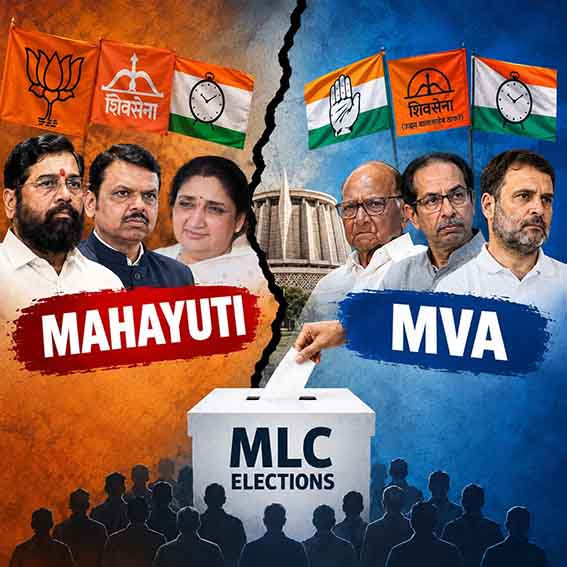
Chief Minister Devendra Fadnavis has publicly asserted that there is no question of new entrants joining the Mahayuti. His statement reflects political logic. The BJP already enjoys numerical dominance alongside Eknath Shinde’s Shiv Sena and Ajit Pawar’s NCP. Bringing Sharad Pawar into the alliance may strengthen the NDA externally, but it could also generate fresh leadership ambitions, competing centres of influence and unnecessary internal tensions.
Issue-Based Cooperation
If there is any movement, therefore, it is more likely to begin with issue-based cooperation in Parliament than with an immediate formal alliance. That explains why the Delimitation Bill has assumed such significance.
Supriya Sule has indicated that her party could support the legislation provided the Centre guarantees a uniform 50 percent increase in parliamentary seats for every state. The position differs from that adopted by several INDIA bloc partners and has naturally fuelled speculation. Yet issue-based support should not automatically be interpreted as political surrender.
Sharad Pawar has rarely subscribed to the idea that opposition requires opposing every government initiative. Throughout his career he has maintained working relationships across party lines, often separating legislative cooperation from electoral competition. That flexibility has repeatedly helped him preserve political relevance even when his party's electoral fortunes fluctuated.
If, despite present denials, Pawar eventually chooses to support or formally align with the NDA, the consequences would extend well beyond Maharashtra. For the INDIA bloc, it would represent perhaps the most damaging psychological blow in western India, depriving it of one of its most experienced strategists and consensus-builders. Congress would lose a veteran ally at precisely the moment it is attempting to rebuild its organisational strength in Maharashtra. Uddhav Thackeray’s Shiv Sena (UBT) could find itself increasingly isolated, forcing a reassessment of both alliances and political strategy before the next Assembly election. And for the BJP, it would amount to the political neutralisation of perhaps its most accomplished regional rival.
Sharad Pawar’s greatest political strength has always been his refusal to close any door before absolutely necessary. Strategic ambiguity has been one of its principal instruments.
At 85, he remains among the last practitioners of an older style of coalition politics, where negotiation often counts for more than confrontation, and where tomorrow’s ally may well have been yesterday’s fiercest opponent.
(The writer is a political observer. Views personal.

Comments