
The Sacred Speaks for Itself

To understand a Devata requires not just intellectual freedom but familiarity with the traditions and lived experiences through which the sacred is encountered.

The term “Devata” evokes bhakti, reverence, ecstasy, surrender, and a profound emotional experience (bhāva) that transcends intellectual understanding. Unlike the Abrahamic conception of “God,” “Son of God,” or “Prophet of God,” the Hindu Devata is inseparable from the land, sacred geography, collective memory, narratives, temples, and lived experience. Savarkar describes the Hindu civilizational domain as “Ā Sindhu-Sindhu Paryanta”—from the Indus to the seas. Its Devatas are deeply rooted in this sacred terrain: Rāma in Ayodhyā, Kṛṣṇa in Mathura, and Hanumān in Kishkindha, associated with Hampi–Anegundi. Śiva and Śakti likewise permeate Bharat, with the Śakti Pīṭhas preserving sacred memory through geography.
In nearly every region of Bharat, one can find a temple, tīrtha, narrative, festival, sacred hill, river, or local tradition linked to Rāma, Kṛṣṇa, Śiva, Śakti, Hanumān, or another Devata. These Devatas are not abstract entities detached from the geography of Hindu civilization; rather, they are tangible personalities of devotion, whose presence is experienced through this geography and the communities that have maintained these traditions over generations. The land itself becomes sacred through layers of memory, worship, pilgrimage, and devotion. Central to this sacred imagination is Bhāratamātā—Bhārata as mother, as sacred land, and as an ancient civilizational presence. A notable strength of Hindu civilization is that the sacred is encountered not solely in an abstract theological domain but throughout the land itself. The Devata resides in the bhāva of the devotee, within the temple, the tīrtha, the narrative, the festival, and the memory of the civilization. Consequently, these Devatas cannot be regarded merely as convenient metaphors for an interpreter's preferred theory. They are integral to a living civilizational world, which must be approached with respect above all else.
Unique Integration
An additional dimension of the Hindu conception of Devata lies in its diverse ways of divine manifestation and human encounter. Devatas may be experienced through avatāra, darśana, worship, ritual, mystical experience, or intimate relationships with devotees. This does not deny divine encounters in other religions but highlights Hindu civilization’s long coexistence of multiple forms of divine presence. The śaraṇas, Nāyaṉmārs, Āḻvārs, and saints recount deeply personal encounters. Bedara Kannappa’s complete surrender to Śiva is believed to have prompted divine manifestation through the liṅga. Śrī Rāmakṛṣṇa Paramahaṃsa’s experiences with the Divine Mother similarly illustrate Devata as tangible presence, prayer, guidance, and relationship.
The Hindu perspective integrates the concept of Devata as both a personal entity and a cosmic force. For example, Śiva and Śakti can be perceived as divine figures and as significant metaphysical entities. In Hinduism, there is no requirement to choose between viewing the Devata as a personal presence or as a cosmic principle. Contemporary discussions on consciousness have examined human experiences of perceived divine or unseen voices. Julian Jaynes's contentious bicameral mind theory suggests that ancient humans might have interpreted internally generated voices as those of gods. Although this theory remains a subject of debate and cannot be considered definitive evidence of divine communication, it highlights the necessity of acknowledging the complexity of human consciousness when evaluating such experiences.
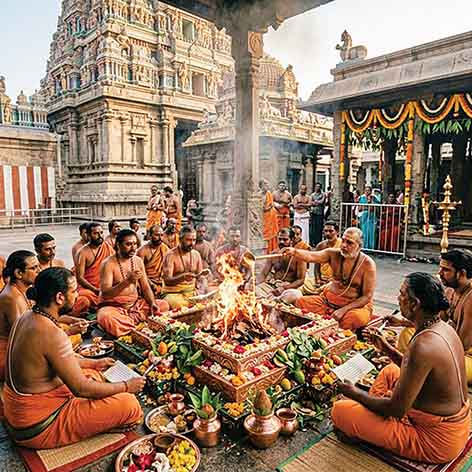
Hindu civilization presents a distinctive relationship with Devatas as an ongoing engagement rather than mere remembrance. Devatas are spoken to, sung to, offered food, carried in processions, visited, celebrated through festivals, and remembered across generations. Whether understood as theological truths, mystical experiences, or psychological phenomena, their civilizational significance remains undeniable. The UN Declaration on the Rights of Indigenous Peoples and SDG 11.4 emphasize preserving cultural, religious, and spiritual heritage. This raises a vital question: should enduring traditions first be understood on their own terms before being reinterpreted through external frameworks?
The inquiry extends beyond identifying who possesses the authority to interpret a Devata. A more profound question arises: who holds the adhikāra to discuss an ongoing relationship experienced by millions?
Forms of Adhikāra
To speak of adhikāra is not to deny anyone the freedom to study or critique Hinduism. But can one claim the authority to define a Devata without understanding the philosophical categories, sacred history and lived traditions through which that Devata is experienced? Modern scholarship itself recognizes positionality—that an interpreter’s location and relationship to a community can shape its representation. Likewise, śāstra, sampradāya, sādhana, upāsanā, lived practice and reverence may provide different forms of adhikāra. Freedom of speech gives everyone the right to express an opinion, but freedom to speak is not the same as adhikāra to interpret. We do not own or appoint the Devata, nor decide what the Devata must become to satisfy our theories. If Ayyappa is understood as a Naishṭhika Brahmacāri, that tradition cannot simply be dismissed for convenience.
And perhaps this is where the Hindu understanding of adhikāra takes us to its most profound conclusion. We spend our time asking who has the authority to interpret the Devata, who is qualified to speak about the Devata, and who can claim the right to define the sacred. But in the Hindu understanding, the ultimate adhikāri is the Devata Himself. We do not appoint Him. We do not define Him. We approach Him—with bhakti, with śāstra, with upāsanā and with surrender. And when the Devata chooses, He reveals Himself; when the Devata chooses, He manifests; when the Devata chooses, He speaks. The stories of our saints and devotees are filled with precisely such moments of divine revelation. Therefore, perhaps the true adhikāra is not the confidence to speak over the Devata, but the humility to listen to Him. We may interpret, we may question, we may study—but ultimately, the Devata remains the final authority. And perhaps that is the deepest lesson of a civilization that has lived with its Devatas for millennia: we do not possess the sacred; the sacred possesses us.
(The writer is a Bengaluru-based author and scholar. Views personal.)


Comments