top of page

By:

Anandajit Goswami

15 April 2026 at 11:15:27 pm

Lessons from the Mountains

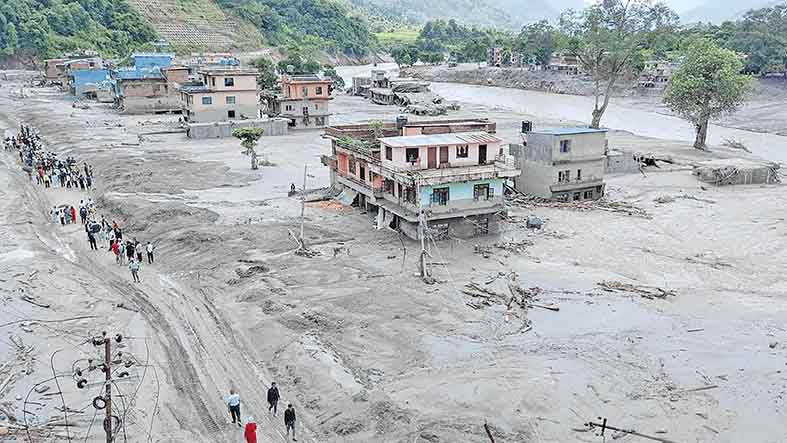
How much of the Himalayas must melt before we rediscover our humanity? I have carried this question for some time. Perhaps it came from the mountains, the rain and the silence. The Himalayas feed rivers, sustain communities and carry memories of centuries. Yet their changing landscape reminds us that nature has limits. We discuss melting glaciers, disappearing water sources and climate change, but too often these remain statistics. What happens when they become part of daily life? I imagine...

Lessons from the Mountains

How much of the Himalayas must melt before we rediscover our humanity? I have carried this question for some time. Perhaps it came from the mountains, the rain and the silence. The Himalayas feed rivers, sustain communities and carry memories of centuries. Yet their changing landscape reminds us that nature has limits. We discuss melting glaciers, disappearing water sources and climate change, but too often these remain statistics. What happens when they become part of daily life? I imagine sitting on those mountains on a rain soaked afternoon, watching clouds descend and the earth being washed clean. In that silence, love arrives. Not the dramatic love we celebrate, but a quieter love that simply sits beside us. And then I ask myself: have I learned to love another human being, or only the idea of humanity? Humanity as an idea is easy to love. The person before us is different. He has fears, weaknesses, anger and wounds. To love a human being requires patience. It requires us to stay. The question stays with me. We often imagine spirituality as a journey away from people, towards mountains, forests and solitude. But perhaps the journey into the mountains is only half the journey. The other half is returning to people. Perhaps we enter the forest not to escape humanity, but to understand it better, and then return to everyday life with a greater ability to see those around us. If spirituality creates distance between us and others, what have we gained? True spirituality should make that distance smaller. It should make us more compassionate, not more detached. We can speak to someone thousands of kilometres away in seconds, but may not know what the person next to us is going through. How much of Nepal do we really reach when we admire its mountains? Perhaps Nepal represents every distant place we admire without truly knowing, every landscape we photograph without understanding, and every suffering we discuss without allowing it to change us. We can cross mountains and borders without ever truly arriving. A journey is complete only when it brings us closer to another human being. Perhaps that is where a spiritual journey becomes meaningful. And then there is violence. A missile can cross the sky in seconds. A bullet can end a life in an instant. But fear travels much faster. It moves from one heart to another and changes the way people see each other. Grief becomes anger, anger becomes hatred, and hatred makes it easier to see another human being as an enemy rather than as a person. At such moments, our philosophies disappear. The mask falls. I imagine looking beside me. I expect to find a gun. But there is no gun. There is a guitar. I do not know who placed it there. Perhaps it was love. Perhaps it was music or another human being reminding me that there is a choice. The gun represents hatred, revenge, intolerance and the desire to silence another voice. The guitar represents conversation, empathy and creativity when the world is full of noise. We can decide what we add to the world. We can add to anger, or we can reduce it. We can answer hatred with hatred, or begin a conversation. Every choice shapes society. Perhaps that is where being human really begins. The Himalayas may continue to melt. Rivers may shrink. Fear may return, and guns may continue to speak. But we still have a choice. We can add another weapon to the noise, or pick up the guitar. We can continue speaking the language of fear, or learn the language of compassion. Perhaps spirituality is making that choice again and again. Humanity begins with the person standing next to us. It could be a stranger, neighbour, colleague, or someone we strongly disagree with. The moment we stop seeing that person as another human being and begin to see something of ourselves in him, the distance becomes smaller. The mountains may teach us silence. Rivers may teach us movement. Rain may teach us renewal. But their greatest lesson is simple: we are all standing on the same fragile earth. The world will continue to change, whether we are ready or not. The real question is what we will become while it changes. Where we expected a gun, perhaps there can be a guitar. Perhaps we should begin there. We may not control the future, but we can influence the human atmosphere we leave behind. (The writer is an author and musician. Views personal.)

The Significant Royal

Nov 8, 2024
2 min read

The MVA faced probably the biggest embarrassment in Kolhapur when the official candidate of the opposition alliance Madhurima Raje withdrew her nomination from the assembly election and the grand alliance that is confident of coming to power in the state had to support an independent candidate in the constituency. However, the developments that followed it have placed a question mark over the sitting Congress MP – Chhatrapati Shahu Raje – as to whether he is merely a pawn for his political party even though he is being revered among the people as the King.


Shahu Maharaj, also known as Shahu II of Kolhapur, is current Member of Parliament (MP) representing the Kolhapur constituency. Born on January 7, 1948, he is a descendant of the illustrious Maratha warrior king, Chhatrapati Shivaji Maharaj, and the great-grandson of the great social reformer Shahu I of Kolhapur.


Shahu Maharaj’s early education was at the prestigious Bishop Cotton School in Bangalore, followed by higher studies at Indore Christian College, where he graduated in 1967 with a degree in History, Economics, and English Literature. His academic background laid a strong foundation for his future endeavors in public service and leadership.


In 1962, Shahu Maharaj was ceremonially crowned as the Maharaja of Kolhapur, a title he holds with great respect and responsibility. Despite the abolition of royal titles and privy purses by the Indian government, he continues to be a revered figure in the Maratha community and beyond.


He is affiliated with the Indian National Congress (INC) and has been actively involved in various political initiatives. His first significant foray into politics was in 1998, although it was not until 2024 that he successfully won the Lok Sabha seat from Kolhapur. His victory was a significant milestone, as it marked the return of a Congress MP to Kolhapur after 25 years.


His personal life is equally distinguished. He is married to Yadnaseniraje, and the couple has two sons, Sambhaji Raje and Maloji Raje, both of whom are also involved in public service. His family continues to uphold the values and traditions of their royal lineage while contributing to the welfare of society.


However, when it came to deciding the candidate for the assembly, it appears as if other local leaders of the Congress and Mahayuti undermined Shahu Maharaj. This left the king very disturbed and even threatened to resign as the party MP. The open outburst of political leaders in favour of and against Shahu Maharaj has exposed the claims of the Congress that it offered him the post of MP just to honour the royal family.


However, this is not the first time that the royal family has been insulted like this due to its involvement in the politics.

Comments


bottom of page