top of page

By:

Abhijit Mulye

21 August 2024 at 11:29:11 am

Fadnavis writes off Rs 48,000 crore

Mumbai: In a clear indication that the Maharashtra government is leaving no stone unturned to keep the state’s agrarian base happy, Chief Minister Devendra Fadnavis has unleashed yet another massive populist measure. Hot on the heels of relaxing the eligibility criteria to ensure a blanket farm loan waiver, the Chief Minister announced a sweeping Rs 48,000 crore waiver on the pending electricity bills of farmers across the state. Addressing a ‘Krutadnyata Sohala’ (gratitude ceremony)...

Fadnavis writes off Rs 48,000 crore

Mumbai: In a clear indication that the Maharashtra government is leaving no stone unturned to keep the state’s agrarian base happy, Chief Minister Devendra Fadnavis has unleashed yet another massive populist measure. Hot on the heels of relaxing the eligibility criteria to ensure a blanket farm loan waiver, the Chief Minister announced a sweeping Rs 48,000 crore waiver on the pending electricity bills of farmers across the state. Addressing a ‘Krutadnyata Sohala’ (gratitude ceremony) organized by the BJP Kisan Morcha at Mumbai’s Yashwantrao Chavan Pratishthan on Wednesday, Fadnavis declared that farmers using agricultural pumps of up to 7.5 horsepower will see their historical electricity dues completely wiped out. The announcement was met with the traditional sounding of the Tutari and thunderous applause from hundreds of farmers who had gathered from every corner of the state. The Chief Minister framed the mega-sop as a necessary step to “wipe the farmers’ slate clean,” enabling them to write a new chapter of prosperity. Calculated Pitch The timing and scale of the announcement underscore a government that is boldly embracing populist economics to solidify its political footprint in rural Maharashtra. While Fadnavis maintained that these decisions were taken purely in the interest of the farmers—pointing out that the original loan waiver was announced when no elections were in sight—the political undertones were unmistakable. Taking a sharp dig at the opposition, the Chief Minister accused rival parties of running “political shops” in the name of farmer agitations without understanding the government’s genuine intent. Asserting his grassroots connection, Fadnavis proudly claimed, “I do not make decisions sitting in my house. I am a farmer myself, a man of the soil.” He openly defended the government’s recent move to strip away the stringent conditions attached to the blanket farm loan waiver, signaling that his administration will not hesitate to clear bureaucratic hurdles if it means putting money directly into the hands of the rural voter. Balancing Sops Even as he rained freebies, the Chief Minister attempted to balance the populist optics with a dose of economic pragmatism. He acknowledged that handing out repeated loan waivers is a symptom of deep-rooted agrarian distress, not a permanent cure. Pointing to the Rs 95,000 crore in aid currently being pumped into the agricultural sector by the state and central governments, Fadnavis outlined his administration’s shift toward an investment-driven agricultural model. He championed the success of schemes like ‘Jalyukt Shivar’ and ‘Magel Tyala Shettale’ (farm ponds on demand), claiming these initiatives have already empowered farmers to harvest multiple crops a year. Addressing the core issue of farming costs, he noted that the government already subsidises power to the tune of Rs 25,000 crore annually. By coupling this with a push for solar pumps and solar agricultural feeders, he promised that 100 percent of the state’s farmers would receive uninterrupted daytime electricity by the end of the year. Infra Dream Looking beyond immediate financial relief, the Chief Minister laid out a grandiose vision to permanently drought-proof Maharashtra’s most vulnerable regions. A staggering Rs 6 lakh crore infrastructure pipeline is being planned to ensure the next generation never witnesses a drought. Fadnavis detailed ambitious river-linking projects, including the Wainganga-Nalganga link, to divert excess floodwaters to parched regions. The state plans to construct 24 new dams and raise the height of 16 existing ones to ensure not a single district in Vidarbha faces water scarcity. Furthermore, massive engineering feats are on the drawing board to divert 200 TMC of floodwater from Western Maharashtra to Marathwada, and lift 275 TMC of wasted water from the Ulhas basin to quench the thirst of North Maharashtra and Marathwada. By marrying immediate, massive debt relief with long-term infrastructure promises, the Fadnavis administration is aggressively cementing its pro-farmer narrative. As the Yashwantrao Chavan auditorium echoed with whistles and cheers, it became highly evident that the government’s strategy of pairing mega populist waivers with big-ticket rural dreams is striking a powerful chord with the state’s agrarian voters.

The Silent Budget Crisis Squeezing Middle Class

Invisible inflation isn't about one big price hike—it's dozens of small increases that quietly erode a family's savings, month after month, without most households even noticing.
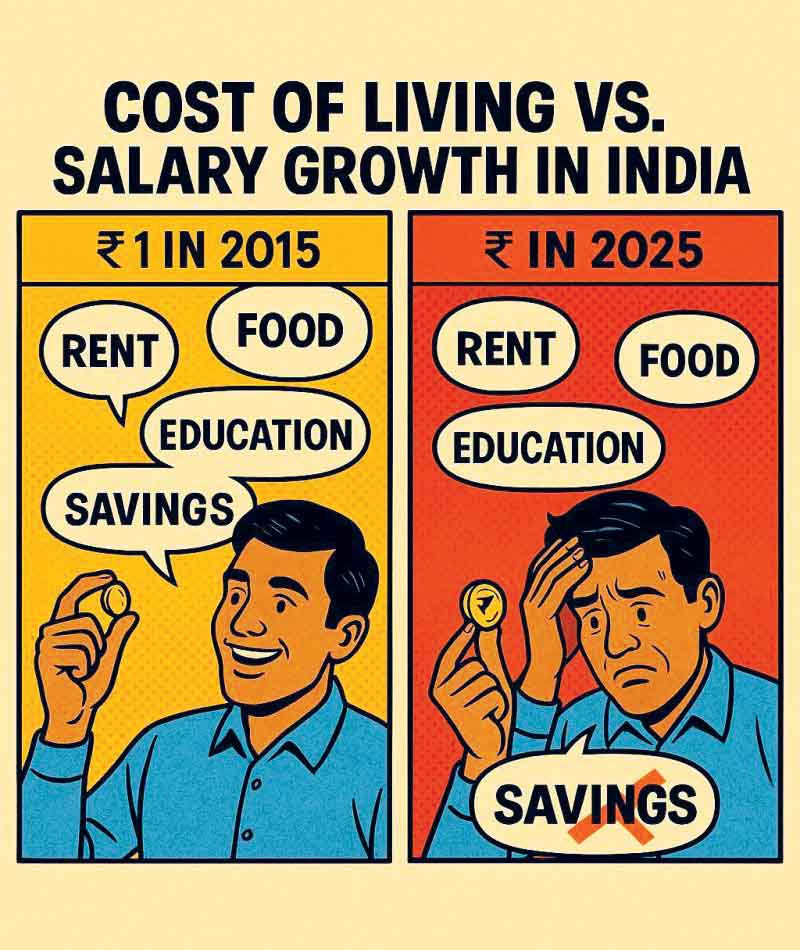
Bharath, a middle-class employee living in Nashik, starts every month with a carefully planned household budget. His salary is credited on the first day, EMIs are deducted within a week, school fees follow, groceries become slightly more expensive than last month, electricity bills fluctuate, fuel prices affect his daily commute, and suddenly the month's savings disappear. Nothing extraordinary happened—and yet everything became costlier. Bharath isn't alone. This is the new reality of India's middle class in 2026: a silent budget crisis.


Unlike previous years, the financial burden today is not caused by one major expense but by dozens of small increases that quietly reduce purchasing power. A Rs 10 increase in milk, a Rs 50 rise in internet bills, higher apartment maintenance charges, expensive medicines, increased transport costs, and frequent digital subscriptions may appear insignificant individually. Together, however, they create a monthly financial gap that many families fail to notice until their savings begin shrinking.


From a Chartered Accountant's perspective, the biggest concern is that household incomes are no longer growing at the same pace as lifestyle expenses. The middle class rarely qualifies for government subsidies, yet it also lacks the financial cushion available to high-income households. This segment pays taxes regularly, repays loans responsibly, and contributes significantly to the economy, but today it finds itself under continuous financial pressure.


An interesting trend emerging in 2026 is what I call "invisible inflation". Unlike traditional inflation, where one notices a sharp rise in prices, invisible inflation quietly enters through annual fee revisions, convenience charges, platform subscriptions, maintenance contracts, delivery fees, education expenses, healthcare costs, and service charges. Families continue spending almost the same amount of money but receive less value in return.


Another worrying pattern is the disappearance of surplus income. Earlier, many middle-class families could comfortably allocate part of their salary towards recurring deposits, SIPs, gold purchases, or emergency savings. Today, that surplus is gradually being consumed by recurring monthly commitments. The result is not immediate financial distress but delayed wealth creation—a risk that often goes unnoticed.


As Chartered Accountants, we believe the solution is not simply earning more but managing money differently. Every family should prepare a quarterly expense review instead of relying only on annual financial planning. Expenses should be classified into essentials, commitments, and lifestyle spending. This simple exercise often reveals unnecessary recurring costs that silently drain household finances.


The emergency fund also deserves renewed attention. Rising living expenses mean that an emergency fund created three years ago may no longer be adequate today. Families should periodically reassess whether their savings can comfortably cover at least six months of current expenses rather than past expenses.


Debt management is equally important. During periods of rising living costs, unnecessary consumer loans and credit card balances become increasingly expensive. Prioritising repayment of high-interest debt often provides a better financial return than chasing aggressive investment opportunities.


Most importantly, financial discussions should become a family activity. Budgeting should no longer remain the responsibility of one earning member. When every family member understands monthly income, expenses, savings goals, and financial priorities, unnecessary spending naturally reduces and long-term financial discipline improves.


The 2026 cost pinch is not merely an economic challenge; it is changing the way India's middle class lives, spends, and plans for the future. As Chartered Accountants, our role is no longer limited to tax filing or compliance. We must guide families towards stronger financial habits, practical budgeting, and sustainable wealth creation. In an era where every rupee matters, financial awareness is becoming the most valuable investment a middle-class household can make.


(The writer is a Chartered Accountant based in Thane. Views personal.)

Comments


bottom of page