top of page

By:

Bhalchandra Chorghade

11 August 2025 at 7:24:18 pm

Panvel: MMR’s next economic hub

Panvel is now emerging as a multi-modal gateway linking Mumbai’s commercial economy with Navi Mumbai’s airport, JNPA’s port ecosystem and Raigad’s industrial belt Mumbai: For centuries, Panvel’s importance came from its location. The town grew around land and sea trade routes and was historically known for its rice market. Today, that same locational advantage is being recast in a dramatically different economic landscape — one shaped by an international airport, a major container port,...

Panvel: MMR’s next economic hub

Panvel is now emerging as a multi-modal gateway linking Mumbai’s commercial economy with Navi Mumbai’s airport, JNPA’s port ecosystem and Raigad’s industrial belt Mumbai: For centuries, Panvel’s importance came from its location. The town grew around land and sea trade routes and was historically known for its rice market. Today, that same locational advantage is being recast in a dramatically different economic landscape — one shaped by an international airport, a major container port, expressways, freight corridors, railways and expanding urban infrastructure. Panvel is consequently moving from being a transit point between Mumbai, Pune and the Konkan to becoming a destination in its own right. “Panvel can no longer be viewed merely as a residential extension of Mumbai and Navi Mumbai. It is fast becoming a commercial and economic destination in its own right,” said Prashant Thakur, MLA, Panvel Assembly Constituency. The transformation is not entirely new. Panvel is around 300 years old and its evolution was closely linked to trade and transportation. Its commercial DNA, therefore, predates the development of Navi Mumbai by several decades. What has changed is the scale and quality of connectivity around it. The development of Navi Mumbai from the 1970s brought planned nodes such as New Panvel, Kharghar, Kamothe, Kalamboli and Taloja into a rapidly urbanising landscape. The creation of the Panvel Municipal Corporation in 2016 further expanded the administrative footprint, bringing the old town and several rapidly developing areas within one municipal framework. That expansion is now meeting an unprecedented infrastructure build-out. Panvel’s Geography Panvel’s strongest advantage is not any single project but the convergence of several major transport systems. The Mumbai–Pune Expressway and Sion–Panvel corridor connect it with Mumbai and Pune, while the Mumbai–Goa highway provides access towards the Konkan. Close by are JNPA, the Navi Mumbai International Airport and the wider Navi Mumbai urban economy. Then came the 21.8-km Atal Bihari Vajpayee Sewri–Nhava Sheva Atal Setu. Opened to traffic in January 2024, the bridge has strengthened the physical and economic connection between Mumbai and the Navi Mumbai–Panvel–Raigad region. For Panvel, its significance extends beyond shorter travel times. It has expanded the geography within which companies can locate offices, warehouses, hotels and support businesses. “The coming decade can establish Panvel and its surrounding region as one of India’s most dynamic economic growth centres,” said Thakur. “An international airport, a world-class port ecosystem, highways, railways, Metro connectivity and Atal Setu are creating an economic ecosystem of enormous potential.” The Navi Mumbai International Airport has added another dimension to this transformation. With commercial operations commencing in December 2025 and international connectivity subsequently being added, the airport corridor has moved from being a long-term infrastructure proposition to an operating economic ecosystem. For Panvel, the airport effect could extend well beyond residential real estate. An international airport generates demand for business hotels, corporate offices, aviation-linked services, logistics, retail, hospitality, healthcare and other ancillary businesses. The emerging airport corridor is already changing the development narrative across Panvel, Ulwe, Kharghar, Taloja, Karanjade, New Panvel and Dronagiri. Perhaps the most distinctive element of Panvel’s economic proposition is its proximity to two major gateways — JNPA and NMIA. JNPA is integrated into the national freight network and is supported by road and rail connectivity, including the Dedicated Freight Corridor. The wider port ecosystem is also being strengthened through improved road links and connectivity towards Panvel and the airport. This gives the region a natural advantage in logistics, warehousing and supply-chain activity. The opportunity extends into the wider Raigad industrial belt, including Taloja, Patalganga, Roha and surrounding manufacturing clusters. For chemical and manufacturing companies, Panvel can potentially serve as a commercial and logistics gateway. Proximity to JNPA can facilitate the movement of imported raw materials, equipment and chemical feedstock, while road and freight connectivity can support distribution to domestic markets. The future opportunity could also extend beyond bulk chemicals to specialty chemicals, pharmaceuticals, advanced materials, chemical equipment and downstream manufacturing. NMIA adds another layer by improving access for high-value and time-sensitive products, corporate executives, technical specialists and international business. However, such growth would require planned industrial infrastructure — including common utilities, effluent treatment, hazardous-material handling, waste management, water recycling and emergency-response systems. Commercial Model Mumbai’s traditional commercial districts face constraints of land availability, high real-estate costs and congestion. Panvel, by contrast, can offer larger land parcels and the possibility of integrated development around multiple transport modes. This opens the door to a different commercial model — large office campuses, mixed-use developments, business parks, hotels, logistics facilities, institutional campuses and specialised industrial offices. Healthcare and education could become equally important components of this ecosystem. Thakur said the development of Medicity and Educity, along with emerging concepts such as Innovation City and Third Mumbai, could further alter the economic geography of the Panvel–Pen region. “Kharghar is also emerging as an important commercial destination, with plans for a new business centre. All these developments point towards one clear conclusion: Panvel is not merely a residential growth corridor; it is becoming a commercial and economic destination,” he said. Jobs Drive Inclusion The real test of Panvel’s transformation, however, will be the employment ecosystem it creates. The airport, logistics sector, IT and digital services, healthcare, hospitality, construction, engineering, financial services and emerging industries can generate opportunities across a broad range of skill levels. “Our youth must be the biggest beneficiaries of this transformation,” said Thakur. “I want the young people of Panvel not merely to witness this transformation, but to participate in it, benefit from it and eventually lead it.” That would require greater emphasis on technical education, industry-oriented training, skill development and employability programmes. An emerging education ecosystem could also create opportunities for specialised disciplines such as chemical engineering, biotechnology, materials science, aviation services and industrial research. The challenge is to build infrastructure ahead of demand. The scale of the opportunity also brings a significant planning challenge. As commercial activity and population increase, Panvel will need adequate water supply, electricity, roads, public transport, sewage systems, waste management, healthcare, education and other civic infrastructure. Rapid urbanisation without corresponding infrastructure capacity could undermine some of the advantages that are currently attracting investment. “Growth must be supported by quality infrastructure,” Thakur said. “Infrastructure capacity must grow ahead of demand rather than struggle to catch up with it.” The proposed Panvel Development Plan for 2024–2044 assumes a much larger urban footprint and seeks to provide a longer-term framework for managing growth. The challenge will be to ensure that infrastructure planning keeps pace with the speed at which private and public investment is reshaping the region. Panvel’s transformation is therefore not simply another real-estate story. Its significance lies in the convergence of its past and future: a centuries-old trading town is now located at the intersection of an international airport, one of India’s major container ports, national highways, the Mumbai–Pune economic corridor, freight infrastructure, suburban rail and metropolitan expansion. Economic Centre Mumbai has traditionally been the economic centre, while Navi Mumbai was developed as its planned counterpoint. Panvel is now emerging as the bridge between that established metropolitan economy and the next growth geography stretching towards Raigad. “Panvel is changing. Panvel is connecting. Panvel is creating opportunities. And Panvel is now emerging as a new commercial address on the global map,” said Thakur. The real shift is from transit to destination. If infrastructure investment is matched by integrated planning, employment generation, social amenities and sustainable industrial development, Panvel could evolve into something more significant than a residential extension of Mumbai or Navi Mumbai: a multi-modal commercial and socio-economic hub serving the entire MMR–Raigad corridor.

Time Turns from Ray to Nolan
Aug 10
5 min read

Separated by 55 years and radically different philosophies, Satyajit Ray and Christopher Nolan found remarkably similar cinematic ways to make the elusive nature of time visible.

A still from Ray's biting classic Mahapurush (1965)

“Gentlemen think alike!” is the proverb that resonated in connection to what Nolan recently said while praising Satyajit Ray's work; and with cinema’s timeless exploration of scientific and philosophical concepts. Let me direct you to a piece of dialogue:


“Kaal exists, but aaj does not. Kaal… meaning time. Time exists, but aaj—meaning the present? There is no such thing as the present. How could there be? Eh? How could there be? … That which is the future, that which is destined to happen—once it happens, it does not simply stop at one place so that someone can label it ‘the present,’ shackle it by the feet, hold it there, and say, ‘Look, here it is—this is the present!’ The instant something happens, it becomes something that has happened, or has already happened, or had happened—in other words, the past… the departed! How many arguments I have had with Plato about this!”


Cyclical Time

The intended metaphysical garbage was uttered by Satyajit Ray’s character, the spiritual imposter Birinchibaba, in the film Mahapurush. Shortly after this dialogue, Birinchi begins to rotate the ring fingers of both his hands in opposite circular motions, and, through this visual imagery, ventures into defining time through an Oriental-spiritual tall tale.


Parashuram’s, or scientist, entrepreneur and eminent Bengali polymath Rajshekhar Basu's original Birinchibaba (in his satirical short story on fake spiritualism of the same name) did not utter these words in this exact connotation. His Birinchi blabbered upon matters of an even loftier order; for instance, he addresses historical Vaivasvata as ‘Bibu,’ or engages in intellectual feuds with Plato and Jesus.


With his own genre of fascinating narrative display, Ray, in his film Mahapurush, introduces the above sequence to convey the essential idea of cyclical time as noted in one form of Eastern spiritual-philosophy. By rotating his fingers, Birinchi transcends the concept into a whole new dimension. The details of written narration and the detailing of cinema are bound to be different. Cinema is visual, a bit of spoon feeding for sure, but at the end provides a direct form of instant gratification. This is why that very visual imagery has remained engraved in our- the cinema and literature savvy Bengali's cultural memory for so long. And it will remain so. Satyajit’s Birinchi is far more accessible. Even amid the amusement generated by an unscientific tall tale, Ray, the genius preserved the power of visual evidence beyond imagination.


 The question now is: why, after all these years, did I return to the fifteen-page “Birinchi Baba” and the one-hour-and-four-minute-long Mahapurush? Surely, enough has already been written and said about them both through the last half a century. Here enters Christopher Nolan. But no, I am not talking about his latest The Odyssey. I am referring to his 2020 film Tenet.


Before proceeding further, it is necessary to say a few words about the film itself. Tenet is a science-fiction based espionage-story. Philosophically, however, Nolan uses the film to investigate his ideas of time, causality, free will, and human moral responsibility. And comparing to our starting sequence I am pleasurably awed to find his definition of time in Tenet to be strikingly similar to Ray's representation with Birinchi, yet philosophically being miles away.


Opposing Directions

In Tenet, time as a quantity is unaltered. Instead, it is a dimension that can be traversed in two opposite directions within the same reality. A little deeper, if you may? Nolan’s film does not conceive of time as something in which one can return to the past and change history. Rather, it presents the idea of moving against the flow of time. The ‘Turnstile’ is a machine capable of reversing the entropy of a person or an object (entropy, in actual physics being the measure of the natural progression of anything, over time, from order towards disorder).
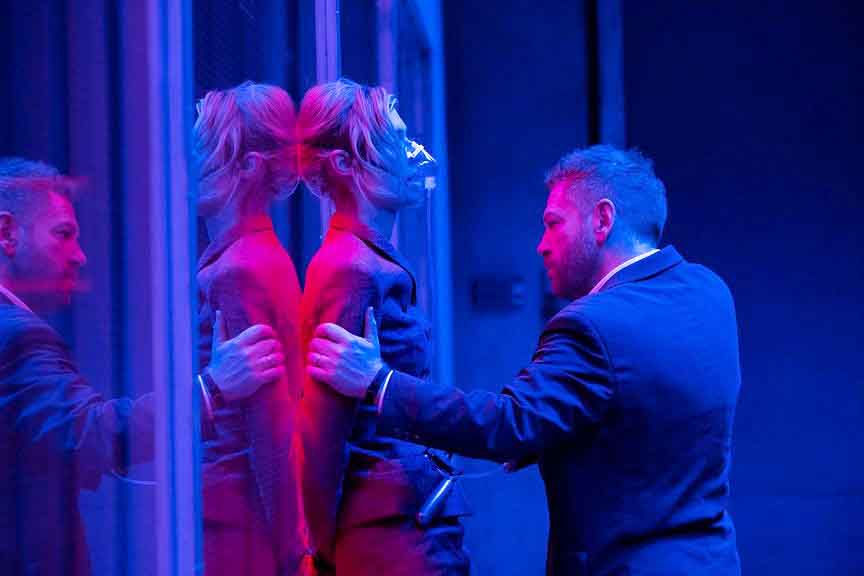
Kenneth Branagh in Nolan's Tenet (2020)

As a result, that person or object no longer moves towards the future but begins travelling backwards along the same timeline, towards the past. Although time continues to move forward from that person’s own perspective, the external physical world (space) appears to move backwards.


The red and blue rooms on both sides of the Turnstile therefore represent two temporal directions within a same representative physical space. Through a glass partition between them, people moving forward and backward in time can see one another. They are not reflections of each other; rather, they are two opposing temporal orientations within the same reality. Another interesting technological idea shown in Tenet is the “temporal pincer movement.” By using the Turnstile, this technique enables ‘travellers’ to both observe and control a battle or event from two opposing temporal-axes.


It is precisely at these two points that any Bengali film lover is bound to connect to the sequence involving Birinchi Baba’s paired fingers in Ray’s Mahapurush. There, two oppositely rotating cycles of time meet at a single point. Birinchi or Ray in the sequence suggested that this point of convergence could serve as a passage from one time-cycle into the other. The Turnstile in Tenet seems to bridge physical reality and that point of time-convergence - a junction between two flows of time.


There is, however, a fundamental philosophical difference. In Nolan’s vision, time is singular and self-contained. The past cannot be changed, nor are alternative timelines created. Human beings may travel in two opposite directions through time, but history remains the same. Thus, the film’s central philosophical proposition is that even if destiny is predetermined, human moral responsibility never disappears—or, as the film puts it, “What’s happened, happened.” In other words, whatever has happened constitutes history, but we ourselves are participants in the construction of that history.


This proposition does not sit comfortably with a student of scientific philosophy like me. But in cinematic execution, both Ray and Nolan are beyond compare.


Think about it: despite working from a somewhat different philosophical position, in his transcendental tall tale involving his paired fingers and the Eastern spiritual idea of cyclical time, wasn’t Birinchi trying to say something similar to what’s been represented in the Turnstile?  Has Nolan watched Mahapurush? I would presume so. But whether he has or not, we cannot help but be astonished by the fact that standing fifty-five years apart, two directorial geniuses used almost the same cinematic vocabulary to explain two concepts of time arising from entirely different philosophical traditions at opposite ends of the world.


Ray and Nolan attempted to see—and to show—two directions of time through two distinct philosophies. Cinema helped science, technology, culture, and philosophy to converge to a ‘point-continuum.’ Only and only cinema has this strength. Be it Ray or Nolan, the fact that, without the contemporary medium of cinema, an ardent technologist like me would virtually lose his cerebral link to society is evident. Cinema is the cultural bridge between technology and society.


(The writer is a Lead Process Engineer with GE HealthCare in France and a columnist with four books to his credit. Views personal.)

Comments


bottom of page