top of page

By:

Akhilesh Sinha

25 June 2025 at 2:53:54 pm

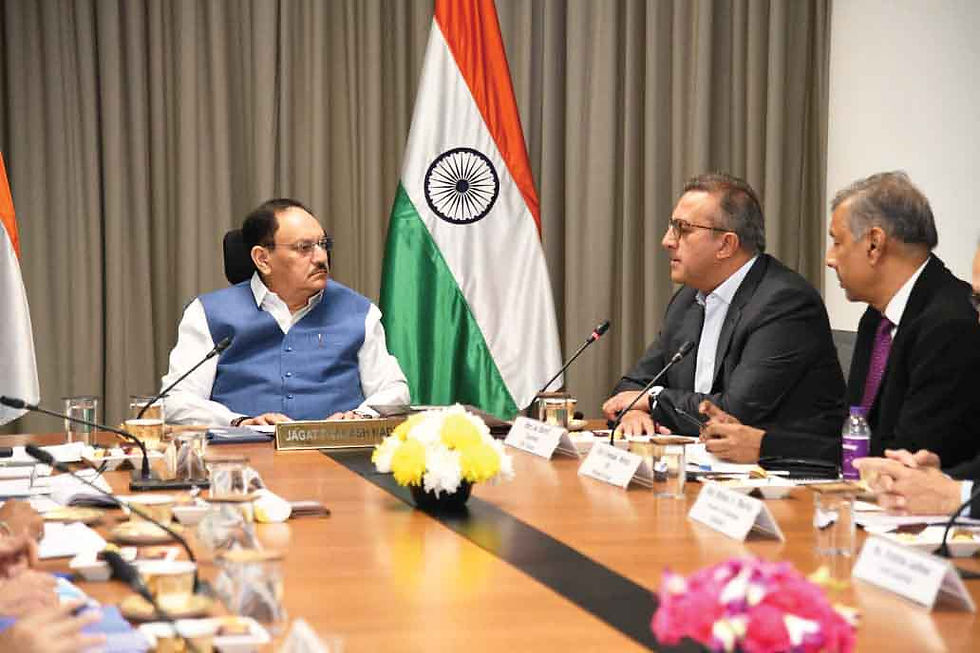
Nadda's strategic meet signals urgency for chemical sector

New Delhi: As war simmers across the volatile landscape of West Asia, whether in the form of a direct confrontation between Israel, United States and Iran, or through Iran's hybrid warfare involving groups like Hezbollah and the Houthis, the tremors are no longer confined to the region's borders. They are coursing through the arteries of the global economy. India's chemicals and petrochemicals sector, heavily dependent on this region for critical raw materials, finds itself among the earliest...

Nadda's strategic meet signals urgency for chemical sector

New Delhi: As war simmers across the volatile landscape of West Asia, whether in the form of a direct confrontation between Israel, United States and Iran, or through Iran's hybrid warfare involving groups like Hezbollah and the Houthis, the tremors are no longer confined to the region's borders. They are coursing through the arteries of the global economy. India's chemicals and petrochemicals sector, heavily dependent on this region for critical raw materials, finds itself among the earliest and hardest hit by this geopolitical turbulence. It is in this backdrop that the recent meeting convened by Union Minister for Chemicals and Fertilisers J. P. Nadda at Kartavya Bhavan must be seen not as a routine consultation, but as a signal of strategic urgency. India's ambition to scale this sector from its current valuation of $220 billion to $1 trillion by 2040, and further to $1.5 trillion by 2047, will remain aspirational unless the country confronts its structural vulnerabilities with clarity and resolve. India today ranks as the world's sixth-largest producer of chemicals and the third-largest in Asia. The sector contributes 6-7 percent to GDP and underpins a wide spectrum of industries, from agriculture and pharmaceuticals to automobiles, construction, and electronics. It would be no exaggeration to call it the backbone of modern industrial India. Yet, embedded within this strength is a paradox. India's share in the global chemical value chain (GVC) stands at a modest 3.5 percent. A trade deficit of $31 billion in 2023 underscores a deeper issue: while India produces at scale, it remains marginal in high-value segments. This imbalance becomes starkly visible when disruptions in West Asia choke the supply of key feedstocks, shaking the very foundations of domestic industry. Supply Disruption The current crisis has laid this fragility bare. Disruptions in the supply of LNG, LPG, and sulfur have led to production cuts of 30-50 percent in several segments. With nearly 65 percent of sulfur imports sourced from the Middle East, the ripple effects have extended beyond chemicals to fertilisers, plastics, textiles, and other downstream industries. Strategic chokepoints such as the Strait of Hormuz have witnessed disruptions, pushing shipping costs up by 20-30 percent and adding further strain to cost structures. This is precisely where Nadda's emphasis on supply chain diversification and resilience appears prescient. In today's world, self-reliance cannot mean isolation; it must translate into strategic flexibility. While India imports crude oil from as many as 41 countries, several critical inputs for the chemical industry remain concentrated in a handful of sources, arguably the sector's most significant vulnerability. Opportunity Ahead A recent report by NITI Aayog outlines a pathway to convert this vulnerability into opportunity. It envisions raising India's GVC share to 5-6 percent by 2030 and to 12 percent by 2040. If achieved, the sector could not only reach the $1 trillion mark but also generate over 700,000 jobs. However, this transformation will demand more than policy intent, it will require sustained investment and disciplined execution. The most pressing challenge lies in research and innovation. India currently spends just 0.7 percent of industry revenue on R&D, compared to a global average of 2.3 percent. This gap explains why the country remains largely confined to basic chemicals, even as the world moves toward specialty and high-value products. Bridging this divide is essential if India is to climb the value chain. Equally constraining is the fragmented nature of the industry. Dominated by MSMEs with limited access to capital and technology, the sector struggles to compete globally. Cluster-based development models offer a pragmatic way forward, such as PCPIRs and the proposed chemical parks.

Two Pakistani nationals arrested in Raipur for fraudulently obtaining Indian voter ID cards


RAIPUR: The Chhattisgarh police in Raigarh have arrested two Pakistani citizens who allegedly obtained Indian voter ID cards by providing false information.


According to district police, the two Pakistani nationals — Iftekhar Sheikh (29) and Armish Sheikh (25)—were living in the Kodatarai area of Raigarh district, around 230 km east of Raipur.


"Raigarh police had launched a campaign to check if any Pakistani nationals were staying illegally in the district. During this drive, we received information about two suspected foreigners living in Kodatarai at the house of a local resident, Yakub Sheikh," said Prashant Rao, in-charge of the Jutemill police station in Raigarh.


"Both Pakistani nationals were located during the intensive verification campaign," he added.


Acting on the information, Jutemill police raided the area. During questioning, both individuals claimed to possess Pakistani passports and valid Long Term Visas (LTVs).


They are originally from Landhi town in eastern Karachi. According to police, they deceitfully secured Indian voter ID cards by submitting false information in Form No. 06 of the Election Commission of India to get their names added to the voters' list.


Police also found other documents in their possession, such as a bank passbook.


A case has been registered against them under sections 199 (false statement in a declaration receivable as evidence), 200 (using a false declaration as true), 419 (cheating by impersonation), 467 (forgery of valuable security or will), 468 (forgery for the purpose of cheating) and 34 (acts done by several persons with common intention) of the Indian Penal Code (IPC).

Further investigation is underway, police officials said.


Meanwhile, following the Cabinet Committee on Security's recent decisions after the Pahalgam terror attack, the Indian government has suspended all visa services for Pakistani nationals with immediate effect.


All existing valid visas issued by India to Pakistani nationals have been revoked, effective from 27 April 2025.

Comments


bottom of page