

What Cinema Misses About the Ramayana

To capture Valmiki’s wonder on screen, filmmakers must look beyond the great battle and to the poignant love between Sita and Rama.

Is there a key to unlock, simultaneously, the poetic beauty as well as the spiritual depth of Valmiki’s Ramayana, for the purpose of turning the epic Itihasa poem into a beautiful cine
matic adaptation? Some literary critics and Valmiki experts concur that there is indeed one such key in the Valmiki Ramayana, and it sits in plain sight right on the first few pages of the great epic poem. It concerns that poignant episode in the second chapter of the first book of the Valmiki Ramayana – the episode that describes a hunter callously slaying one of a pair of mating birds while they were lost in each other during an act of love. Few are aware of the episode, and fewer still realise that it holds the key to understanding what Valmiki’s Ramayana is really all about.
Narrow Vision
So far, every major screen adaptation of the Ramayana has pivoted on the Rama versus Ravana conflict. The horizon of imagination for these popular film/TV adaptations has seldom extended beyond portraying Lord Rama – the eponymous protagonist of the epic poem and a just but star-crossed scion of Ayodhya’s famed Ikshvaku clan – as little more than the slayer of Ravana, the hubristic king of the Rakshasa clan ruling from Lanka. Be it Ramanand Sagar’s widely popular TV series from the late 1980’s (which, by the way, was heavily inclined towards Tulsidas’s Ramacharitamanasa rather than Valmiki), or Yugo Sako’s superb animated film Ramayana: The Legend of Prince Rama (1993), or even the caricaturish recent Bollywood flick Adipurush (2023) – the screen adaptation plots have characteristically pivoted on the heroic military campaign launched by the Rama-Sugriva alliance, following the abduction of Lord Rama’s beautiful and pious wife, the Princess Sita of Videha, by Ravana.
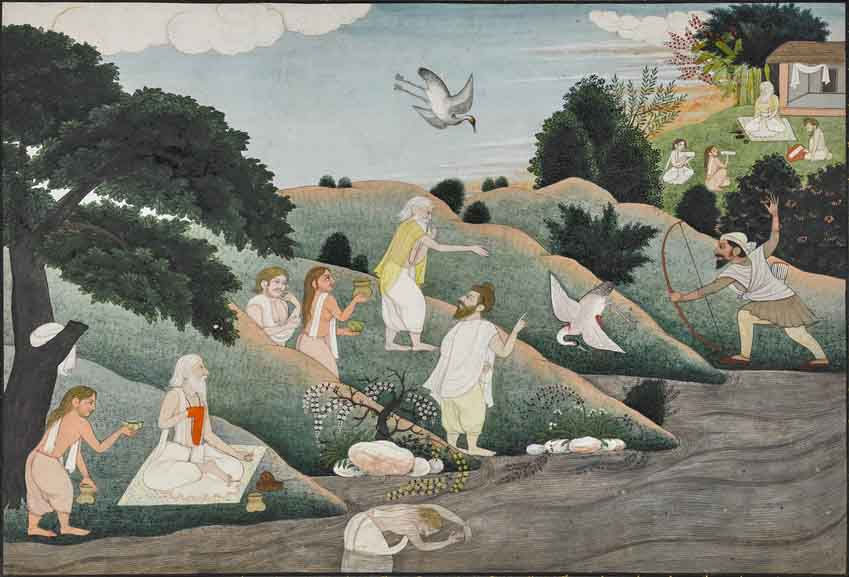
Ravana used both trickery and force to abduct Princess Sita from the forest while she was living in exile accompanying her husband Rama. Ultimately, Ravana is defeated and killed by Lord Rama in open battle. While their extraordinary military conflict provides necessary momentum to the epic’s storyline, the Rama-Ravana power dynamic does not really capture the essence of Valmiki’s Ramayana. What does capture it wholly and beautifully is the tragically disrupted romantic dynamic between Sita and Rama, apprehended early in the epic poem through the deeply significant symbolic episode of a hunter slaying one of the two lovestruck birds as the poet-sage Valmiki looks on helplessly.
Fascinating Layer
By pivoting the epic’s screen adaptation around this love story, the filmmaker will not only humanise the characters who may seem a bit distant due to their divine status but also add a fascinating layer to the narrative that permeates Valmiki’s Ramayana. In Valmiki, the development of this love story is gradual and subtle. It isn’t really what they call “love at first sight”. It doesn’t begin as soon as Rama wins Sita in marriage by stringing the great bow, Haradhanu, when both of them were merely teenagers. It is a saga of gradually deepening mutual love, which culminates in a tragic separation. Valmiki takes great care to show the young couple growing increasingly affectionate and loyal towards each other over the happy, youthful years of their cohabitation in the royal palace in Ayodhya. Yogo Sako did touch upon this aspect in his beautiful animated film, but he chose to focus on the couple’s time together in Panchavati, a sublime forest retreat where Sita and Rama had dwelt during their exile. An eminently fitting and melodious soundtrack, “Panchavati Manabhaavan Upavan”, makes for a compelling and memorable sequence of the Sita-Rama romantic dynamic in Sako’s work. Despite being part of an animated film, that sequence almost captures the expression of ideal conjugal love, in all its sweetness and hopeful aspirations, as Valmiki depicted it in his epic poem.

This brings us to another crucial aspect of Sita and Rama’s romantic relationship: the forest. The forest plays a major role in Valmiki’s epic poem, serving not only as the background for key events that propel and twist the epic’s plot, but also providing moving metaphors to both the union and the separation of Sita and Rama. The forest is pleasing here, terrible there; peaceful here and haunting there; it is eloquent with spring’s bounty at moments of union, and at other times impenetrably silent, mournfully still with the pathos of separation. The forest reveals its many moods in Valmiki’s poem, especially in the Aranya and Sundara Kanda-s, the third and fifth books of the Valmiki Ramayana. Therefore, any adaptation that aspires to capture the epic’s soul must be able to depict the forest in all these various moods. Needless to say, it would require some serious location hunting, because VFX simply won’t cut it. No artificial imagery, no sophistication of digital technology would be able to recreate or replace nature’s sublime majesty captured in a wide-angle lens. Without the natural touch, neither the profound joy of Sita-Rama’s togetherness nor the unbearable pain of their separation will come through in a cinematic adaptation. Thankfully, India has no dearth of breathtaking natural locations – mountain wildernesses, deep forests and virgin seashore locations still abound in this country.
Casting Choices
Lastly, a few words on casting. What sort of skill is required to play the parts of unmistakably divine, tragically vulnerable, yet enduring human characters of the Ramayana? Just like locations, India has no dearth of talented actors either. Several robust film industries in the country, catering to specific linguistic zones such as Hindi, Telugu, Malayalam, and Tamil, have been attracting a steady stream of fine acting talent over the years. But talent alone won’t suffice for the narrative and psychological demands of Ramayana characters. Filmmakers, producers, writers, casting directors, and actors need to ask themselves: Are they ready to immerse themselves in the narrative universe of Valmiki’s Ramayana? Are they willing to fathom the psychological depths, the poetic finesse, or the heroic arc of the characters they wish to recreate or play? There are documented cases from recent filmmaking history of directors and producers engaging with rigorous academic scholarship on the subjects they chose to film. Hayao Miyazaki painstakingly waded through Japanese historiography, anthropology, religious and environmental studies to prepare for the making of Princess Mononoke (1997). Peter Brook and his crew travelled across the length and breadth of the Indian Subcontinent to immerse themselves in every little aspect of traditional and contemporary Indian culture – consulting scholars and translators, visiting ancient temples, watching art forms like Kathakali and observing Hindu rituals – all as preparation for his wondrous stage and film/TV productions of the Mahabharata (1989). Are our Indian film crew ready to undertake such a mammoth preparatory discipline? Even if they were not to engage with the scholarly output on Valmiki Ramayana to prepare for a film/TV adaptation, are they at least willing to read the text from cover to cover, at least in the form of a serious and unabridged modern translation of the kind that, for example, the late Bibek Debroy has produced in three volumes? One hopes that such dedication, commitment, and artistic daring are still not lacking in a handful of Indian actors, even in today’s zooming-zapping-wheezing digital world of ever-shortening attention span and amid the ever-widening scope of artificiality.

Aadi-Kavi Valmiki’s Ramayana is a tale of silent yet intense love – one in which the royal lovers themselves make unthinkable sacrifices for the greater good while enduring unbearable pain through loneliness and eternal ignominy. If nothing else, the filmmakers and actors seeking to adapt this Aadi Mahakavya for the screen need to bring to the project a fraction of that sacrifice and loving dedication in their art and trade. The fruit of their labours should reflect love for the saga of Sita-Rama, above all. That, apart from producing a stellar adaptation, would also become a most fitting tribute to this enduring classic of the Indian civilisation.
(The writer is a Kolkata-based educator, writer, researcher and musician. Views personal.)


Comments