top of page

By:

Prasad Dixit

11 October 2024 at 1:09:23 am

The Human Advantage in an Artificial Age

As artificial intelligence grows smarter and more efficient, the real battle may not be about machines surpassing humanity but about whether humans squander the qualities that still set them apart. With the recent news of a Chinese robot beating the human record in a half- marathon, there is renewed debate on how AI could outsmart human beings. Many experts see it as yet another proof of impending disaster as AI takes over most of the jobs in the years to come. This is not the first time when...

The Human Advantage in an Artificial Age

As artificial intelligence grows smarter and more efficient, the real battle may not be about machines surpassing humanity but about whether humans squander the qualities that still set them apart. With the recent news of a Chinese robot beating the human record in a half- marathon, there is renewed debate on how AI could outsmart human beings. Many experts see it as yet another proof of impending disaster as AI takes over most of the jobs in the years to come. This is not the first time when human civilization is facing a technological revolution that has the potential to impact society and economy in a profound manner. There is, however, a crucial difference with AI driven revolution that is often missed out. The first industrial revolution happened because steam engines were invented and it led to mechanization of production. It was followed by discovery of electrical energy and technologies to harness it for mass production. Next wave of evolution was led by computerization and automation in practically all the fields covering both offices and industrial shop floors through mainframes, personal computers, and programmable logic controllers. While all these leaps in technologies are very different in terms of the specific underlying inventions, they all have one thing in common. They were all invented to do things that were humanly impossible to do. One steam engine or electric motor could do the work that perhaps hundreds of humans would never be able to accomplish even with their collective muscle power. Automation of the manufacturing assembly line would deliver speed and accuracy that human beings would never be able to achieve. Beyond Human Technological advances in Telecommunication, for that matter, have simply expanded the range of 'hearing' and 'seeing' far beyond what human vocal chords, ears, and eyes could manage to do on their own. Computers, at its core, are essentially doing the math and calculations at a speed and accuracy that the human brain can never achieve. To add to that, machines using all these innovations in technology would work tirelessly without any fatigue for a duration that human beings would never be able to match. Although AI is yet another highly potent technological innovation, it is not as straightforward as the previous ones. It can absorb and synthesize huge amounts of data that the human brain perhaps cannot do. Ability of AI to answer any question reasonably well using all the global knowledge made available to it, summarize enormous amount of data and text quickly, quickly draw a complex picture based on instructions given verbally, predict a trend, recognize and highlight a specific face in a fraction of a second from millions of faces, write code based on simple English instructions, are all examples where the speed and accuracy of underlying computation is delivering what human being cannot match. However, there are several areas where human beings are trying to improve AI so that it can, some day, match or exceed capability that human beings themselves already have. Examples of this include the ability of AI to completely replace a human driver safely in all situations, understand full context or an intent behind a statement, carry out complex and well-coordinated mechanical activity in response to various unpredictable situations, react appropriately by correctly assessing the emotions at play, integrate generated code appropriately in the existing larger systems landscape, and so on. In such cases, AI is not exhibiting any capability that is humanly impossible to match. On the contrary, AI is trying to catch up with what humans can do easily. In other words, in these areas, AI is trying to become what humans already are. This very aspect separates AI driven technology revolution from all the previous ones. Direct Competition It is often said that AI and humans will co-exist in the future, and people will need to change their ways of working. It is obvious that AI is also going to directly compete with humans in many sectors. Equipment with an embedded chip on-board do compete with humans even today. A case in point is household equipment such as ‘intelligent’ washing machines and dish-washers where robots to do vacuum cleaning and floor mopping do compete with humans offering these services. A human household help can perform these activities far better than what a machine can do. However, given an affordable choice, an increasing number of households prefer machines over human maid services for a reason. Human household help may not always be punctual, sincere, honest, and reliable. But machines are. Uncontrolled emotions, anger, frustration, laziness, indiscipline, absenteeism do affect humans - but not AI driven machines (at least till the time AI itself acquires emotions of its own, and becomes self-aware some day). This aspect of comparison between AI and humans is likely to become far more prominent and consequential as AI driven machines and robots become more and more intelligent and thereby start competing far more effectively with human capability in many spheres. Competition is said to bring about improvement. Just as AI improves itself through continuous learning to mimic human behaviour and actions, human workforce also needs to improve itself by avoiding behavioural issues and inefficiencies referred to above. Otherwise, humans would lose the natural advantage that they still enjoy over AI, and which is likely to continue even in the foreseeable future. Employers or consumers in the labour-intensive service sector will accept AI driven machines and robots with all its known limitations if it turns out to be a better net-net deal in comparison to services offered by humans. This specific aspect has tremendous significance for India. Many Countries from the developed world do not have a young population with reasonably good IQ in required numbers. India, on the other hand, has it in abundance. One could compare it with abundant availability of Thorium or Sunlight in India as compared to the Western world. Consequently, unlike many Countries in the world that have a Uranium centric approach towards nuclear energy, India's approach needs to be centered around Thorium. India's strategy related to renewable, non-conventional, green energy needs to be based on solar power. Indian Context Strategies for adopting AI in the Indian context need to be similarly tailored for the Indian context. India needs to adopt AI in the areas where it clearly has an advantage over humans in terms of speed, throughput, ease of use, accuracy, and efficiency. However, the use of AI needs to be judiciously controlled in areas where AI is trying to catch up with the capabilities of the human mind and body. Several labour-intensive services such as drivers, caregivers for the elderly people, parcel delivery, security guards, maintenance and repair of various equipment, are all examples in that category. Educational policies and overall work culture in the Country needs to appreciate this reality. Just as AI experts are trying hard to 'teach' AI algorithms and improve them through supervised learning, another set of experts need to sensitize and teach humans on how to understand, appreciate, preserve, and further hone the significant natural advantage that they already have over AI. Despite all the technological breakthroughs in AI, in many areas, still, it is a battle that humans will lose only if they choose to. (The writer works in the Information Technology sector. Views personal.)

When the Cartel Loses Its Grip

The UAE’s exit from the OPEC signals not just a rupture in oil diplomacy, but a shift toward a more buyer-friendly energy order.
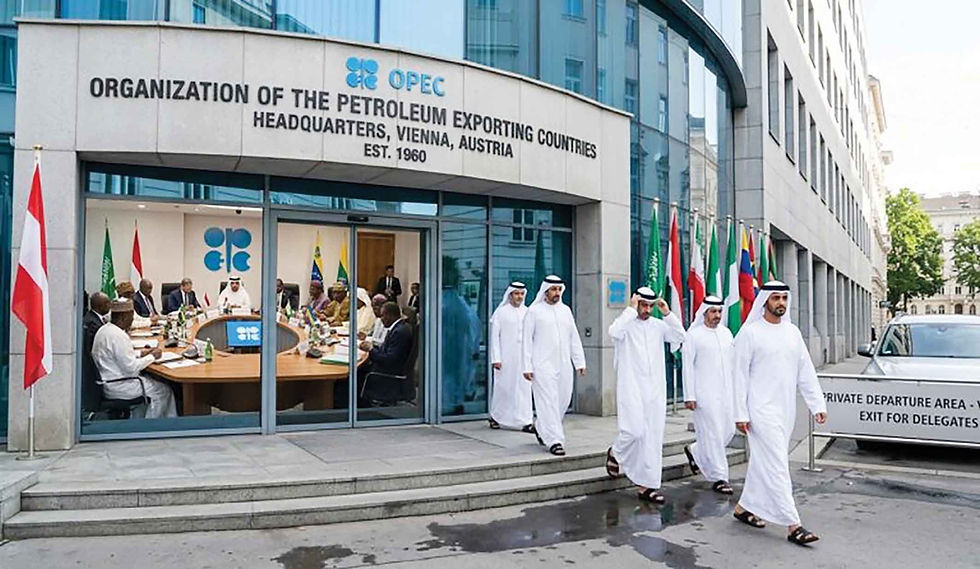
For much of the modern economic age, oil has been less a commodity than a lever of power. Industrial growth, geopolitical alignments and even wars have turned on access to crude. For decades, that lever was held firmly in Western hands by the clutch of companies famously dubbed the ‘Seven Sisters’ that dominated the global oil trade from the 1920s to the 1960s, exercising near-total control over production, pricing and distribution. Through vertical integration, collusive pricing and tight control over concessions, they managed to command roughly 85 percent of the world’s oil reserves while keeping prices conveniently profitable for them.


The emergence of the Organization of the Petroleum Exporting Countries (OPEC) in 1960 marked a rare and consequential revolt against this order. Founded in Baghdad by Iran, Iraq, Kuwait, Saudi Arabia and Venezuela, the cartel sought to reclaim sovereignty over natural resources and wrest pricing power from Western oil majors. By coordinating production levels, OPEC aimed to stabilise markets and secure predictable revenues for its members. Its headquarters in Vienna became the unlikely nerve centre of global energy politics.


Weaponizing Oil

The oil shocks of the 1970s demonstrated OPEC’s ability to weaponize supply, sending prices soaring and forcing consuming nations to rethink their dependence. Yet success bred its own complications. Over time, internal disagreements, the rise of alternative producers and technological innovations and most notably America’s shale revolution began to erode OPEC’s dominance. The creation of the broader OPEC+ alliance in 2016, incorporating non-members such as Russia, was an acknowledgment that the cartel could no longer steer markets alone.


Now, that uneasy coalition faces a more fundamental test. The decision by the United Arab Emirates to exit OPEC, effective from May 1, marks the most significant rupture in the organisation’s six-decade history. It reflects a deeper recalibration of national interest in a world where the incentives for collective discipline are weakening.


The UAE’s departure has been long in the making. Frustrations over production quotas, particularly with Saudi Arabia, OPEC’s de facto leader, have simmered for years. As Abu Dhabi invested heavily in expanding its oil capacity, it found itself constrained by limits that no longer aligned with its ambitions. Freed from these restrictions, the country now plans to boost output from around 3.4 mn barrels per day to 5 mn by 2027. In doing so, it signals a willingness to prioritise market share over cartel cohesion.


The implications are immediate and far-reaching. OPEC’s collective share of global oil supply could fall from roughly 30 percent to 26 percent, weakening its ability to influence prices. More damaging is the blow to Saudi Arabia’s authority. The kingdom has long played the role of swing producer, adjusting output to balance markets. But its leadership depends on compliance from others. If a wealthy and strategically significant member like the UAE can walk away, others may be tempted to follow.


Significant Breach

The risk of further fragmentation looms large. OPEC has always been a coalition of unequal partners with divergent fiscal needs and political priorities. Lower-income members often favour higher prices to shore up revenues, while wealthier states can afford to prioritise long-term market positioning. As these differences sharpen, the logic of collective restraint weakens. The cartel risks becoming less a unified bloc than a loose forum for negotiation.


For oil markets, this could herald a period of greater volatility. In the short term, increased supply from the UAE may exert downward pressure on prices. Analysts already anticipate that a surge in output could soften benchmarks, offering relief to import-dependent economies. Yet the longer-term picture is less clear. Without a cohesive mechanism to manage supply, markets may swing more sharply in response to geopolitical shocks or demand fluctuations.


Such uncertainty carries both risks and opportunities. For consuming nations, particularly in Asia, the prospect of cheaper oil is enticing. India, which imports nearly 90% of its crude requirements, stands to benefit significantly. The UAE’s geographic proximity reduces shipping times and freight costs, while its expanded production capacity could provide a reliable alternative to more distant suppliers.


Infrastructure adds another layer of advantage. The Abu Dhabi Crude Oil Pipeline, linking onshore fields to the Fujairah terminal on the Indian Ocean, allows exports to bypass the Strait of Hormuz. For India, increased access to such routes enhances energy security by diversifying supply lines. Swift bilateral agreements could lock in these gains, insulating the country from disruptions elsewhere.


Yet cheaper oil is not an unalloyed good. Persistently low prices can discourage investment in new production, setting the stage for future supply crunches. They may also slow the transition to cleaner energy sources by reducing the economic incentive to shift away from fossil fuels. The weakening of OPEC could complicate not just energy markets but climate policy as well.


More broadly, the UAE’s exit underscores a shift in the global energy order. The era of tightly controlled cartels is giving way to a more fragmented landscape, where national strategies increasingly trump collective discipline. Producers are recalibrating their roles in response to technological change, shifting demand patterns and the growing importance of energy security in foreign policy.


As the historian Daniel Yergin has observed, oil and gas have always been political commodities. That remains true today, albeit in a more complex and multipolar context. The fracturing of OPEC does not signal the end of coordination, but it does suggest that the mechanisms of control are becoming more diffuse.


The old certainties are fading. In their place is emerging a system that is less predictable, more competitive and, for consumers at least, potentially more forgiving. Whether this new equilibrium proves stable will depend on how deftly nations manage the delicate interplay between cooperation and self-interest in the years ahead.


(The author is a retired naval aviation officer and a defence and geopolitical analyst. Views personal.)

bottom of page