

A Scientist Who Built a Future

PM Bhargava's greatest strength was his ability to combine scientific excellence with institutional vision.
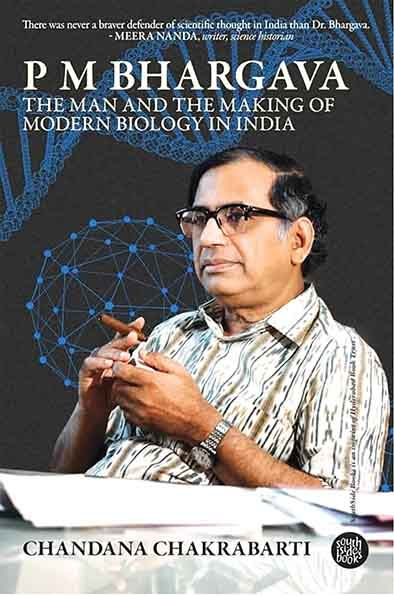
The history of modern Indian science is often narrated through institutions, discoveries, and national programmes. Yet, behind these achievements are individuals whose vision and determination transformed the country's scientific landscape. Pushpa Mitra Bhargava was one such individual—a pioneering molecular biologist, institution-builder, and public intellectual whose influence extended far beyond the laboratory. In PM Bhargava: The Making of Modern Biology in India, Chandana Chakrabarti offers an illuminating account of a scientist who shaped a discipline and helped define the character and aspirations of post-Independence Indian science.
This is much more than the biography of an accomplished scientist. It is also the story of the emergence of modern biology in India. Through Bhargava's life and work, Chakrabarti traces the country's transition from traditional, descriptive biology to the frontiers of molecular science, while placing that transformation within the aspirations of a young nation determined to achieve scientific self-reliance.
Bhargava's greatest strength was his ability to combine scientific excellence with institutional vision. At a time when molecular biology was still an emerging field, he recognised its transformative potential and understood that India needed institutions capable of matching the world's best laboratories. His crowning achievement—the establishment of the Centre for Cellular and Molecular Biology (CCMB) in Hyderabad—was not merely an administrative accomplishment; it was the realisation of an ambitious scientific vision. Chakrabarti presents the creation of CCMB as an act of intellectual imagination: an attempt to create an environment in which curiosity, originality, and rigorous scientific inquiry could flourish.
One of the book's notable strengths is its ability to place Bhargava's career within the evolving history of Indian science. The decades following independence were marked by optimism and nation-building but also by limited resources, bureaucratic constraints, and competing developmental priorities. Chakrabarti captures these complexities with balance, showing how Bhargava consistently resisted compromising on scientific excellence. He believed Indian scientists deserved world-class research environments and devoted much of his career to turning that conviction into reality.
Equally compelling is the portrait of Bhargava as a public intellectual. He viewed science not as an isolated academic pursuit but as an essential component of an enlightened and democratic society. His strong advocacy of scientific temper, opposition to superstition and pseudoscience, and insistence that public policy should be guided by evidence reflected a deeper commitment to reason as a civic value. Chakrabarti demonstrates that, for Bhargava, science carried ethical and social responsibilities alongside its intellectual ones.
The biography is also effective because it avoids uncritical admiration. Bhargava emerges not simply as a celebrated scientist but as an independent and often uncompromising thinker whose determination occasionally brought him into conflict with institutional authorities and prevailing orthodoxies. These episodes add authenticity to the narrative and reveal the tensions and challenges that accompany the creation of enduring scientific institutions.
Perhaps the book's greatest achievement is its portrayal of Bhargava as a deeply human figure. Behind the celebrated scientist was a man driven by intellectual curiosity, moral conviction, and a strong commitment to public service. His passion for biology was inseparable from his concern for education, scientific literacy, and the social responsibilities of science. In Chakrabarti's telling, the laboratory and society remain closely connected; scientific knowledge acquires its fullest meaning when it contributes to the larger well-being and intellectual progress of society.
The book therefore succeeds on two levels: as a biography of an extraordinary scientist and as a history of an important phase in Indian science. It reminds readers that building scientific capacity is not simply a matter of establishing laboratories or acquiring sophisticated equipment. It requires vision, institutional courage, intellectual freedom, and people willing to challenge established ways of thinking.
‘PM Bhargava: The Making of Modern Biology’ in India is consequently a valuable contribution to the literature on Indian science and its pioneers. Chandana Chakrabarti brings together the personal, scientific, institutional, and public dimensions of Bhargava's life to create a portrait that is both engaging and significant. The book is particularly relevant at a time when questions about scientific temper, evidence-based policy, research excellence, and the role of science in society remain important.
(The writer is the Chief Executive of The National Centre for Science Communicators, Mumbai. Views personal).



Comments