

The Women Behind the American Dream

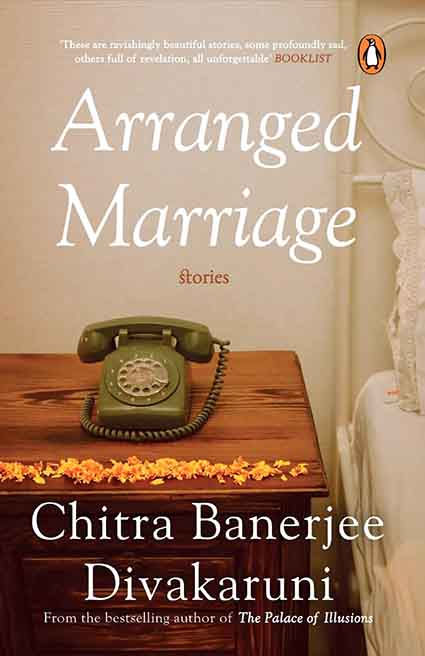
Arranged Marriage, a collection of short stories first published in 1995, is celebrated author Chitra Banerjee Divakaruni’s debut fiction work. Apart from being a bestseller in the United States, the book won the PEN Oakland Josephine Miles Prize for fiction, an American Book Award and the Bay Area Book Reviewers Award for fiction. Divakaruni, apart from teaching creative writing at a local college, is the coordinator for a helpline for South Asian women.
This book reflects her interest and passionate involvement with the plight of (married) South Asian women who very often leave their families in India to settle down in the United States and carve out a new life for themselves. This is a prospect which is both exciting and sometimes emotionally terrifying.
The short stories are written in a lucid, uncomplicated style which the reader will enjoy due to its sheer simplicity. Haunting, poignant, displaying a sensitivity which probes the diverse situations the protagonists find themselves in - whether it is marital or any other relationship - the stories entice the reader to not only immerse himself/herself in the narrative, but also identify himself/herself with some of the personages in the stories.
The tales remind one of a flower that blooms petal by petal, unfurling itself in layers of beauty and delicacy that intoxicate the reader as would a bee feasting on nectar. The stories unfold in a manner which absorb the person perusing them and then leave him/her spellbound at each of the climaxes. Identifying oneself with the accounts is easy—so humane and approachable are the plots.
The themes are manifold: relationships that are in peril or virtually torn asunder by marital violence, infidelity, cultural differences (here the adjustment to the United States by Indians is incisively brought out), murder of a partner in the US, and in one case - even the desire of an Indian American woman to adopt an unknown child she encounters.
The short stories are set both in India (veering towards the traditional) and in the United States, where more contemporary topics such as live-in relationships among other things, are discussed. These create disharmony between the women involved in them and their scandalized families in India.
Xenophobia, racial hatred, and the acceptance of grim realities by not-so-successful Indian migrants are brought out vividly in the short story Silver Pavements, Golden Roofs. Also portrayed magnificently in the narrative is the contrast between the expectations from the United States of Indian youth and the sardonic disillusionment of an older generation which came to the US in pursuit of the American dream and found this vision shattered. The struggle and frustration of an older couple is movingly described.
The cultural gap experienced by ambitious Indian women who have relationships with Indian/American men, who many a time cannot comprehend the womens’ longing for family ties (especially that pertaining to the mothers), is brought out with great sensitivity in the short story The Word Love.
The Indian women in many of the stories emanate from societies where even to speak and discuss sex and relationships borders on taboo. When they come to the United States, they experience a sudden and exhilarating independence which they enjoy but find difficult to disclose to their infinitely more orthodox family members at home.
Divakaruni has brought out many nuances about familial associations that have diverse layers and angles to them. Her style is captivating in a simple yet profoundly touching manner. The short stories are not simply read by the reader - they touch a strong emotional chord which makes one wonder at the various situations faced by the stories’ protagonists. One practically lives these tales, because these experiences could be faced by anyone, without being extraordinary. These are bold themes that need to be brought up. Society, at least in India, has a tendency to suppress and avoid them.
The stories unfold dexterously, reminding us of the perfect and charming gurgling of a brook harmoniously flowing on its charted path. The accounts just flow, no verbosity, no melodrama, just a narrative gripping in its overwhelming pathos and introspective capability. Divakaruni is a craftswoman of exceptional abilities. In Arranged Marriage she captivates the reader in the seductive warp and weft of the stories, an entrapment one is loath to extricate oneself from.
(The writer is a Mumbai based educator.)


Comments