top of page

By:

Akhilesh Sinha

25 June 2025 at 2:53:54 pm

The BJP’s urban playbook

Mumbai’s civic verdict which saw the Thackerays’ being dethroned signals a national turn from dynasty to delivery, unsettling India’s regional satraps New Delhi:  The election result to the Brihanmumbai Municipal Corporation (BMC), the richest civic body in India, which saw the fall of the Thackeray clan has not merely reshaped Maharashtra’s politics but sent tremors across India’s federal map. The BJP–Shinde Shiv Sena alliance secured 118 of the 227 seats, ending the Thackeray family’s...

The BJP’s urban playbook

Mumbai’s civic verdict which saw the Thackerays’ being dethroned signals a national turn from dynasty to delivery, unsettling India’s regional satraps New Delhi:  The election result to the Brihanmumbai Municipal Corporation (BMC), the richest civic body in India, which saw the fall of the Thackeray clan has not merely reshaped Maharashtra’s politics but sent tremors across India’s federal map. The BJP–Shinde Shiv Sena alliance secured 118 of the 227 seats, ending the Thackeray family’s 25-year grip over the city’s civic empire. The BJP alone won 89 wards, polling 11,79,273 votes, which translated into 45.22 percent of the winners’ vote share and 21.58 percent of the overall turnout. This surpassed its 2017 tally of 82 seats and marked the party’s most decisive urban triumph in western India. Institutional Backbone For a quarter of a century, the BMC was the institutional spine of Thackeray power, funding patronage networks and reinforcing a politics rooted in kinship and cultural assertion. That edifice has now cracked. Uddhav Thackeray’s Shiv Sena (UBT) slumped to 65 seats, a collapse that reflects not merely factional splits but a deeper exhaustion with a style of politics that seemed increasingly indifferent to everyday civic failures. Devendra Fadnavis’ Mahayuti alliance tapped into this frustration by projecting governance over political pedigree. What makes Mumbai’s verdict resonate nationally is its timing. Almost simultaneously, the BJP staged a breakthrough in Kerala’s local elections, capturing 50 of 101 wards in Thiruvananthapuram and installing V.V. Rajesh as mayor - its first in the state capital in 45 years. The Left Democratic Front was reduced to 29 wards and the Congress-led United Democratic Front to 19. In two very different cities, voters appeared to reward a narrative of administrative competence and anti-corruption over ideological lineage. The BJP, long caricatured as a north-Indian force, has begun to nationalise its local-body playbook. The lesson from Mumbai is stark. Urban electorates, especially the middle class, are becoming less sentimental and more transactional. For over two decades, the BMC functioned as a symbol of Marathi pride and familial continuity. Yet when potholes and floods became annual rituals, pride curdled into impatience. The electorate’s punishment was swift. Such behaviour suggests a maturing urban voter, willing to dispense with entrenched elites when delivery falters. Wider Implications These signals are being keenly watched in West Bengal, which heads to a crucial Assembly poll in April this year. Mumbai’s outcome arms the BJP with a tested template to challenge Mamata Banerjee’s Trinamool Congress in urban centres such as Kolkata. The party’s 2021 assembly performance had already demonstrated its urban appeal. Civic failures, scandals and a fraying Congress–Left understanding offer further openings. Welfare schemes like Lakshmir Bhandar continue to secure rural loyalty for Banerjee, but cities are less forgiving. The BJP’s experience in Mumbai suggests that competence, and not confrontation, may be the sharper weapon. The ripple effects extend southwards. Tamil Nadu’s 2026 contest pits the ruling DMK against an opposition that may yet coalesce. The AIADMK, weakened but still the principal challenger, is flirting with a renewed alliance with the NDA. Its 20 percent vote share in the 2024 Lok Sabha election, combined with the BJP’s 11 percent could, on paper, threaten M.K. Stalin’s coalition, which polled around 27 percent. A swing of 5 percent would be enough to imperil the DMK in urban centres such as Chennai, particularly amid persistent allegations of graft. Yet, internal feuds within the AIADMK and the rise of actor Vijay’s political outfit dilute opposition unity, limiting the BJP’s reach despite its urban pitch. Kerala’s verdict reinforces the broader pattern. Anti-corruption appeals and development-first messaging have shown themselves to be portable, even in states long resistant to the BJP. Still, cultural and social divides impose limits. The party’s advances are incremental rather than transformative. Regional heavyweights such as the TMC and DMK may suffer morale shocks, but they retain deep-rooted organisational strength and emotive narratives. Even so, Mumbai’s civic upheaval marks a turning point. It suggests that India’s urban voters are increasingly willing to judge parties as service providers rather than cultural custodians. For the BJP, the BMC offers a replicable model: alliances stitched pragmatically, campaigns anchored in delivery, and an appeal tailored to middle-class anxieties. For the opposition within the I.N.D.I.A. bloc, it is a warning. Welfare populism without administrative credibility may no longer suffice.

Agriculture’s Blind Spot

The missing variable in India’s farm economics is the slow erosion of farmers’ bodies and minds.
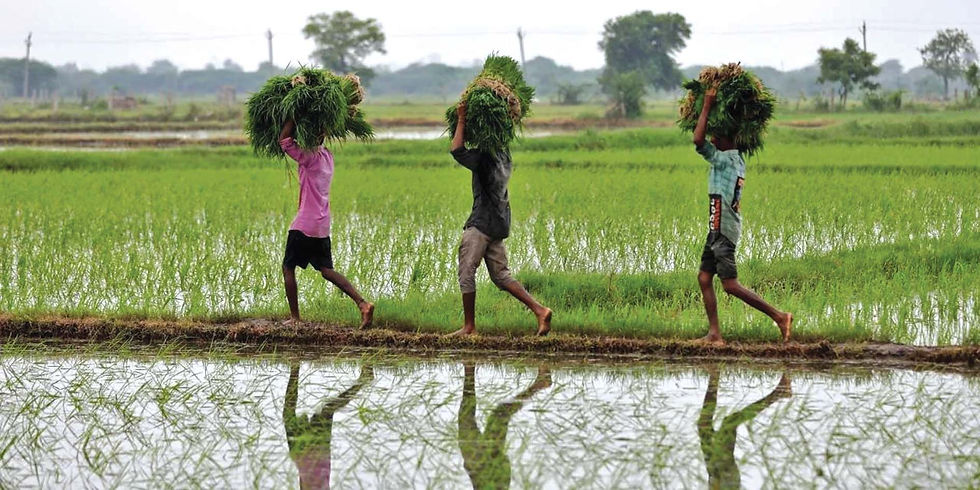
Agriculture is usually narrated as a story of soil, seeds and rain. In policy papers and production models, land is measured in acres, fertiliser in kilograms and water in cubic metres. Labour appears, if at all, as a residual cost. What is almost never counted is the condition of the person doing the work. Yet on India’s farms, especially those growing labour-intensive crops, the health of the farmer is not a side issue. It is a core input into production, as decisive as irrigation or fertiliser, and far more fragile.


Spend time on sugarcane, cotton or paddy farms and this becomes obvious. Crops such as sugarcane, rice, wheat, mango, cashew, vegetables and cotton generate high gross returns, but they demand relentless physical effort. Bending, cutting, carrying, spraying and harvesting over months leaves bodies worn and minds frayed. The economic system records the output, but not the erosion of the person producing it.


Uncounted Costs

Take sugarcane, a flagship crop in much of western and southern India. On a single acre, a farmer may put in around 80 full labour days in a year, in addition to buying seeds, fertiliser and irrigation. According to the Commission for Agricultural Costs and Prices (CACP) Cost of Cultivation Report for 2024–25, these visible inputs add up to roughly Rs. 70,000 per acre. That is what the books show. But when one factors in what can be called ‘Farmer Health Capital depreciation’ – which is the cumulative physical and mental strain of repetitive, exhausting work - the true cost rises by about Rs. 16,000 more. This estimate draws on the NSSO daily wage of Rs. 350 and on occupational-strain research (Bharati et al., 2019; Ramesh et al., 2021). In other words, nearly a fifth of the real cost of growing sugarcane is being silently absorbed by the farmer’s body.


Cotton tells a similar story. Pest management, weeding and manual harvesting demand sustained, often back-breaking effort. In regions such as Vidarbha, where smallholders dominate, a single acre can exhaust an entire household over the season. If cultivation costs are adjusted for health loss, they rise by 15–20 percent, even if gross income remains unchanged. Traditional farm accounting, which focuses on cash outlays and ignores bodily wear and tear, simply misses this hidden burden.


Bringing health into the production function changes the way agricultural economics looks. Farmer Health Capital is best thought of as a stock—like soil fertility—that diminishes with intensive use. Health in the production function is a flow, influencing how much effective labour a farmer can supply at any moment. A fatigued, injured or depressed farmer produces less, just as surely as a field with depleted nutrients yields less grain.


Formally, output can be written as Y = f (S, F, W, L × H), where S is seed, F fertiliser, W water, L labour and H the health-adjustment factor, which lies between 0 and 1 (P. J. Patil, 2026). When H falls because of chronic pain, illness or mental strain, effective labour falls with it. This makes health not a soft social variable but a measurable economic input, one that can be priced into the true cost of cultivation.


Uncomfortable Implications

The implications for India’s minimum support prices (MSP) are uncomfortable. MSP calculations today account for paid-out costs and imputed family labour, but not for health depreciation. If sugarcane and cotton were priced with this in mind, MSPs would need to rise by perhaps 15–25 percent to reflect the real value of farmers’ effort. That would not merely be a fiscal transfer. By making exhausting crops more expensive, it would nudge farmers and governments towards mechanisation, crop diversification and techniques that reduce physical strain.


India’s chronic agrarian distress and high rates of farmer suicide cannot be understood only through income statements. Many farmers keep going under extreme strain even when earnings look adequate on paper. By ignoring health deterioration, policymakers miss what might be called ‘silent distress’ or the slow accumulation of pain, fatigue and anxiety that can precede chronic illness or mental-health crises (NCRB, 2023; ICSSR, 2021). Tracking Farmer Health Capital could therefore act as an early-warning system, flagging households and regions where intervention is needed before tragedy strikes.


None of this requires mystical new economics. It requires acknowledging what is already visible in the fields: that farming is not just an interaction between land and technology, but between human bodies and unforgiving tasks. Counting the invisible cost of health is not an academic flourish. It is a prerequisite for making Indian agriculture sustainable and humane.


(The writer is a member of Maharashtra Agriculture Price Commission. Views personal)

Comments


bottom of page