

Beyond the AI Arms Race: The Apple Way to AI
- Rupak Bardhan Roy

- 3 hours ago
- 5 min read
As the economics and ecology of hyperscale AI begin to crack, Apple’s delayed strategy appears remarkably prescient.

Apple’s WWDC 2026 delivered one unmistakable message: it has rebuilt its entire software and device ecosystem around Apple Intelligence. Siri AI has been re‑engineered from the ground up with on‑device reasoning, Private Cloud Compute now anchors Apple’s hybrid AI architecture, macOS and iOS have become AI‑native operating systems, and developers received new agentic frameworks that make Apple silicon the center of future AI workflows. The company’s long‑delayed AI strategy has arrived, privacy‑preserving(?), and infrastructurally distinct from the hyperscale LLM race. Apple has officially entered the full‑AI mode.
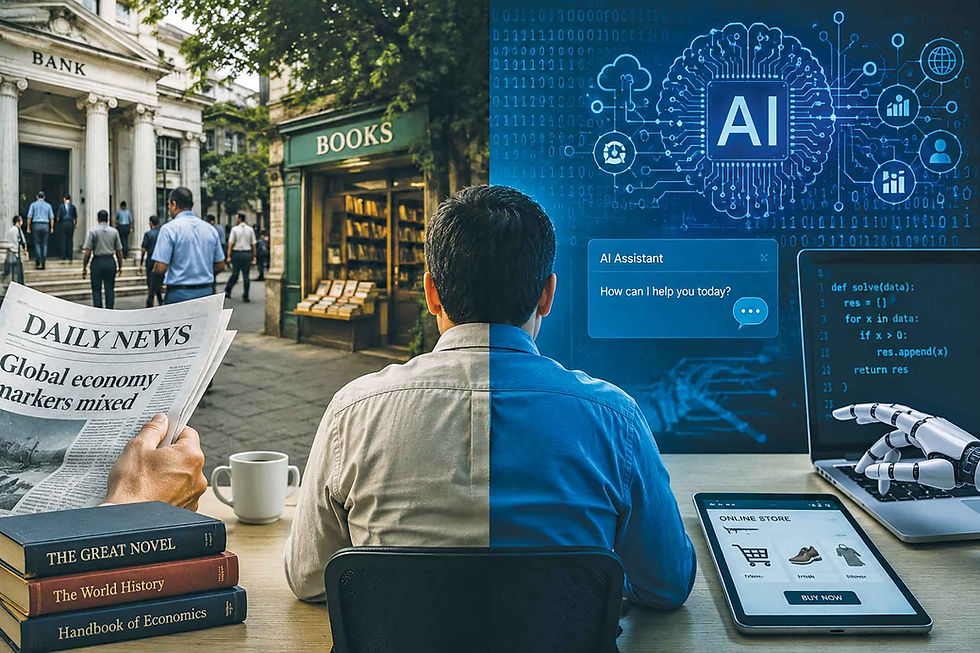
To understand the significance of Apple’s 2026 pivot, we must revisit the strange, almost theatrical silence of 2025. Last year, the global AI industry was in a frenzy. OpenAI, Google, Meta, and Microsoft were locked in a war of model sizes, parameter counts, and compute budgets. Every quarter brought a new LLM, a new benchmark, a new promise of “general intelligence.” The world was intoxicated by chatbots; investors, governments were anxious; and the public was swept into a wave of AI immersion that was reckless. And yet, Apple stood apart.
At WWDC 2025, instead of unveiling a Siri‑GPT or an Apple‑branded conversational agent, the company introduced Liquid Glass, a shimmering, polarizing UI experiment that seemed almost indifferent to the global AI race. Critics mocked the absence of an Apple chatbot. Analysts speculated that Apple had fallen behind. A few commentators even suggested that Apple’s “end days” were approaching, as if the company’s refusal to join the hype cycle were a sign of weakness rather than discipline.
But inside Apple, something was cooking. Siri’s 2024 prototype, though functional, did not meet Apple’s quality bar. Craig Federighi and Greg Joswiak said openly that Apple would not release “just another chatbot.” They wanted something “Apple‑like”—a personal, intelligent companion that understood context, respected privacy, and integrated seamlessly with the device ecosystem. Apple’s R&D culture, unchanged since the days of Steve Jobs, demanded long‑term coherence over short‑term spectacle. In 2025, this stance looked eccentric. In 2026? Pragmatic.
The Cracks in Hyperscale AI
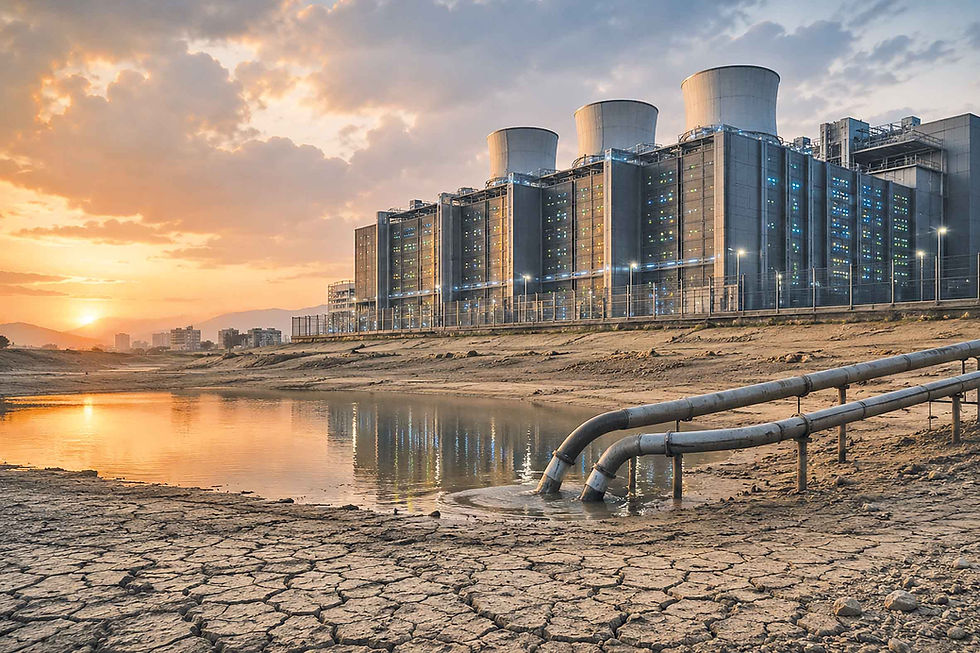
2025 was also the year the global AI infrastructure began to shudder. The LLM boom depended on hyperscale data centers—vast campuses consuming huge quantities of electricity and water. These centers were the unseen engines behind ChatGPT, Gemini, LLaMA, and Copilot. But the engines were overheating, physically, politically and ecologically.
Across the world, communities began resisting data‑center construction. In the United States alone, more than a hundred projects faced delays or cancellations. A Gallup poll showed that 71 percent of Americans opposed data centers in their neighborhoods. States considered moratoriums. Local governments demanded environmental impact audits. Litigation was routine. Water scarcity became the flashpoint. Evaporative cooling—the method used to keep AI servers from melting—requires enormous volumes of potable water. Not groundwater. Not recycled wastewater. Potable, drinkable water to avoid panel contamination from bacteria, dirt, minerals etc. Google’s proposed Santiago data center requiring 7 billion liters of water annually, and the Stargate project near Marfa, Texas planning to use 260 million gallons of clean water per year, exceeding the town’s own potable water needs were not isolated cases. They were early warnings. By late 2025, drought‑zone communities from Arizona to Virginia were blocking hyperscale projects. Environmental groups mobilized. Farmers protested. Legislators intervened. The infrastructure that powered the AI revolution was becoming politically reactive.
As a result, Big Tech began to retreat. Microsoft paused gigawatts of planned capacity. Google reconsidered multiple sites. Meta faced legal challenges. The Stargate megaproject—once envisioned as a $500‑billion monument to AI—was scaled back, with UK and Norway sites halted and pushed timelines to 2028. The AI bubble, inflated by compute optimism, met head-on with the hard physics of water and electricity.
Divergent Path
This is where Apple’s 2025 silence becomes meaningful. While other companies were racing to build larger models and larger data centers, Apple was quietly building an alternative architecture—one that did not depend on hyperscale campuses, evaporative cooling towers, or gigawatt substations. Apple’s bet was simple: AI should run on the device people already own. This was not a marketing slogan. It was an infrastructural philosophy. By running AI directly on the devices people already own, Apple sidestepped many of the constraints that are beginning to define the industry’s future. On-device intelligence eliminates the enormous water requirements of hyperscale data centres, reduces dependence on already strained electricity grids, and avoids the political backlash that accompanies large-scale AI infrastructure projects. At the same time, because data remains on the user's device rather than being continuously transmitted to the cloud, it offers stronger privacy protections while also easing the regulatory burdens associated with data sovereignty and compliance.
Apple’s early articulation of personal cloud computing—a hybrid model where sensitive tasks run locally and only anonymized requests touch the cloud—was not merely a privacy innovation. It was an infrastructural innovation. It was a way to build AI without building megacenters. In 2025, this looked like caution. But today, it looks like foresight.
WWDC 2026 was Apple’s declaration that its long game had matured. Siri is no longer a voice assistant. It is a contextual reasoning agent capable of understanding on‑screen content, executing multi‑step tasks across apps, and maintaining conversational memory—all without siphoning user data into distant servers. Apple Intelligence is now woven into Safari, Messages, Mail, Calendar, Photos, Home, and third‑party apps. It organizes tabs, summarizes content, interprets images, and automates workflows. When cloud compute is necessary, Apple will use micro‑compute clusters designed for privacy and efficiency—not hyperscale farms. These clusters are geographically distributed, energy‑efficient, and architecturally distinct from the water‑hungry campuses of other Big Tech firms. iOS 27 and macOS 27 “Golden Gate” are built around contextual assistance. Siri integrates directly into Spotlight. The OS understands user intent, not just user input. Last but not the least, the company introduced Foundation Models Framework, Core AI, and expanded App Intents—tools that allow developers to build AI agents optimized for Apple silicon rather than cloud GPUs. Even for industry insider-outsiders or as I call the Adult Technocrats like us, who are inherently skeptic of privacy concerns associated with LLMs, this is not Apple catching up but Apple redefining the playing field.
Meanwhile, the rest of Big Tech is being forced by social politics, civil rights movements, ecology, and economics to reconsider its dependence on hyperscale AI. The industry that once worshipped scale is now learning the limits of scale. The companies that once believed “bigger models solve everything” are now confronting the reality that bigger models require bigger data centers, and bigger data centers require bigger quantities of water and electricity—resources that communities are no longer willing to sacrifice. The AI revolution is being forced to shrink, decentralize, and become intimate. Exactly the direction Apple chose in 2025.
Strategic Implication
Apple’s 2026 pivot is not just a technological milestone. It is a philosophical stance about the future of AI. Apple has implied that intelligence should be: personal, private (highly questionable when Siri accesses your data to reply emails), local, efficient, sustainable, integrated with hardware, and free from infrastructural fragility – a post hyperscale vision of AI; a stance miles away from the LLM maximalism of 2023–2024. The global retreat from hyperscale data centers, the political backlash against water consumption, the energy‑grid constraints, the regulatory pressure, and the infrastructural fragility of LLM‑centric AI—all of these forces are pushing Big Tech toward the very path Apple chose a year earlier- which leaves us with one final question: What Apple thinks today, other Big Tech thinks tomorrow. Or do they?
(The writer is a Lead Process Engineer with GE HealthCare in France and a columnist with four books to his credit. Views personal.)

Comments