

The Thirst Behind the Cloud

As Maharashtra positions itself at the centre of India’s AI revolution, water security is emerging as an uncomfortable constraint.
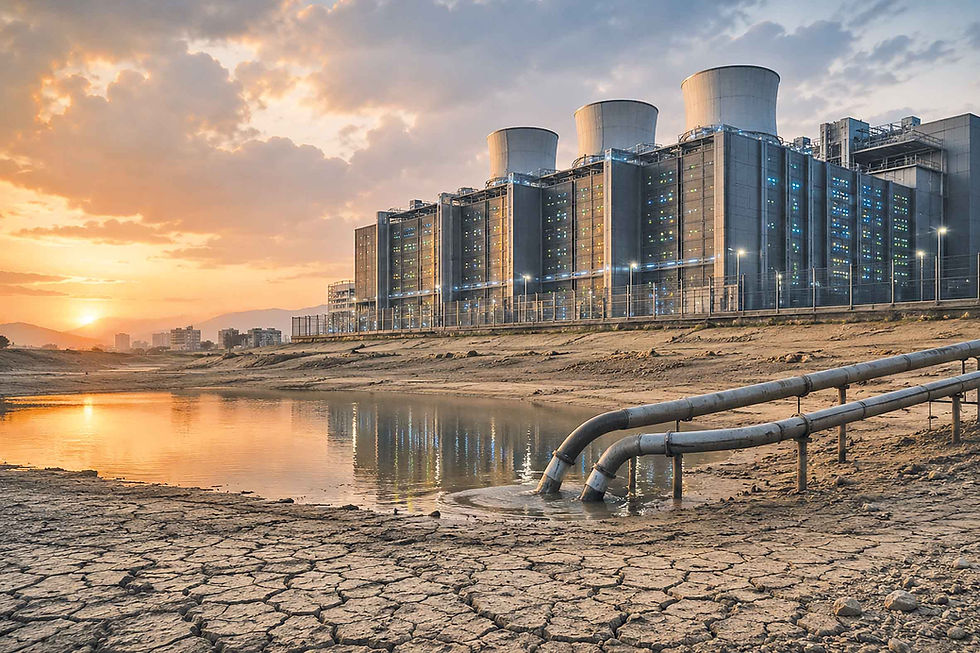
The digital economy is often referred to as weightless. Streaming video from a smartphone. An artificial intelligence chatbot answers a question. A financial transaction takes only seconds to complete. A cloud server that contains millions of files. The average user views the internet as almost immaterial, in some virtual realm, without the physical constraints that traditional industries are subject to. But there is a vast physical infrastructure behind every click, search query, and AI-generated answer. They store data, process transactions, run cloud computing services and, increasingly, run the artificial intelligence systems that governments and corporations are racing to implement.
Maharashtra is emerging as the prime destination in India for this infrastructure. Global technology corporations and data center operators have invested billions of dollars in the Mumbai Metropolitan Region, in Navi Mumbai, Thane and Pune. Its strategic location in the state, strong connectivity for telecommunications, access to undersea cable networks and proximity to India’s financial capital make it an ideal hub for digital infrastructure. But with Maharashtra gearing up for a data centre boom, there is an important question yet to be answered: where will the water come from? The answer could decide whether the state’s digital ambitions can be sustained for decades to come.
Unused Potential
Data centers use huge amounts of electricity and that has drawn the attention of policymakers. How much they depend on water is less well understood. Servers generate heat constantly. Failure to cool properly may lead to equipment failure, reduced performance and a threat to operational reliability. Many facilities have cooling systems that can use significant quantities of water to dissipate the heat. With the rise of artificial intelligence, global alarm has been raised over data centers’ water use. AI workloads demand more computer power, which means more heat generation, and therefore more cooling. So, there is an increasing demand for water and electricity.
The problem isn't only how much water is drunk, but where it comes from. Industry’s big demands can clash with those of homes, farms and local ecosystems – especially where water is scarce. This is a problem that Maharashtra has to tackle.
Maharashtra is among the most economically successful states of India. It accounts for a large share of the country’s GDP, attracts considerable foreign investment and is home to some of the country’s important industrial clusters. But it is also a state facing water stress. Some parts of Marathwada and Vidarbha face drought-like conditions every summer. Reservoir levels are falling, groundwater is depleting further and water tankers are becoming a lifeline for many communities. Nor are cities an exception. Mumbai receives heavy monsoon rains but is susceptible to changes in reservoir storage and rising demand from a growing population.
Climate change will probably complicate matters. Heavier downpours, longer periods without rain and rising temperatures are all expected to increase the strain on water management systems. In this context, the arrival of dozens of new data centers creates a new form of industrial water demand. Individual facilities may constitute a small proportion of total state water use but their concentration in specific metropolitan and peri-urban locations may lead to localised pressures. This cumulative effect is all the more pronounced as Maharashtra promotes itself as the key digital infrastructure hub of India.
The AI Factor
Then generative AI adds another level of complexity. Artificial intelligence is more than a digital service. It requires far more resources than conventional computing applications. Training advanced AI models needs gigantic computing clusters that run non-stop for long periods of time. Even simple AI queries require processing power not used by traditional web searches.
Governments, organizations and consumers are expected to adopt AI capabilities and the demand for data center capacity is expected to soar. This is a paradox for policy makers. AI can increase efficiency, unleash innovation and boost economic competitiveness. But the infrastructure required to support AI could put even more strain on already stressed energy and water systems. Digital expansion and water management are strategic priorities of Maharashtra and these two goals need to be tackled together, rather than separately.
Governments around the world are beginning to take this seriously. Huge data centre developments have caused anxiety among communities in the United States and Europe over their environmental impact. Local planning conflicts now have prominent issues of water use, energy needs and land-use impacts. Some authorities have responded by calling for more transparency in the use of resources. Others prefer other cooling technologies, water recycling systems and treated wastewater instead of freshwater supplies.
These approaches offer useful lessons for India. The goal should not be to slow the development of digital infrastructure. Data centres are crucial for economic development, digital sovereignty, financial services, e-commerce and developing technology. The aim should rather be to ensure that growth takes place within environmental limits.
Water Strategy
Maharashtra has the chance to act now, before water problems become baked in. First, big data center projects should be required to report on their water use. Open disclosure would help policymakers and local people better understand the cumulative effects. Second, greater emphasis must be placed on recycled and treated waste water. However, when other sources of water are available, it is increasingly difficult to justify the use of potable freshwater for industrial cooling in water stressed areas. Third, location planning is important. The long-term water resilience of data centres, along with connectivity and land availability, must be examined.
Fourth, policymakers should encourage innovation in cooling technologies. Better liquid cooling, closed-loop systems and other efficiency approaches can reduce water use significantly while maintaining performance. And finally, water has to be part of the overall digital infrastructure development. “The conversation around data centers has largely been about power and connectivity. Water has to become an equally important topic of discussion.
Maharashtra’s ambition to be the digital infrastructure hub of India is comprehensible. In an increasingly digital world, data centers provide investment, jobs, technical skills and strategic advantages.
But every technology development depends on physical resources. The cloud is not in the heavens. Built on land and powered by electricity, it is cooled with water. As India enters the age of artificial intelligence, the challenge is not just about building digital infrastructure anymore. It is building infrastructure that is in harmony with environmental realities.
For Maharashtra, the question is not whether to create data centres. But the bigger question is whether or not the state can guarantee that its digital future will not come at the expense of one of its most valuable and hotly contested resources. Water might be the most important resource in the race to run the next generation of tech.
(The writer is a columnist and climate researcher with experience in political research analysis, ESG research and energy policy. Views personal.)


Comments