top of page

By:

Quaid Najmi

4 January 2025 at 3:26:24 pm

Seventy-six mayors ruled BMC since 1931

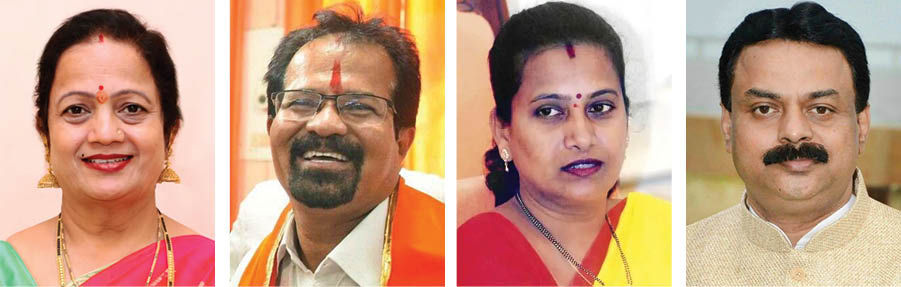
After four years, Mumbai to salute its first citizen Kishori Pednekar Vishwanath Mahadeshwar Snehal Ambekar Sunil Prabhu Mumbai: As the date for appointing Mumbai’s First Citizen looms closer, various political parties have adopted tough posturing to foist their own person for the coveted post of Mayor – the ‘face’ of the country’s commercial capital. Ruling Mahayuti allies Bharatiya Janata Party (BJP) and Shiv Sena have vowed that the city...

Seventy-six mayors ruled BMC since 1931

After four years, Mumbai to salute its first citizen Kishori Pednekar Vishwanath Mahadeshwar Snehal Ambekar Sunil Prabhu Mumbai: As the date for appointing Mumbai’s First Citizen looms closer, various political parties have adopted tough posturing to foist their own person for the coveted post of Mayor – the ‘face’ of the country’s commercial capital. Ruling Mahayuti allies Bharatiya Janata Party (BJP) and Shiv Sena have vowed that the city will get a ‘Hindu Marathi’ person to head India’s richest civic body, while the Opposition Shiv Sena (UBT)-Maharashtra Navnirman Sena also harbour fond hopes of a miracle that could ensure their own person for the post. The Maharashtra Vikas Aghadi (MVA) optimism stems from expectations of possible political permutations-combinations that could develop with a realignment of forces as the Supreme Court is hearing the cases involving the Shiv Sena-Nationalist Congress Party this week. Catapulted as the largest single party, the BJP hopes to install a first ever party-man as Mayor, but that may not create history. Way back in 1982-1983, a BJP leader Dr. Prabhakar Pai had served in the top post in Mumbai (then Bombay). Incidentally, Dr. Pai hailed from Udupi district of Karnataka, and his appointment came barely a couple of years after the BJP was formed (1980), capping a distinguished career as a city father, said experts. Originally a Congressman, Dr. Pai later shifted to the Bharatiya Janata Party, then back to Congress briefly, founded the Janata Seva Sangh before immersing himself in social activities. Second Administrator The 2026 Mayoral elections have evoked huge interest not only among Mumbaikars but across the country as it comes after nearly four years since the BMC was governed by an Administrator. This was only the second time in the BMC history that an Administrator was named after April 1984-May 1985. On both occasions, there were election-related issues, the first time the elections got delayed for certain reasons and the second time the polling was put off owing to Ward delimitations and OBC quotas as the matter was pending in the courts. From 1931 till 2022, Mumbai has been lorded over by 76 Mayors, men and women, hailing from various regions, backgrounds, castes and communities. They included Hindus, Muslims, Christians, Parsis, Sikhs, even a Jew, etc., truly reflecting the cosmopolitan personality of the coastal city and India’s financial powerhouse. In 1931-1932, the Mayor was a Parsi, J. B. Boman Behram, and others from his community followed like Khurshed Framji Nariman (after whom Nariman Point is named), E. A. Bandukwala, Minoo Masani, B. N. Karanjia and other bigwigs. There were Muslims like Hoosenally Rahimtoola, Sultan M. Chinoy, the legendary Yusuf Meherally, Dr. A. U. Memon and others. The Christian community got a fair share of Mayors with Joseph A. D’Souza – who was Member of Constituent Assembly representing Bombay Province for writing-approving the Constitution of India, M. U. Mascarenhas, P. A. Dias, Simon C. Fernandes, J. Leon D’Souza, et al. A Jew Elijah Moses (1937-1938) and a Sikh M. H. Bedi (1983-1984), served as Mayors, but post-1985, for the past 40 years, nobody from any minority community occupied the august post. During the silver jubilee year of the post, Sulochana M. Modi became the first woman Mayor of Mumbai (1956), and later with tweaks in the rules, many women ruled in this post – Nirmala Samant-Prabhavalkar (1994-1995), Vishakha Raut (997-1998), Dr. Shubha Raul (March 2007-Nov. 2009), Shraddha Jadhav (Dec. 2009-March 2012), Snehal Ambedkar (Sep. 2014-March 2017). The last incumbent (before the Administrator) was a government nurse, Kishori Pednekar (Nov. 2019-March 2022) - who earned the sobriquet of ‘Florence Nightingale’ of Mumbai - as she flitted around in her full white uniform at the height of the Covid-19 Pandemic, earning the admiration of the citizens. Mumbai Mayor – high-profile post The Mumbai Mayor’s post is considered a crucial step in the political ladder and many went on to become MLAs, MPs, state-central ministers, a Lok Sabha Speaker, Chief Ministers and union ministers. The formidable S. K. Patil was Mayor (1949-1952) and later served in the union cabinets of PMs Jawaharlal Nehru, Lah Bahadur Shastri and Indira Gandhi; Dahyabhai V. Patel (1954-1955) was the son of India’s first Home Minister Sardar Vallabhbhai Patel; Manohar Joshi (1976-1977) became the CM of Maharashtra, later union minister and Speaker of Lok Sabha; Chhagan Bhujbal (1985-1986 – 1990-1991) became a Deputy CM.

BJP bets big on Chavan

Elevation of a ‘Maratha’ from ‘Konkan’ to counter all shades of Sena

Mumbai: Accessibility, responsiveness, ability to strike an instant connect with party cadres as well as electorate and strong political strategic acumen are the qualities that describe Ravindra Chavan. However, apart from these qualities, him being a Maratha from Konkan region and one who has won consecutive elections from district known for dominance of Shiv Sena, seem to have played a major role in catapulting him to the position of the state BJP President.Ravindra Chavan, known as a steadfast voice from Dombivli, will be officially declared elected as the BJP’s Maharashtra state President at a gathering of party workers at the NSCI dome at Worli on Tuesday.


Born on 20 September 1970 in Mumbai, Chavan began his political career in 2002 as the Kalyan Sub-District President of the BJYM, the youth wing of the BJP. His early years were marked by active participation in civic issues and public mobilization. In 2005, he was elected as a corporator in the Kalyan-Dombivli Municipal Corporation (KDMC). His leadership qualities quickly propelled him to the position of Chairman of the Standing Committee in 2007. In 2009, Chavan made a significant leap by becoming the first MLA from the newly formed Dombivli Assembly constituency. Since then, he has retained the seat in four consecutive elections cementing his popularity and influence in the region. The reason behind his popularity is his accessibility and responsiveness, say voters from his constituency.


Ministerial tenure

In the Devendra Fadnavis-led government, Chavan served as a Minister of State between 2016 and 2019. In the Eknath Shinde cabinet, between August 2022 and November 2024, he became the Cabinet Minister for Public Works (excluding Public Undertakings) and Food, Civil Supplies & Consumer Protection. He also served as the Guardian Minister for Palghar and Sindhudurg districts, overseeing regional development and governance. The power helped him galvanize his skills with public and the organizational cadres.


The party took note of his skills and abilities and moulded him for the responsibility. Chavan was appointed as the General Secretary of the state BJP in 2020 and was elevated to the position of Working President in January this year. His rise within the party ranks reflects his strategic thinking and ability to connect with both the cadre and the electorate.


But, more than these abilities, him being a Maratha from Konkan region appears to be his bigger qualification in the present political situation in the state. Konkan had always been a bastion of Shiv Sena. It was due to Chavan’s efforts, many of the Shiv Sena (UBT) leaders have joined the BJP in recent times. Also, Chavan comes from Dombivali, which comes under the Kalyan Lok Sabha constituency represented by Dr Shrikant Eknath Shinde. The BJP cadres had locked horns with Shinde faction of Shiv Sena for a long time. Hence, elevation of Chavan to the post of state unit president is also a message to Shinde, to stay within limits.


Grassroot connection

Chavan has demonstrated grassroots connect and administrative acumen. He has also championed several local initiatives in Dombivli, including infrastructure development, digital governance, and public welfare schemes. His efforts to improve civic amenities and streamline public services have earned him a loyal voter base. In short, he is well aware of the entire cross-section of the state administration and possesses proven abilities to engage party cadres as well as the common people. Probably this is why the party has chosen him to shape the political narrative of the state without losing focus on development and inclusive governance.


Comments


bottom of page