top of page

By:

Bhalchandra Chorghade

11 August 2025 at 1:54:18 pm

NMIA set for commercial take-off on December 25

Long-term expansion plans take shape Mumbai: Even as long-term expansion plans gather momentum, Navi Mumbai International Airport (NMIA) is preparing to mark a defining milestone with the commencement of commercial operations from December 25, 2025. Sources familiar with the development confirmed that the first flight is scheduled to land at NMIA at around 8.30 am from Bengaluru, operated by IndiGo. The same aircraft will subsequently depart for Delhi, symbolically placing the greenfield...

NMIA set for commercial take-off on December 25

Long-term expansion plans take shape Mumbai: Even as long-term expansion plans gather momentum, Navi Mumbai International Airport (NMIA) is preparing to mark a defining milestone with the commencement of commercial operations from December 25, 2025. Sources familiar with the development confirmed that the first flight is scheduled to land at NMIA at around 8.30 am from Bengaluru, operated by IndiGo. The same aircraft will subsequently depart for Delhi, symbolically placing the greenfield airport on India’s aviation map and formally integrating it into the country’s busiest air corridors. This operational launch comes at a time when the City and Industrial Development Corporation (CIDCO), the project’s nodal planning authority, has initiated the process to appoint a consultant for conducting a geotechnical feasibility study for a proposed third runway at NMIA. The parallel movement of near-term operational readiness and long-term capacity planning underlines the strategic importance of the airport, not just as a secondary facility to Mumbai, but as a future aviation hub in its own right. The December 25 launch date carries significance beyond symbolism. NMIA has been envisioned for over two decades as a critical solution to the capacity constraints at Chhatrapati Shivaji Maharaj International Airport (CSMIA), which operates close to saturation. With limited scope for further expansion at Mumbai’s existing airport, NMIA’s entry into operations is expected to ease congestion, rationalise flight schedules and improve overall passenger experience across the Mumbai Metropolitan Region (MMR). Modest Operations Initial operations are expected to be modest, focusing on select domestic routes, with Bengaluru and Delhi being logical starting points given their high passenger volumes and strong business connectivity with Mumbai and Navi Mumbai. Aviation experts note that starting with trunk routes allows operators and airport systems to stabilise operations, fine-tune processes and gradually scale up capacity. IndiGo’s choice as the first operator also reflects the airline’s dominant market share and its strategy of early-mover advantage at new airports. While NMIA’s first phase includes two runways, the initiation of a geotechnical feasibility study for a third runway highlights planners’ expectations of robust long-term demand. CIDCO’s move to appoint a consultant at this early stage suggests that authorities are keen to future-proof the airport, learning from the capacity limitations faced by CSMIA. A third runway, if found technically and environmentally feasible, would significantly enhance NMIA’s ability to handle peak-hour traffic, support parallel operations and attract international long-haul flights over time. The feasibility study will play a critical role in determining soil conditions, land stability, construction challenges and environmental sensitivities, particularly given Navi Mumbai’s complex terrain and proximity to mangroves and water bodies. Experts point out that such studies are essential to avoid cost overruns and execution delays, which have historically plagued large infrastructure projects in the region. From an economic perspective, the operationalisation of NMIA is expected to act as a catalyst for growth across Navi Mumbai and adjoining regions. Improved air connectivity is likely to boost commercial real estate, logistics parks, hospitality and tourism, while also strengthening the case for ancillary infrastructure such as metro lines, road corridors and airport-linked business districts. The timing of the airport’s opening also aligns with broader infrastructure upgrades underway in the MMR, including new highways and rail connectivity, which could amplify NMIA’s impact. However, challenges remain. Smooth coordination between airlines, ground handling agencies, security forces and air traffic control will be critical during the initial phase. Any operational hiccups could affect public perception of the new airport, making the first few weeks crucial. Additionally, the transition of flights from CSMIA to NMIA will need careful calibration to ensure passenger convenience and airline viability. As NMIA prepares to welcome its first aircraft on December 25, the simultaneous push towards planning a third runway signals a clear message: the airport is not just opening for today’s needs, but is being positioned to serve the region’s aviation demands for decades to come.

Budapest: Where Christmas Lights Meet Timeless History

Part 2 – Continuing our European journey, we found Budapest to be a remarkable blend of history, architecture, healing traditions, and warm culture.
ree

After Austria’s beautiful Christmas markets and glittering winter landscapes, we began the next leg of our journey—Budapest. This city has always fascinated me. Formed by the merger of Buda, Óbuda, and Pest in 1873, it is now a remarkable blend of history, architecture, healing traditions, and warm culture.


Budapest is known for many things: its famous thermal baths fed by more natural springs than any other capital, the world’s second-oldest metro system, and its iconic ruin bars in abandoned buildings. It also boasts Europe’s largest synagogue, a vast underground cave system, and is the birthplace of the Rubik’s Cube.


Yet beneath its beauty lies a painful past. During World War II, Hungary suffered under the Arrow Cross Party, whose brutal anti-Semitic ideology mirrored that of the Nazis. The most moving reminder is the Shoes on the Danube Bank—60 pairs of iron shoes marking where countless Jews were executed after being forced to remove their footwear. Standing before those silent shoes was deeply affecting, a reminder that travel isn’t only about beauty but also about remembering.


After the fall of the Soviet Bloc, Hungary slowly regained its freedom and identity. Today, like Latvia and Estonia, it remains more affordable than many Western European countries, making it an appealing destination for travellers.


Heart of Budapest

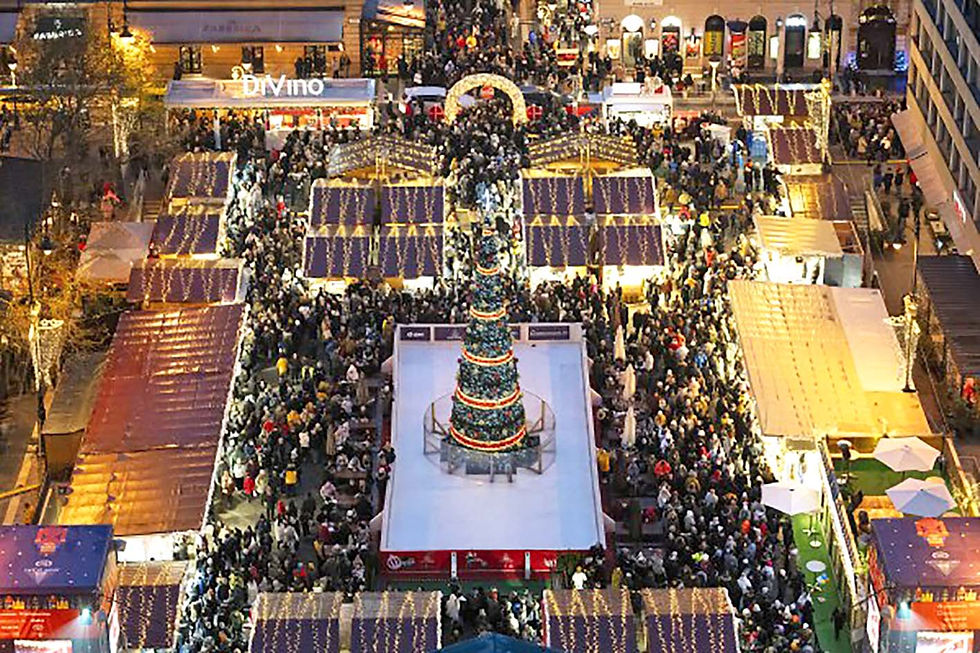
After wrapping up our Austrian adventure, we travelled by coach and checked into our central Budapest hotel. Everyone was excited—Budapest captivates you instantly. Without wasting time, we headed out for an evening walk to St Stephen’s Basilica Christmas Market, often voted the best in Europe.

It was magical—twinkling lights, wooden stalls, Christmas music, and the basilica standing like a silent guardian. We loved it so much we promised to return the next day—and we did!


We also explored the lively Vörösmarty Square Christmas Market, Budapest’s oldest. Another highlight was the 3D light show at St Stephen’s Basilica, which made the basilica come alive. Hungry from all the walking, we treated ourselves to the famous Hungarian chimney cake (Kürtőskalács) before stopping for photos at the majestic Parliament building.


Finally, a peaceful walk along the Danube brought us back to our hotel, our tired feet reminding us that Budapest is a city best explored slowly and lovingly.


Night on the Danube

The next morning, despite the cold, we visited Budapest’s iconic thermal baths. Stepping into the steaming pools while the chilly air brushed our faces felt surreal—just the winter magic we needed. Relaxing and believed to have medicinal benefits, it was easy to see why locals love them.


In the afternoon, we browsed the vibrant Christmas shops on Váci Street and enjoyed a delicious local lunch at the Central Market Hall, a historic space filled with handmade goods and traditional Hungarian food.


Our evening was the highlight: a Danube River cruise under a sky of Christmas lights. The illuminated Parliament, Buda Castle, and Chain Bridge shimmering like gold—none of us could stop smiling. It was one of those moments you tuck away in your heart forever.


Day Trip to Szentendre

The next day, we took a short trip to the charming riverside town of Szentendre. With its art galleries, craft shops, and colourful architecture, it felt like stepping into a Christmas storybook. We were delighted to find the Szentendre Christmas Village—a small, artistic market with handmade chocolates, pottery, candles, and local crafts.


Every corner felt warm and inviting. By evening, we returned to Budapest, grateful for the unexpected beauty this little town had shared with us.


That night, as I lay in bed, a thought crossed my mind: the more you explore the world, the more you realise how endless its wonders are.


Heartfelt Goodbye

Soon, it was time to say goodbye to Hungary. We returned to Vienna, spent a night at our hotel, relaxed at Café Sacher, and then made our way to Vienna International Airport for our flight back to India.


As I reflected on our journey, a few memories shone brightest: Rathausplatz and Schönbrunn in Vienna; the Cathedral and Fortress markets in Salzburg; St Stephen’s Basilica and Vörösmarty Square in Budapest; the warm thermal baths; the twinkling Christmas trams; and the sweet tradition of “Jézuska” (Baby Jesus) bringing gifts on Christmas Eve.


As a Maharashtrian girl raised in a Hindu family, Christmas wasn’t something I grew up celebrating. Yet I always wished to experience its true essence. Working as a tour leader and travelling with curious, enthusiastic people has turned that quiet wish into a beautiful reality—again and again.


May this journey continue—and may you join me on the next chapter of Europe’s magical Christmas trail!


(The writer is a tourism professional and runs a company, Global Voyages. She could be contacted at goglobalvoyages@gmail.com. Views personal.)



Comments


bottom of page