

Corruption and the Cost of Truth: The Men Who Framed Col. Purohit
A multi-part investigation into how the 2008 Malegaon blasts was turned into a political weapon, a narrative war and a cover for deeper conspiracies involving India’s most wanted fugitive and the Maoist underground.
The Malegaon Files - Part 4
From the Mumbai underworld to men in uniform, the Malegaon case reveals how India’s terror investigations were consumed by political rot and institutional betrayal.
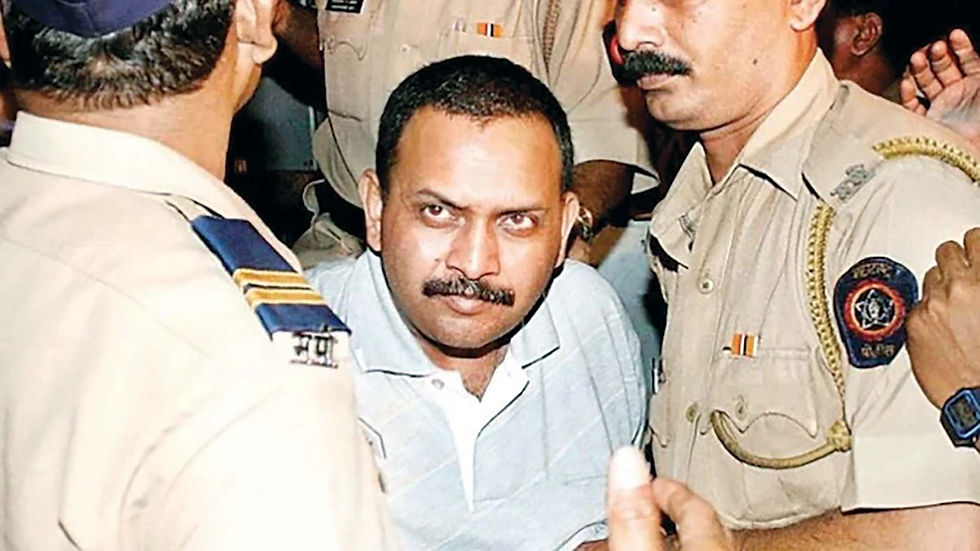
With last week’s acquittal of Lieutenant Colonel Prasad Purohit and others in the 2008 Malegaon blast case, a long and deliberately muddied chapter in India’s counter-terrorism saga finally appears to have reached closure. Yet the ordeal Lt. Col. Purohit endured still stands as one of the most egregious abuses of intelligence and policing power in recent memory. His story lays bare a disturbing matrix of concocted evidence, manipulated forensic reports and a nexus of compromised officials who, shielded by political patronage, appeared not just intent on framing him but on erasing him altogether.
One of the murkiest elements in this saga centres around a man named Shekhar Bagde. In 2008, Bagde was a little-known Assistant Police Inspector (API) in Maharashtra’s Anti-Terrorism Squad (ATS). Today, he is an Assistant Commissioner in Thane Police, rubbing shoulders with the likes of Mumbai’s ‘encounter specialists’ - officers such as Daya Nayak, Pradeep Sharma and the late Vijay Salaskar, who became notorious for their theatrical operations, and whose reputations oscillated between heroic vigilantism and institutionalised criminality.
According to multiple sources within India’s National Investigation Agency (NIA), Bagde was the one who physically planted the RDX (military-grade explosive) inside the Nashik home of Sudhakar Chaturvedi, a Military Intelligence (MI) informer. That bomb would be cited as primary evidence in the framing of Col. Purohit and others in the Malegaon case. The question that investigators and observers have asked ever since is where did Bagde get that RDX?
The answer, if true, is astonishing. NIA officials now allege that the RDX Bagde used came not from any contemporary source but from the very stockpile used in the 1993 Mumbai bomb blasts, one of the deadliest terror attacks in India’s history. That explosives from that infamous operation, orchestrated by underworld don Dawood Ibrahim and his Pakistani handlers, were still available to local law enforcement agencies years later is damning in itself. That it may have been deployed by those same agencies to frame Indian Army officers marks an even deeper rot.
Yet, far from being disciplined or dismissed, Bagde appears to have prospered. His career trajectory mirrors that of many controversial police officers in Maharashtra, who, regardless of scandals, have gone on to amass considerable power and wealth. Bagde was reportedly caught red-handed on October 3, 2008, while planting RDX at Chaturvedi’s residence. The incident, if properly prosecuted, could have dismantled the entire narrative of “saffron terror” and exonerated Purohit from the start. Instead, it was hushed up.
Crucially, the forensic analysis of that RDX and of multiple blasts in 2006 and 2008 was consistently routed through one man: Dr. Subhash Madhukar Bakre, a forensic expert with a curious history. In nearly every high-profile blast case in Maharashtra during that period, Bakre appeared on the scene, regardless of jurisdiction. That was no coincidence. As insiders later revealed, senior ATS officers like ACP Mohan Kulkarni bypassed the standard chain of command and wrote directly to Bakre, effectively handpicking a forensic specialist to tailor reports as required.
Such procedural irregularities point to a broader pattern of fabrication. The correct forensic protocol demands that any such request be routed to the Director of the Forensic Science Laboratory, who then assigns the case. Instead, Bakre was summoned personally, a practice that undermined both the independence and the credibility of forensic investigations. According to whistleblowers, Bakre routinely produced findings that aligned with ATS narratives, no matter how implausible.
Meanwhile, Bagde’s rise within the force seemed impervious to public criticism or internal scrutiny. He is now reportedly a member of Maharashtra’s notorious ‘100 Crore Club’ - a term coined during a separate corruption scandal involving former Home Minister Anil Deshmukh and the now-suspended API Sachin Vaze. The phrase refers to the practice of systematic extortion by senior police officials, each of whom allegedly collected or laundered Rs. 100 crore or more while in service.
Multiple political leaders have accused Bagde of operating far outside the law. Nationalist Congress Party (NCP) leader and current Deputy Chief Minister Ajit Pawar once held a press conference detailing Bagde’s alleged assets: a three-storey commercial building in Nashik, luxury flats in Thane and Navi Mumbai, properties in his father’s and brother’s names, agricultural land in Igatpuri, and even a food mall near Khalapur on the Mumbai-Pune Expressway.
Despite these explosive allegations, no action has been taken against him. Part of the reason, insiders suggest, is that Bagde has cultivated allies across political parties. Though named and shamed by both Ajit Pawar and NCP (SP) leader Jitendra Awhad, Bagde was reportedly close to senior NCP leader and former minister Nawab Malik, who himself has faced serious allegations involving the underworld. Malik’s personal assistant is said to be Bagde’s brother. Their joint real estate holdings and the use of a shared chartered accountant to launder black money underscore the deep fusion of crime, politics and policing in this case.
Even the erstwhile Mahayuti government that was led by Eknath Shinde had appeared unwilling to touch Bagde. His proximity to Shinde and his MP son, Shrikant, had granted him political impunity. It is a grim reflection of how institutional mechanisms meant to safeguard accountability have been co-opted by those in power.
The deceit, however, does not end there. When confronted by NIA officials during the re-investigation of the Malegaon blast case, Bagde attempted a sentimental defence. He claimed that, as the son of an army officer, he could never betray the armed forces by falsely implicating them. But even that turned out to be a lie. The NIA found no record of his father ever having served in the military. He was a civilian employee, not a commissioned officer. The claim was yet another invention – just like the RDX, the forensic reports and the confessions that were later retracted.
What emerges from this part of the story is not merely a tale of rogue officers and corrupt politicians. It is the story of how the institutions responsible for national security - the police, forensic labs, investigative agencies and even sections of the judiciary - can be hijacked to serve political goals. In this case, the goal was to fabricate a narrative of “Hindu terror,” thus diverting public scrutiny away from Islamist groups with transnational links and recasting the threat in terms more palatable to certain political ideologies.
Lt. Col. Purohit’s framing was a calibrated act. That it involved serving policemen, senior ATS officials, politically connected forensic experts and possibly even members of the political class, raises deeply uncomfortable questions.
The legacy of the Malegaon case is not just about one man’s lost years. It is about the erosion of public trust in the very apparatus that claims to protect the republic. As long as officers like Shekhar Bagde continue to operate with impunity, and as long as forensic experts like Subhash Bakre are allowed to tailor scientific evidence to political requirements, the potential for systemic injustice remains frighteningly real.
Justice may have finally arrived for Lt. Col. Purohit. But the architecture of impunity that ensnared him still stands, waiting for its next target.
(The writer, who goes by his nom de plume of Akela, is a senior investigative journalist based in Mumbai.)



Comments