

The Encounter That Wasn’t: How Col. Purohit Survived a Framed Death
A multi-part investigation into how the 2008 Malegaon blasts was turned into a political weapon, a narrative war and a cover for deeper conspiracies involving India’s most wanted fugitive and the Maoist underground.
The Malegaon Files - Part 3
An inside account of how Lt. Col. Prasad Purohit narrowly escaped a staged killing and what it reveals about the murky world of India’s anti-terror investigations.
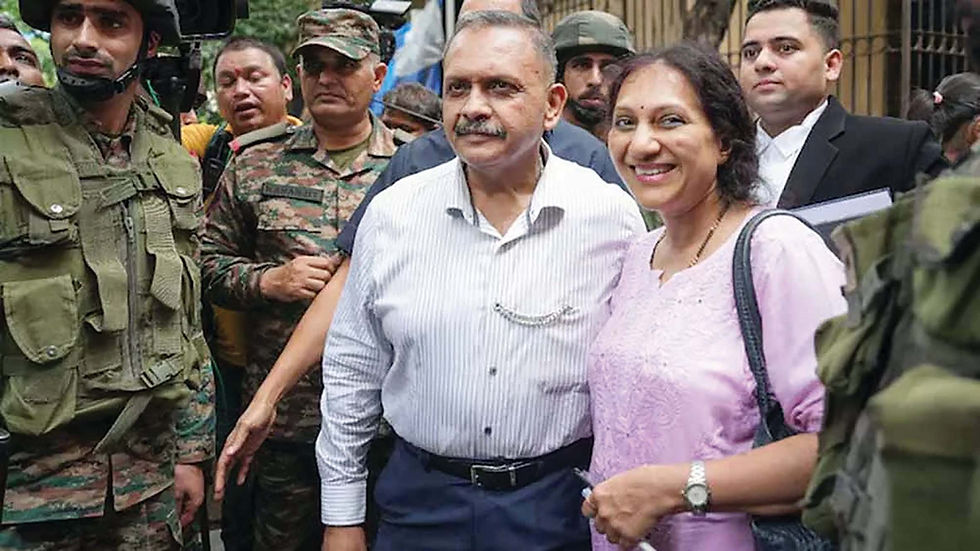
With the recent acquittal of Lieutenant Colonel Prasad Purohit and others in the 2008 Malegaon blast case, the smoke is finally beginning to clear from one of India’s longest and most politically fraught terror investigations. But Purohit’s painful odyssey remains one of the darkest chapters in India’s intelligence and policing establishments. It involves not just fabricated evidence, but a chilling attempt to eliminate him in a staged encounter.
On the night of October 29, 2008, the Maharashtra Anti-Terrorism Squad (ATS), aided by officers from Military Intelligence and the Intelligence Bureau (IB), transported Colonel Purohit from Mumbai airport to a secluded bungalow in Khandala, near Pune. He had just been spirited from his language course in Panchmarhi, Madhya Pradesh, under a forged movement order signed by his senior, Colonel R.K. Srivastava. The trap had been set; now came the violence.
Present in the Khandala bungalow were a cluster of high-ranking officials: Colonel Srivastava, IB officer Sanjay Garg, ATS chief Hemant Karkare, Additional Commissioner Param Bir Singh, an officer of the State Intelligence Department (SID), and six ATS constables. Purohit, a military man long used to navigating operational grey zones, had just been thrown into one far murkier.
A large television blared news of the case. “Breaking: ATS cracks Malegaon blast; Sadhvi Pragya, Lt Col Purohit among key accused.” Before he could digest the spectacle, Purohit was tied to a chair by two constables. Over the next five days, from October 29th until the evening of November 3rd, Purohit endured systematic torture. Senior officers including Karkare, Srivastava, and Singh interrogated him with brutal physicality to extract a pre-scripted confession.
The questions they demanded answers to were telling. Who were his sources in the intelligence world? Who was passing on information about Islamic preacher Zakir Naik, the Pakistani intelligence agency ISI, and the Students Islamic Movement of India (SIMI)? And above all, they insisted, he must confess to masterminding the Malegaon blast and implicate the Rashtriya Swayamsevak Sangh (RSS), Vishwa Hindu Parishad (VHP), and BJP MP Yogi Adityanath. That Purohit refused to admit to any of this only escalated the violence.
The ATS officers, already under public and political pressure to ‘solve’ the Malegaon case, appeared determined to extract a narrative that fit a political thesis: that Hindutva groups were engaged in “saffron terror” as a counterweight to Islamist militancy. Purohit, a military man with links to Hindutva groups but no proven involvement in the blast, became the ideal fall guy.
By November 3, something shifted. Karkare suddenly told Purohit: “The information about you was wrong. You have no role in the Malegaon blast. You are innocent. You can go now.” But after days of beatings, Purohit could barely walk. An old knee injury from an earlier operation in Kashmir had been aggravated, and he pleaded to be dropped at the nearest bus stop or railway station.
Hemant Karkare refused. “Your bag has wheels. You can pull it. The bus stop is only 500 metres away.” Then, curiously, state Director General of Police Anami Narayan Roy, known more for his political leanings than his policing acumen, entered the room. Roy, who styled himself ‘Roy’ to appear Bengali and less North Indian, was reportedly close to the ruling Nationalist Congress Party (NCP). When Purohit asked to be dropped to the State Police Headquarters in Colaba, Roy simply left the room.
By 9 p.m. that evening, the bungalow was largely empty. Purohit, battered and confused, was preparing to leave when a junior ATS officer entered the room. He quietly locked the door and folded his hands before him. “Sir, please don’t step out tonight. An encounter has been planned at the bus stop. ATS officers have already taken their positions.” The officer’s name is known to this writer.
That quiet warning saved Purohit’s life. But that is not where the plot ends.
The same day (November 3, 2008), another covert operation was underway in Deolali, near Nashik. There, Assistant Police Inspector (API) Shekhar Bagde, then with the ATS, allegedly planted RDX and explosives at the rented home of Sudhakar Chaturvedi, who would later be named as Accused No. 11 in the Malegaon case.
Bagde’s motive? According to sources familiar with the internal workings of Military Intelligence (MI), this was part of a broader attempt to frame not just Chaturvedi - an MI-paid informer - but to justify the planned killing of Colonel Purohit. The explosives allegedly recovered from Chaturvedi’s house were to serve as ‘evidence’ of Purohit’s terror link after his staged death in Khandala.
The facts are chilling. On the evening of November 3, Bagde contacted MI Subedar Keshav Karbhari Pawar (also known as KK Pawar), seeking Chaturvedi’s address. Suspicious, Pawar reported the request to Colonel Praveen Madhav Khanzode, who in turn informed MI headquarters. Once cleared, Pawar passed on the address, only for Bagde to later claim that he no longer needed it.
Sensing something amiss, Khanzode and Pawar rode a scooter to Chaturvedi’s residence. What they saw confirmed their worst fears. The door was slightly ajar. Pawar entered to find Bagde rubbing something on the floor beside a suspicious-looking bag. When challenged, Bagde folded his hands and begged: “Please don’t tell anyone. I will lose my job.”
Chaturvedi was soon arrested, and the explosives ‘recovered’ from his house were used to build the Malegaon case. What most reports ignored was that Chaturvedi was not an outsider. He was a registered informer with MI, his rent paid by the agency, and his assignment focused on political surveillance and anti-national activities.
The plot becomes darker still when one recalls that just hours earlier, ATS officers were preparing to kill Colonel Purohit in Khandala. Once dead, it would have been easy to link him to the explosives planted in Chaturvedi’s house. The two ends of the conspiracy - a dead colonel and a pliant patsy – could then neatly tie the Malegaon case into a package of ‘Hindutva terror’.
This was not an anomaly in Maharashtra’s policing landscape.
Consider the curious parallel with API Sachin Waze, a notorious officer with deep political links. Waze planted explosives in a car near industrialist Mukesh Ambani’s residence, then murdered the car’s owner, Mansukh Hiran, and tried to pass it off as suicide. It was only the intervention of the National Investigation Agency (NIA) that derailed the plan. Waze, like Bagde, enjoyed the patronage of NCP heavyweights, including former Home Minister Anil Deshmukh.
Bagde too had his political protectors. Then closely associated with current Deputy Chief Minister Eknath Shinde, he had a reputation for impunity. While posted as Senior Inspector in Manpada, Dombivli, Bagde once killed a young man inside his cabin in front of a complainant. The case went nowhere.
In that context, the alleged effort to kill Purohit and pin the crime on a fellow MI informer appears less like a rogue operation and more like a sanctioned campaign. A campaign that extended into the manipulation of evidence, abuse of military and civilian authority, and the use of India’s terror laws to settle ideological and political scores.
What saved Colonel Purohit in 2008 was not just one low-ranking officer’s guilty conscience, but the vigilance of Military Intelligence. The warnings, the scooter ride, the confrontation with Bagde - each helped unravel a chilling tale of institutional betrayal.
But while the courts may have acquitted Purohit and others, the deeper questions remain unanswered. How many more officers were complicit in shaping a terror narrative for political gain? How many informers like Chaturvedi were thrown to the wolves to prop up a headline?
(The writer, who goes by his nom de plume of Akela, is a senior investigative journalist based in Mumbai)



Comments