

Dominoes of Discontent
- Commodore S.L. Deshmukh

- Sep 15, 2025
- 4 min read
From Dhaka to Kathmandu, the rising shadow of foreign meddling in South Asia is compelling India to face new tests of resilience.
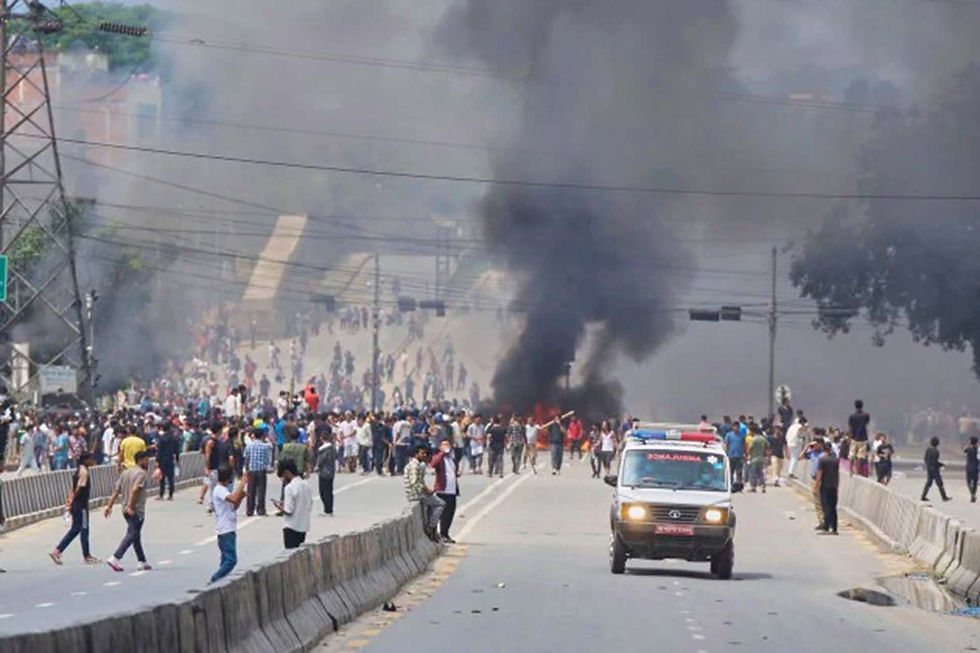
When governments fall in quick succession, amid protests, conspiracies and foreign machinations, the presence of a hidden wrecking ball becomes obvious. The political upheavals in first Bangladesh and now Nepal point to a broader regional instability that India cannot afford to ignore. While superficially different, both instances share striking similarities with stark implications for India’s security and diplomatic posture.
‘Regime change’ at its core involves replacing one government with another. Historically, this has occurred through revolution, military coups, civil wars and more insidiously, via foreign intervention. The Cold War offers many examples, from the Anglo-American-engineered Operation Ajax in 1953, which ousted Iran’s Prime Minister Mohammed Mossadegh in favour of the Shah, to France’s transition from its Fourth to Fifth Republic in 1958 spurred by military intervention. More recently, August 2024 and September 2025 witnessed regime changes in Bangladesh and Nepal respectively.
External Puppetry
Bangladesh’s political shift reads like a textbook case of external interference. Once a close partner of the United States, Bangladesh’s relations with Washington soured over the past decade. Tensions culminated in 2021 when the US imposed sanctions on several high-ranking officials of Bangladesh’s Rapid Action Battalion, accusing them of human rights abuses. The real flashpoint, however, was Prime Minister Sheikh Hasina’s persistent refusal to host a US air force base on St. Martin Island, a strategic location in the Bay of Bengal.
What followed was a systematic and well-orchestrated campaign to undermine Hasina’s government. Initially, protests were staged by ostensibly disaffected youth and students citing unemployment, inflation and poor governance. These soon morphed into sustained agitation. The parallels with Nepal’s Gen Z protests are hard to miss. Predictably, these protests culminated in Hasina’s ouster, replaced by Muhammad Yunus, widely seen as a US-backed interim leader.
Today, Bangladesh’s political landscape is mired in uncertainty. While China and Türkiye seem poised to gain influence, India’s strategic position has suffered blows both in terms of bilateral relations and national security. Dhaka’s historical ties with India, rooted in shared culture and geography, now seem increasingly tenuous.
Gen Z Surge
Nepal’s own political crisis was brewing for some time, but the Gen Z protests appear to have been the tipping point. While ostensibly against corruption, nepotism and restrictions on social media, these were in fact the culmination of a series of earlier disturbances, namely pro-monarchy demonstrations in February, teachers’ strikes in April, and growing public disillusionment.
What makes Nepal particularly alarming is the speed and violence of the unrest. Observers suggest they were scripted by actors beyond Nepal’s borders, echoing the Bangladesh experience. The fall of KP Sharma Oli’s government was less a popular mandate than a carefully staged political theatre.
In a move of limited optimism, former Chief Justice Sushila Karki was appointed interim head of state, under army consultation with protest leaders. Yet, the future remains opaque. China’s rising influence in Kathmandu, long a strategic concern for India and the US, now appears to have gained an additional edge.
For Beijing, Nepal represents more than a neighbour. It is a buffer state and a gateway for influence in the Himalayas. Nepal’s strategic location enables China to exert pressure on India, particularly given the Tibet factor. Meanwhile, it provides Islamabad with a convenient platform to foment anti-India activities. For India, this comes as a triple whammy. What do these two crises teach New Delhi? First, the neighbourhood is no longer stable. Regimes are toppling like pins in a bowling alley, replaced by others whose longevity or allegiance remain uncertain. The emerging pattern is one of deep-state agents, backed by foreign powers, using popular discontent as a cover to install puppet governments.
India’s response must be measured yet decisive. The government of the day should resist the temptation to suppress protests with brute force. Heavy-handed crackdowns play directly into the hands of these covert regime-change efforts. The antidote lies in good governance while maintaining a strong, responsive connection with the citizenry.
Moreover, New Delhi must nurture grassroots leaders and party workers who are attuned to local realities. Both Bangladesh and Nepal failed in this respect; their political parties became top-down structures, isolated from the people resulting in a vacuum easily exploited by external and internal agents of change.
Power should not be overly centralized. Decentralization of authority, effective local governance and strong public institutions are India’s best bulwark against manufactured unrest. After all, India’s greatest asset remains its people. Unlike its neighbours, where governments have changed abruptly, Indian democracy has proven resilient as evidenced by regular elections and peaceful transitions of power.
However, the Indian government must not be complacent. The US’s dissatisfaction with India, China’s hidden antagonism, and the active role of fundamentalist networks in fomenting unrest represent threats that cannot be underestimated. These forces will seek to undermine India’s democratic process, not through the ballot box, but through the backdoor.
This is a time for prudence, not reactionary politics. India must strengthen its institutions, double down on social welfare policies, and remain vigilant in its border regions. Its ability to resist these insidious attempts will be determined by the depth of its democratic ethos and the connection between the state and its citizens.
The neighbourhood is restless. And India’s best defence is to govern well, remain close to its people and not fall prey to provocations. The stakes are too high for anything less.
(The author is a retired Naval Aviation Officer and a defence and geopolitical analyst. Views personal.)


Comments