

Faith and Fog
A scuffle at the Sangam reveals how Uttar Pradesh’s politics struggles to manage mass devotion without turning it into a contest of power.
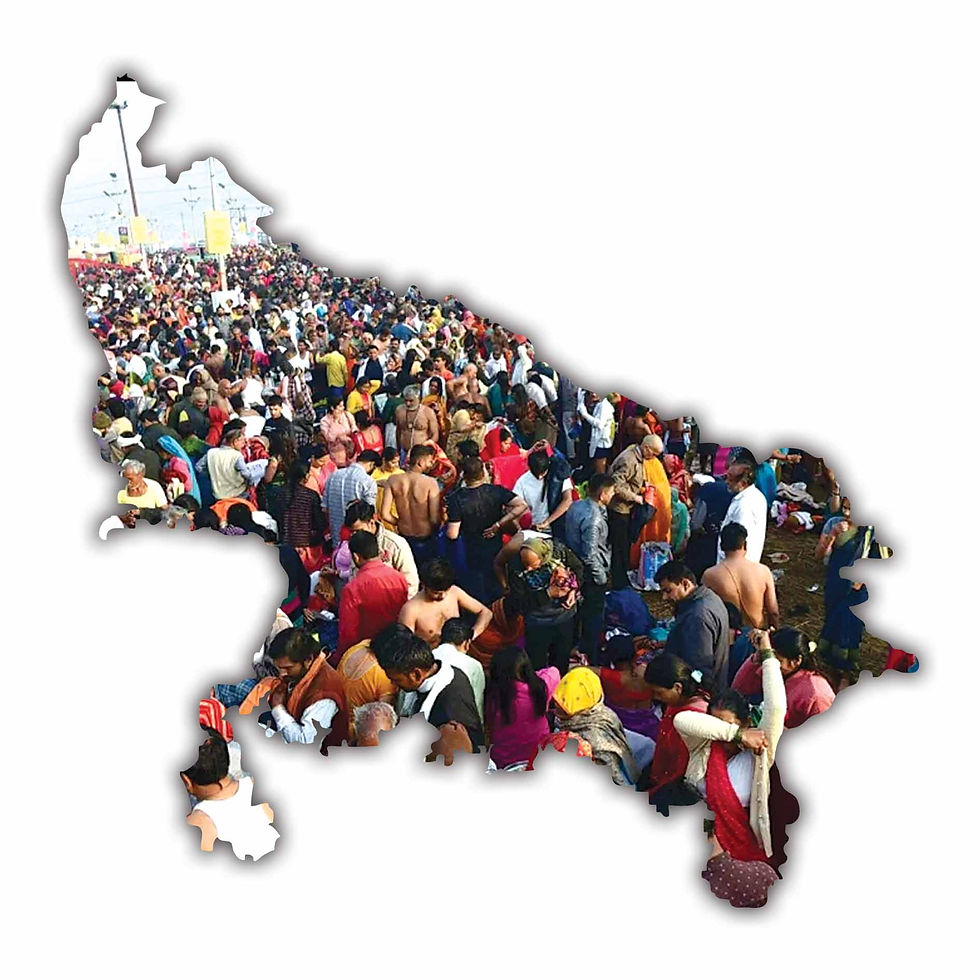
The Magh Mela, a part rival to the Kumbh, once again tested Uttar Pradesh’s ability to choreograph belief on a civilisational scale. As more than 4.5 crore devotees recently converged on the Sangam for Mauni Amavasya, an exercise in logistical endurance turned into a political flashpoint after a prominent seer was stopped by the police.
Opposition leaders, otherwise infamous for their disdain of Hinduism, meanwhile rushed in to scent sacrilege.
The seer in question, Jyotirpeeth Shankaracharya Swami Avimukteshwaranand Saraswati, arrived with a large entourage seeking to proceed to the Sangam for the ritual bath. Police officials say he attempted to breach a barricade near Bridge Number 2 without prior permission, accompanied by 200–250 followers, at a time when the ghats were already under crushing pressure. He was stopped. He returned without taking the dip. A few minutes of disruption were enough to ignite a day-long political storm.
Former Chief Minister Akhilesh Yadav, the leader of the Samajwadi Party, not otherwise known for championing Hindu practices, circulated videos of the episode and demanded a probe, declaring the ‘mistreatment’ of saints unpardonable. Draping himself in the language of continuity and custom, he lamented the disruption of the centuries-old tradition of the Shahi Snan - an inheritance he rarely invokes except in this case when it serves to embarrass the Yogi Adityanath-led BJP government.
The police, meanwhile, insisted that safety, not status, was the governing principle. With tens of millions funnelled through a limited stretch of riverbank, even symbolic breaches can trigger physical danger. Officials pointed to the scale of preparations: 800 hectares divided into seven sectors; more than 25,000 toilets; 3,500 sanitation workers; 10,000 police personnel; civil defence volunteers; reflective tapes on poles; bike-taxis and golf carts; flower petals showered from helicopters on the Chief Minister’s instructions.
Managing a religious congregation of this magnitude is an administrative feat bordering on the impossible. The Uttar Pradesh government has, largely, prevented major disasters so far except for the stampeded at the Maha Kumbh. But Hindu religious authority is not merely another stakeholder to be processed through barricades and permits. In a polity where religion is central to political legitimacy, the optics of a Shankaracharya being halted by uniformed police are bound to resonate far beyond the bridge where it occurred.
India’s modern state has long oscillated between reverence and regulation when it comes to mass faith. Colonial administrators fretted over pilgrim taxes and crowd control; post-Independence governments inherited both the crowds and the anxiety. What has changed under the BJP is the explicit fusion of religious symbolism with political authority. Chief Minister Yogi Adityanath is himself a saffron-robed monk. The government’s claim to cultural stewardship therefore raises expectations of seamless deference to religious figures that sometimes collide with the realities of crowd science and risk management.
Akhilesh Yadav’s intervention, meanwhile, is less about the sanctity of saints than the sanctity of political opportunity. The Samajwadi Party has long accused the BJP of hollowing out Hindu tradition in favour of spectacle and control. By casting the incident as an insult to Sanatani custom, he seeks to prise open a space in what is otherwise the BJP’s most secure ideological territory.
The deeper problem lies in the blurred hierarchy at events like the Magh Mela. Who, precisely, has the right of way: the anonymous devotee who has walked for days, or the seer whose authority is symbolic but whose following magnifies risk?
Uttar Pradesh’s government would do well to recognise that order alone is not legitimacy. Clear protocols, transparently communicated to religious leaders well in advance, would reduce the scope for confrontation. Equally, seers who command large followings must acknowledge that devotion without discipline can turn lethal. The Sangam is not just a site of salvation but a potentially lethal bottleneck.
In the end, Mauni Amavasya passed without tragedy, which is no small achievement. But the episode exposed a familiar paradox that a state government strong enough to marshal millions remains curiously fragile in the face of symbolism.


Comments