top of page

By:

Abhijit Mulye

21 August 2024 at 11:29:11 am

The Unequal Cousins

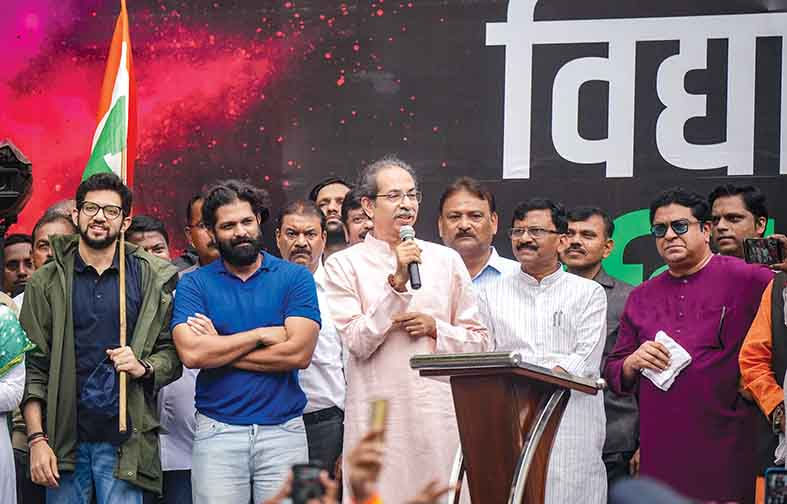
Raj Thackeray’s ‘sacrifice’ saved Shiv Sena (UBT) but sank the MNS Mumbai: In the volatile theatre of Maharashtra politics, the long-awaited reunion of the Thackeray cousins on the campaign trail was supposed to be the masterstroke that reclaimed Mumbai. The results of the Brihanmumbai Municipal Corporation (BMC) elections, however, tell a story of tragic asymmetry. While the alliance has successfully helped the Shiv Sena (UBT) stem the saffron tide and regain lost ground, it has left Raj...

The Unequal Cousins

Raj Thackeray’s ‘sacrifice’ saved Shiv Sena (UBT) but sank the MNS Mumbai: In the volatile theatre of Maharashtra politics, the long-awaited reunion of the Thackeray cousins on the campaign trail was supposed to be the masterstroke that reclaimed Mumbai. The results of the Brihanmumbai Municipal Corporation (BMC) elections, however, tell a story of tragic asymmetry. While the alliance has successfully helped the Shiv Sena (UBT) stem the saffron tide and regain lost ground, it has left Raj Thackeray’s Maharashtra Navnirman Sena (MNS) staring at an existential crisis. The final tally reveals a brutal reality for the MNS - Raj Thackeray played the role of the savior for his cousin, but in the process, he may have become the sole loser of the 2026 mandate. The worse part is that the Shiv Sena (UBT) is reluctant to accept this and is blaming Raj for the poor performance of his party leading to the defeat. A granular analysis of the ward-wise voting patterns exposes the fundamental flaw in this tactical alliance. The vote transfer, the holy grail of any coalition, operated strictly on a one-way street. Data suggests that the traditional MNS voter—often young, aggressive, and driven by regional pride—heeded Raj Thackeray’s call and transferred their votes to Shiv Sena (UBT) candidates in wards where the MNS did not contest. This consolidation was critical in helping the UBT hold its fortresses against the BJP's "Infra Man" juggernaut. However, the favor was not returned. In seats allocated to the MNS, the traditional Shiv Sena (UBT) voter appeared hesitant to back the "Engine" (MNS symbol). Whether due to lingering historical bitterness or a lack of instructions from the local UBT leadership, the "Torch" (UBT symbol) voters did not gravitate toward Raj’s candidates. The result? The UBT survived, while the MNS candidates were left stranded. ‘Second Fiddle’ Perhaps the most poignant aspect of this election was the shift in the personal dynamic between the Thackeray brothers. Decades ago, they parted ways over a bitter dispute regarding who would control the party helm. Raj, refusing to work under Uddhav, formed the MNS to chart his own path. Yet, in 2026, the wheel seems to have come full circle. By agreeing to contest a considerably lower number of seats and focusing his energy on the broader alliance narrative, Raj Thackeray tacitly accepted the role of "second fiddle." It was a pragmatic gamble to save the "Thackeray" brand from total erasure by the BJP-Shinde combine. While the brand survived, it is Uddhav who holds the equity, while Raj has been left with the debt. Charisma as a Charity Throughout the campaign, Raj Thackeray’s rallies were, as always, electric. His fiery oratory and charismatic presence drew massive crowds, a sharp contrast to the more somber tone of the UBT leadership. Ironically, this charisma served as a force multiplier not for his own party, but for his cousin’s. Raj acted as the star campaigner who energised the anti-BJP vote bank. He successfully articulated the anger against the "Delhi-centric" politics he accuses the BJP of fostering. But when the dust settled, the seats were won by UBT candidates who rode the wave Raj helped create. The MNS chief provided the wind for the sails, but the ship that docked in the BMC was captained by Uddhav. ‘Marathi Asmita’ Stung by the results and the realisation of the unequal exchange, Raj Thackeray took to social media shortly after the counting concluded. In an emotive post, he avoided blaming the alliance partner but instead pivoted back to his ideological roots. Urging his followers to "stick to the issue of Marathi Manoos and Marathi Asmita (pride)," Raj signaled a retreat to the core identity politics that birthed the MNS. It was a somber appeal, stripped of the bravado of the campaign, hinting at a leader who knows he must now rebuild from the rubble. The 2026 BMC election will be remembered as the moment Raj Thackeray proved he could be a kingmaker, even if it meant crowning the rival he once despised. He provided the timely help that allowed the Shiv Sena (UBT) to live to fight another day. But in the ruthless arithmetic of democracy, where moral victories count for little, the MNS stands isolated—a party that gave everything to the alliance and received nothing in return. Ironically, there are people within the UBT who still don’t want to accept this and on the contrary blame Raj Thackeray for dismal performance of the MNS, which they argue, derailed the UBT arithmetic. They state that had the MNS performed any better, the results would have been much better for the UBT.

‘Green’ oases amid ‘Saffron’ surge

AIMIM and ISLAM parties rock in civic polls

Mumbai: Amid Maharashtra’s sweeping saffron surge, a counter-current has quietly but decisively come to the fore – in the form of a fledgling Indian Secular Largest Assembly of Maharashtra (ISLAM) Party and the All India Majlis-e-Ittehadul Muslimeen (AIMIM).


Shocking punters and pundits, both parties with a Muslim base have etched striking footprints in the elections to 29 municipal corporations, marking a dawn of reshaping minority politics in the state.


Interestingly, a total of 29 Muslim candidates are elected to the BMC, including Congress (14), AIMIM (8), SS (UBT)’s 3, SP and NCP (2 each).


‘Kite’ Soars

For the 99-year-old AIMIM, the election is a milestone as the party crossed the 125-seat mark across Maharashtra, registering strong gains in urban centres where it was once scorned, as the Muslims search for a new ‘messiah’.


In Chhatrapati Sambhajinagar, it won 33 of 115 wards, improving from 24 in 2017, and presenting itself as a formidable civic force working for the commoners, as the ‘Kite’ (poll symbol) climbed higher.


More significantly, AIMIM will make a thundering entry to the Brihanmumbai Municipal Corporation (BMC) with 8 seats, including 2 non-Muslims, in the 227-member house – up from just 2 wins in 2017 -  considered a big leap of faith in India’s financial capital.


This gladdened the hearts of AIMIM President, Barrister Asasuddin Owaisi, state chief Imtiaz Jaleel and Spokesperson Waris Pathan termed their party’s performance as a ‘vindication’ of their hard work and acceptance among the Muslims and minorities, and a slap for those who dismiss them as BJP’s B-Team.


ISLAM Bulldozes

The minority-dominated Malegaon delivered a major political earthquake as the 15-month-old ISLAM Party emerged as the single largest in Malegaon Municipal Corporation, capping 35 of 84 seats; the AIMIM bagged 21.


Celebrating the mandate by zooming around in the ‘Autorickshaw’ (party symbol), ISLAM Party President Aasif Shaikh Rasheed, struck a conciliatory yet confident tone. Staking claim to the post of Mayor as the largest party, he kept a window open for suitable adjustments “in the interest of unity and development.”


The AIMIM-ISLAM parties’ performance indicates a quiet political churning – Muslim voters feeling betrayed by all parties are now examining viable options - parties or leaders who promise them ‘salvation’.


With AIMIM’s 21 seats, the ISLAM Party and its ally SP (5) is hoping to install its Mayor, as the Mahayuti ally Shiv Sena managed 18 seats; Congress 3; and BJP a paltry 2.


Rasheed’s own political journey has been quite a whirlwind ride - from a Congress MLA to NCP leader, then an independent candidate, and now heading the ISLAM Party – with hopes to end Malegaon’s anxious search for credible local Muslim leadership.


SP ‘Cycle’ punctured

Once trusted as a Muslim-Dalit political platform in Maharashtra, the Uttar Pradesh-based SP is faltering with a decline in its overall performance.


This has rattled the state SP chief Abu Asim Azmi, a 4-time MLA, as the AIMIM bagged 7 seats in his backyard of Mankhurd-Govandi.


Comments


bottom of page