

High traffic volumes, strong punctuality

Airport handles 148 ATMs; 20,500 passengers daily
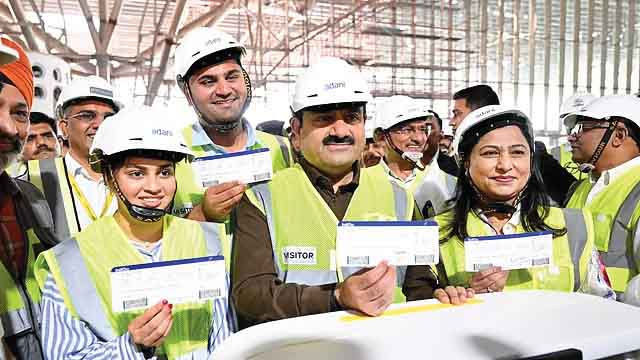
Mumbai: The Navi Mumbai International Airport (NMIA) has swiftly established itself as a high-capacity aviation hub, with airport officials highlighting sustained growth in passenger traffic alongside stable operational performance since its launch on December 25, 2025. The latest data indicates that the airport is currently handling more than 148 air traffic movements (ATMs), translating into approximately 20,500 passengers passing through the facility each day. Of this, around 10,500 passengers are departures, reflecting robust outbound demand while maintaining a near-balanced arrival flow.
Officials pointed out that on May 6, 2026, the airport handled 27 arrivals and 45 departures, a distribution that reflects evolving airline scheduling strategies and slot optimization. The higher number of departures on the day also suggests that airlines are increasingly using NMIA as a base for outbound rotations, particularly during peak travel windows.
A key highlight of NMIA’s performance has been its operational reliability. According to airport officials, on-time arrival performance currently stands at 96.4 per cent, while on-time departures are recorded at 86.7 per cent. These figures are considered strong for an airport still in the early months of operation, especially as it continues to scale up both flight movements and passenger throughput. Officials attributed this consistency to efficient coordination between air traffic control, ground handling agencies and airline operators, as well as the deployment of modern infrastructure designed to handle higher traffic volumes with minimal disruption.
Growth Trajectory
Officials further noted that the airport is on a clear growth trajectory, with projections made in late April 2026 indicating that NMIA could soon handle nearly 50,000 passengers daily. This anticipated jump would represent more than a two-fold increase from current levels and is expected to be driven by a combination of factors, including route expansion by domestic and international carriers, increasing passenger preference for the new facility, and the gradual redistribution of traffic from the congested Chhatrapati Shivaji Maharaj International Airport.
The current scale of operations marks a sharp rise from the airport’s initial days. On its inaugural day, NMIA handled over 4,000 passengers and 48 flight movements, setting the stage for a phased but steady ramp-up. In the first five days of operations, between December 25 and December 30, 2025, the airport handled 26,021 passengers across 162 ATMs, reflecting encouraging early adoption by both airlines and passengers.
Officials said that the momentum gathered pace quickly in the following weeks. By early January 2026, within just 19 days of commencing operations, NMIA had already crossed the 100,000 passenger movement mark. This rapid accumulation of traffic was seen as a strong indicator of latent demand in the Mumbai Metropolitan Region and the immediate need for additional aviation capacity to supplement existing infrastructure.
Steady Increase
Beyond the raw numbers, officials emphasised that NMIA’s growth story is also about efficient traffic management and scalability. The steady increase in ATMs without a proportionate decline in punctuality suggests that the airport’s operational framework has been able to absorb rising volumes effectively. The high on-time arrival rate indicates streamlined airspace management and efficient landing sequences, while the relatively lower, but still strong, departure punctuality points to ongoing refinements in turnaround times and ground operations.
Officials also underscored that NMIA is gradually emerging as a preferred alternative for both passengers and airlines, owing to its modern facilities, reduced congestion and improved passenger handling capabilities. As airlines continue to expand their presence, the airport is expected to play a larger role in regional and national connectivity, easing pressure on existing infrastructure while supporting the growth of India’s aviation sector.
In cumulative terms, NMIA’s journey from handling just a few thousand passengers on its opening day to over 20,000 daily passengers within a matter of months reflects a steep and well-managed growth curve. Airport officials maintained that the combination of rising traffic, strong punctuality metrics and ambitious expansion projections positions NMIA as a transformative infrastructure project for the region.
As traffic levels continue to climb toward the projected 50,000 daily passengers, NMIA is not only reinforcing its role as Mumbai’s second airport but also redefining traffic distribution patterns across the metropolitan region. With continued operational fine-tuning and increasing airline participation, officials believe the airport is on track to become one of India’s key aviation hubs in the near future.


Comments