

Holy Retreat
The revocation of the land pooling scheme in Ujjain lays bare the limits of political authority.
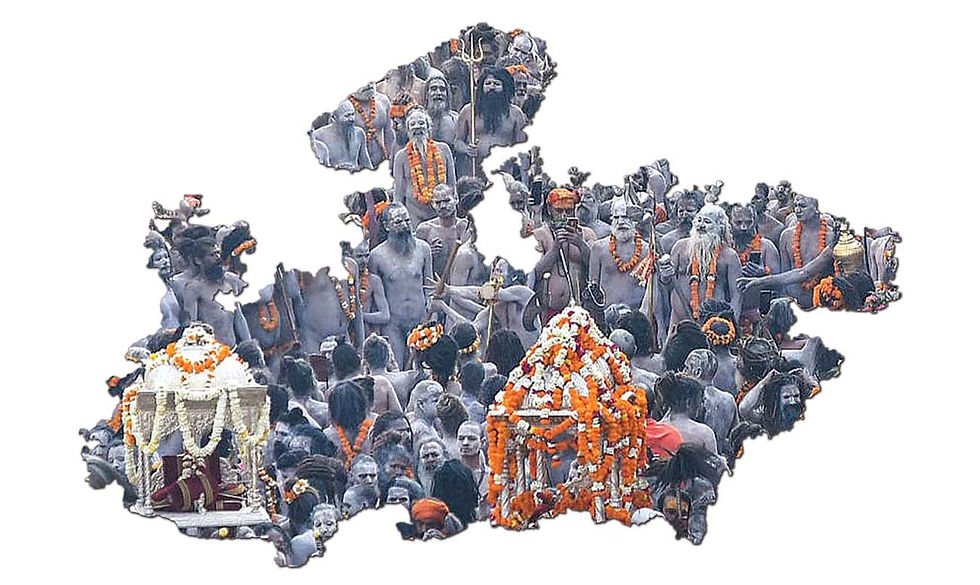
Few spectacles test the Indian state quite like the Kumbh Mela. It blends faith, logistics and politics on a civilisational scale. Yet in Ujjain, where the Simhastha Kumbh is due in 2028, the Madhya Pradesh government has discovered that even the most sanctified ambitions can founder on the stubborn realities of land, livelihood and consent.
This week the government quietly but decisively scrapped its land pooling scheme aimed at acquiring 2,378 hectares across 17 villages to build permanent infrastructure for the Simhastha. The move followed weeks of farmer mobilisation, threats of fresh agitation and more tellingly, dissent from within the ruling Bharatiya Janata Party (BJP) ranks.
The scheme, unveiled earlier this year, was ambitious to the point of hubris. Unlike previous Simhasthas, where farmland was temporarily acquired for a few months with compensation, the new plan envisaged a permanent Kumbh city. Roads, ashrams, hospitals, underground drainage, electricity networks and government buildings were to rise on what is now agricultural land. An estimated Rs. 2,000 crore would be spent to prepare for an expected footfall of over 12 crore pilgrims, almost double the turnout in 2016.
For Chief Minister Mohan Yadav, the proposal carried personal and political weight. As the MLA from Ujjain South, transforming the temple town into a year-round pilgrimage hub would have been a signature achievement. It would also have aligned neatly with the BJP’s broader strategy of marrying religious symbolism with visible infrastructure.
However, this has run into rough weather with between 5,000 and 8,000 farmer families standing to lose land that has sustained them for generations. Land pooling, with its promises of future development gains, may appeal in urbanising corridors. In sacred geography, where land is livelihood rather than asset class, it looks more like disguised expropriation.
Soon enough, tractor rallies rolled through Ujjain while meetings hardened into threats of indefinite strikes. The Bharatiya Kisan Sangh (BKS), not a habitual adversary of the BJP, given its RSS lineage, accused the government of betrayal. Its call for a “dera dalo, ghera dalo” agitation from December 26 is a warning shot from within the Sangh ecosystem itself.
The government attempted a familiar manoeuvre: tactical retreat disguised as clarification. On November 17 it amended the scheme, limiting compulsory acquisition to land needed for roads, water and sewage, while exempting other infrastructure. However, the farmers and the BKS saw through it, accusing the government of duplicity.
The final reversal in this episode has been scrapping the town development schemes entirely under the Town and Country Planning Act, which was alter framed as an act of “public interest.” In reality, it was an act of political triage. With state elections behind it but local anger simmering, the BJP chose containment over confrontation.
The episode exposes a deeper contradiction in India’s development politics. The state is increasingly eager to monumentalise religion by building corridors, plazas and permanent infrastructures around sites of worship. But faith-based urbanism often collides with rural India’s fragile social contract. Farmers may tolerate temporary disruption in the name of dharma. Permanent dispossession is another matter.
It also underlines the limits of ideological alignment. The BJP’s long-held assumption that farmer discontent can be managed through cultural affinity rather than economic justice has been repeatedly tested—from the repealed farm laws to localised agitations such as this one. When livelihoods are at stake, symbolism offers thin protection.


Comments