top of page

By:

Akhilesh Sinha

25 June 2025 at 2:53:54 pm

India's multi-align diplomacy triumphs

New Delhi: West Asia has transformed into a battlefield rained by fireballs. Seas or land, everywhere echoes the roar of cataclysmic explosions, flickering flames, and swirling smoke clouds. et amid such adversity, Indian ships boldly waving the Tricolour navigate the strait undeterred, entering the Arabian Sea. More remarkably, Iran has sealed its airspace to global flights but opened it for the safe evacuation of Indians.   This scene evokes Prime Minister Narendra Modi's memorable 2014...

India's multi-align diplomacy triumphs

New Delhi: West Asia has transformed into a battlefield rained by fireballs. Seas or land, everywhere echoes the roar of cataclysmic explosions, flickering flames, and swirling smoke clouds. et amid such adversity, Indian ships boldly waving the Tricolour navigate the strait undeterred, entering the Arabian Sea. More remarkably, Iran has sealed its airspace to global flights but opened it for the safe evacuation of Indians.   This scene evokes Prime Minister Narendra Modi's memorable 2014 interview. He stated that "there was a time when we counted waves from the shore; now the time has come to take the helm and plunge into the ocean ourselves."   In a world racing toward conflict, Modi has proven India's foreign policy ranks among the world's finest. Guided by 'Nation First' and prioritising Indian safety and interests, it steadfastly embodies  'Vasudhaiva Kutumbakam' , the world as one family.   Policy Shines Modi's foreign policy shines with such clarity and patience that even as war flames engulf West Asian nations, Indians studying and working there return home safe. In just 13 days, nearly 100,000 were evacuated from Gulf war zones, mostly by air, some via Armenia by road. PM Modi talked with Iran's President Masoud Pezeshkian to secure Iran's airspace for the safe evacuation of Indians, a privilege denied to any other nation. Additionally, clearance was granted for Indian ships carrying crude oil and LPG to pass safely through the Hormuz Strait. No other country's vessels are navigating these waters, except for those of Iran's ally, China. The same strategy worked in the Ukraine-Russia war: talks with both presidents ensured safe corridors, repatriating over 23,000 students and businessmen. Iran, Israel, or America, all know India deems terrorism or war unjustifiable at any cost. PM Modi amplified anti-terror campaigns from UN to global platforms, earning open support from many nations.   Global Powerhouse Bolstered by robust foreign policy and economic foresight, India emerges as a global powerhouse, undeterred by tariff hurdles. Modi's adept diplomacy yields notable successes. Contrast this with Nehru's era: wedded to Non-Aligned Movement, he watched NAM member China seize vast Ladakh territory in war. Today, Modi's government signals clearly, India honors friends, spares no foes. Abandoning non-alignment, it embraces multi-alignment: respecting sovereignties while prioritizing human welfare and progress. The world shifts from unipolar or bipolar to multipolar dynamics.   Modi's policy hallmark is that India seal defense deals like the S-400 and others with Russia yet sustains US friendship. America bestows Legion of Merit; Russia, its highest civilian honor, Order of St. Andrew the Apostle. India nurtures ties with Israel, Palestine, Iran via bilateral talks. Saudi Arabia stands shoulder-to-shoulder across fronts; UAE trade exceeds $80 billion. UN's top environment award, UNEP Champions of the Earth, graces India, unlike past when foreign nations campaigned against us on ecological pretexts.   This policy's triumph roots in economic empowerment. India now ranks the world's fourth-largest economy, poised for third in 1-2 years. The 2000s dubbed it 'fragile'; then-PM economist Dr. Manmohan Singh led. Yet  'Modinomics'  prevailed. As COVID crippled supply chains, recession loomed, inflation soared and growth plunged in developed countries,  Modinomics  made India the 'bright star.' Inflation stayed controlled, growth above 6.2 per cent. IMF Chief Economist Pierre-Olivier Gourinchas praised it, advising the world to learn from India.

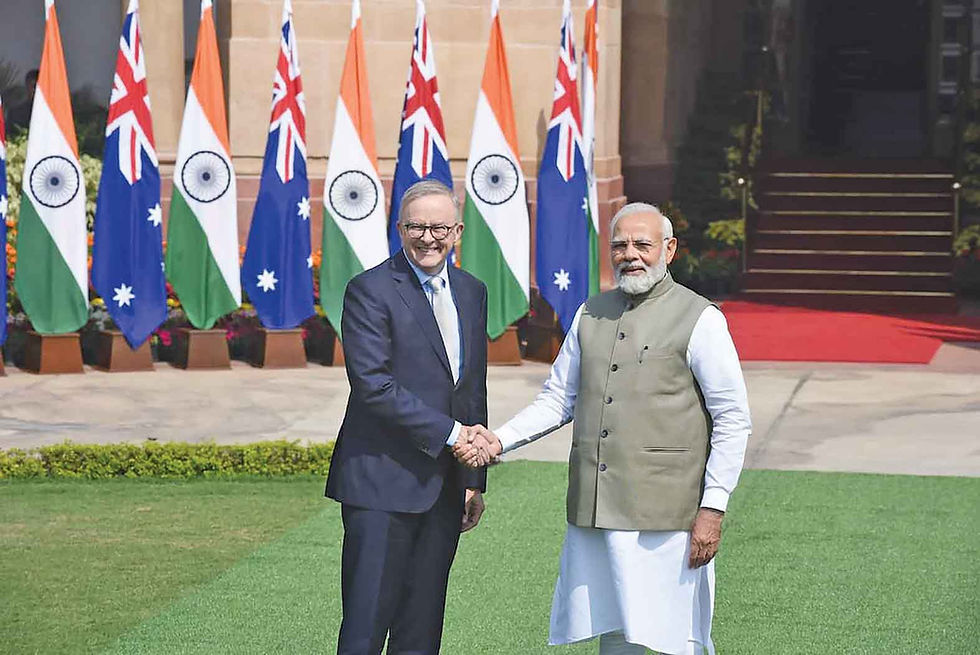
India's multi-align diplomacy triumphs

New Delhi: West Asia has transformed into a battlefield rained by fireballs. Seas or land, everywhere echoes the roar of cataclysmic explosions, flickering flames, and swirling smoke clouds. et amid such adversity, Indian ships boldly waving the Tricolour navigate the strait undeterred, entering the Arabian Sea. More remarkably, Iran has sealed its airspace to global flights but opened it for the safe evacuation of Indians.


This scene evokes Prime Minister Narendra Modi's memorable 2014 interview. He stated that "there was a time when we counted waves from the shore; now the time has come to take the helm and plunge into the ocean ourselves."


In a world racing toward conflict, Modi has proven India's foreign policy ranks among the world's finest. Guided by 'Nation First' and prioritising Indian safety and interests, it steadfastly embodies 'Vasudhaiva Kutumbakam', the world as one family.


Policy Shines

Modi's foreign policy shines with such clarity and patience that even as war flames engulf West Asian nations, Indians studying and working there return home safe. In just 13 days, nearly 100,000 were evacuated from Gulf war zones, mostly by air, some via Armenia by road. PM Modi talked with Iran's President Masoud Pezeshkian to secure Iran's airspace for the safe evacuation of Indians, a privilege denied to any other nation. Additionally, clearance was granted for Indian ships carrying crude oil and LPG to pass safely through the Hormuz Strait. No other country's vessels are navigating these waters, except for those of Iran's ally, China.

The same strategy worked in the Ukraine-Russia war: talks with both presidents ensured safe corridors, repatriating over 23,000 students and businessmen. Iran, Israel, or America, all know India deems terrorism or war unjustifiable at any cost. PM Modi amplified anti-terror campaigns from UN to global platforms, earning open support from many nations.


Global Powerhouse

Bolstered by robust foreign policy and economic foresight, India emerges as a global powerhouse, undeterred by tariff hurdles. Modi's adept diplomacy yields notable successes. Contrast this with Nehru's era: wedded to Non-Aligned Movement, he watched NAM member China seize vast Ladakh territory in war. Today, Modi's government signals clearly, India honors friends, spares no foes. Abandoning non-alignment, it embraces multi-alignment: respecting sovereignties while prioritizing human welfare and progress. The world shifts from unipolar or bipolar to multipolar dynamics.


Modi's policy hallmark is that India seal defense deals like the S-400 and others with Russia yet sustains US friendship. America bestows Legion of Merit; Russia, its highest civilian honor, Order of St. Andrew the Apostle. India nurtures ties with Israel, Palestine, Iran via bilateral talks. Saudi Arabia stands shoulder-to-shoulder across fronts; UAE trade exceeds $80 billion. UN's top environment award, UNEP Champions of the Earth, graces India, unlike past when foreign nations campaigned against us on ecological pretexts.


This policy's triumph roots in economic empowerment. India now ranks the world's fourth-largest economy, poised for third in 1-2 years. The 2000s dubbed it 'fragile'; then-PM economist Dr. Manmohan Singh led. Yet 'Modinomics' prevailed. As COVID crippled supply chains, recession loomed, inflation soared and growth plunged in developed countries, Modinomics made India the 'bright star.' Inflation stayed controlled, growth above 6.2 per cent. IMF Chief Economist Pierre-Olivier Gourinchas praised it, advising the world to learn from India.

Comments


bottom of page