top of page

By:

Akhilesh Sinha

25 June 2025 at 2:53:54 pm

Congress tries a ‘third’ hand

New Delhi: The BJP latest manoeuvre in elevating Nitin Nabin as the party’s national working president has had consequences in Maharashtra’s two biggest cities - Mumbai and Pune. The result has left the Congress party in a curiously ambivalent mood: quietly pleased by the opportunities created, yet wary of the turbulence ahead. In Maharashtra, the immediate beneficiary of the BJP’s move is Eknath Shinde’s Shiv Sena. The BJP’s organisational signal has strengthened its hand in the forthcoming...

Congress tries a ‘third’ hand

New Delhi: The BJP latest manoeuvre in elevating Nitin Nabin as the party’s national working president has had consequences in Maharashtra’s two biggest cities - Mumbai and Pune. The result has left the Congress party in a curiously ambivalent mood: quietly pleased by the opportunities created, yet wary of the turbulence ahead. In Maharashtra, the immediate beneficiary of the BJP’s move is Eknath Shinde’s Shiv Sena. The BJP’s organisational signal has strengthened its hand in the forthcoming elections to the BMC, Asia’s richest civic body, and in Pune, the state’s second city. For Shinde, whose legitimacy still rests on a contentious split with the party founded by Bal Thackeray, any reinforcement from the BJP’s formidable machine is welcome. For Uddhav Thackeray, who leads the rival Shiv Sena (UBT), the message is ominous. His party, once the natural custodian of Marathi pride in Mumbai, now faces the prospect of being squeezed between a BJP-backed Sena on one side and a revived Maharashtra Navnirman Sena (MNS) led by his cousin, Raj Thackeray, on the other. Shotgun Alliance That pressure has forced Thackeray into an awkward embrace with his estranged cousin. A reunion of the Thackeray clans, long rumoured and often aborted, has unsettled Thackeray’s MVA ally - the Congress. Signals from the party’s high command suggest a calculated distancing from Shiv Sena (UBT), particularly in Mumbai, where Congress leaders are exploring arrangements with smaller parties rather than committing to a Thackeray-led front. In Pune, the party’s pragmatism is even more pronounced. Quiet efforts are under way to entice Ajit Pawar’s NCP, currently aligned with the BJP, into a tactical understanding for the civic polls. Control of the municipal corporation, even without ideological harmony, is the immediate prize. For the embattled Congress, the civic polls offer a chance to do two things at once. First, by keeping a degree of separation from the Uddhav–Raj combine, it can strengthen its own organisational sinews, which have atrophied after years of playing junior partner. Secondly, it can allow the BJP–Shinde Sena and the Thackeray cousins to polarise the Marathi vote between them, leaving Congress to position itself as a ‘third pole.’ Such a strategy is particularly tempting in Mumbai. A tie-up with outfits like Prakash Ambedkar’s Vanchit Bahujan Aghadi (VBA) could help Congress consolidate minority, Dalit and tribal voters, constituencies it believes are more reliably mobilised without the ideological baggage of Thackeray’s Sena (UBT). Severing or loosening ties with Shiv Sena (UBT) would also simplify Congress’s messaging ahead of assembly elections elsewhere. In states such as West Bengal and Tamil Nadu, where polls loom next year, the party has historically preferred alliances that allow it to emphasise secular credentials and oppose the BJP without accommodating overtly Hindu nationalist partners. Mixed Signals The Congress’ internal signals, however, are mixed. When talk of a Thackeray reunion resurfaced, Maharashtra Congress leader Vijay Wadettiwar publicly welcomed it, arguing that Raj Thackeray’s limited but distinct vote share could help consolidate Marathi sentiment. Mumbai Congress chief Varsha Gaikwad was more circumspect, hinting that alliances with parties prone to street-level militancy deserved scrutiny. Wadettiwar swiftly clarified that decisions would rest with the party’s senior leadership, underscoring the centralised nature of Congress’s calculus. In Pune, meanwhile, senior leaders are reportedly engaged in discreet conversations with Ajit Pawar, whose defection from his uncle Sharad Pawar’s NCP last year still reverberates through state politics. The outline of a broader strategy is becoming visible. Congress appears content to let the BJP and Shinde’s Sena draw on non-Marathi and anti-dynasty voters, the Thackerays appeal to wounded Marathi pride while it quietly rebuilds among minorities and lower-caste groups. Mumbai Approach Mumbai’s demography lends some plausibility to this approach. Alongside its Marathi core, the city hosts millions of migrants from Uttar Pradesh, Bihar and Jharkhand, a constituency that has increasingly gravitated towards the BJP. Raj Thackeray’s strident rhetoric against North Indians, once electorally potent, now risks narrowing his appeal and complicating Uddhav Thackeray’s efforts to broaden his base. None of this guarantees success for Congress. Playing the ‘third pole’ is a delicate art. Yet, the Congress, struggling for survival, has few illusions about sweeping victories. Its aim, for now, is more modest – it is to survive, to remain relevant, and to exploit the cracks opened by its rivals’ rivalries. In Maharashtra’s civic chessboard, that may be advantage enough.

Maximum city braces for maximum governance

Asia’s richest civic body remains a critical pillar for the administration of Mumbai and its financial powerhouse

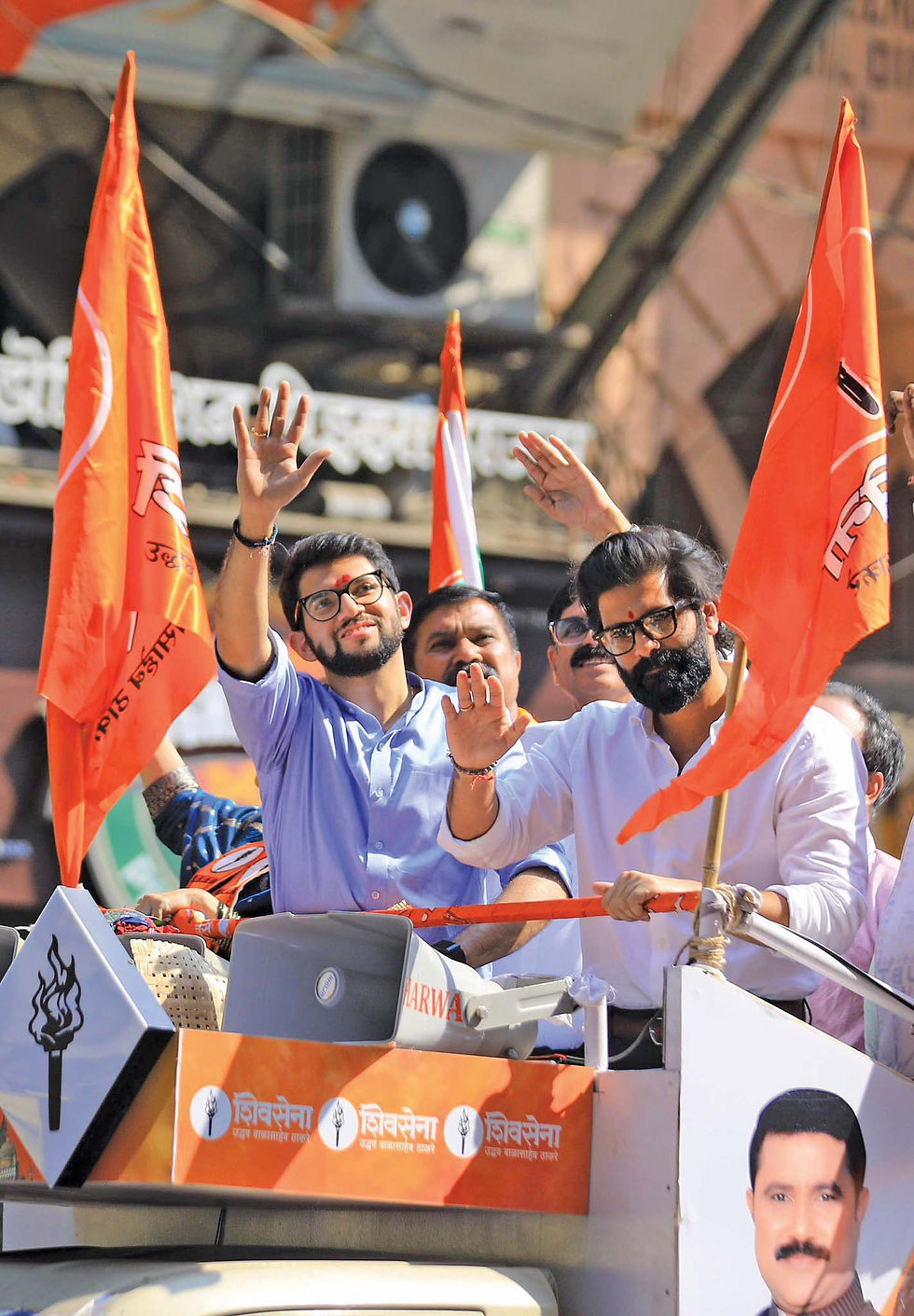
A man arranges scarves of political parties ahead of BMC elections, at a shop in Lalbaug, Mumbai, on Monday. | Pic: Bhushan Koyande

Mumbai: After a historic 45-month long tenure under an Administrator, Asia’s richest and India’s biggest civic body, the Brihanmumbai Municipal Corporation (BMC) is slated to return to democratic governance from January 2026.


This was only the second time in its 160-year-old history that BMC was governed by an Administrator – the first being for 13 months, from April 1984-May 1985. The last elected body was in power from 2017-2022.


As the countdown and the cacophony of the elections start, national attention is again riveted on the country’s commercial capital that makes billions and billionaires – though its streets may not be paved with ‘gold’, to borrow a phrase from the classic tale of ‘Dick Whittington and his Cat’.


Yet, the BMC remains a critical pillar for the administration of Mumbai and its financial powerhouse, enjoying a massive clout both domestically and internationally. It is virtually regarded as a ‘trophy’ for the party ruling it – since 1948 by the Congress with its allies and after 1985 by the (undivided) Shiv Sena, and later with its ex-ally, Bharatiya Janata Party (BJP).


The same groups, with different political permutations-combinations are now vying to grab the ‘key to the treasury’ – after eyeing it hungrily for nearly four years when the Administrator flaunted it. The BMC elects 227 Municipal Corporators, making it one of the largest civic corporations in the country.


Staggering Budget

After all, the BMC boasts of a staggering annual budget – almost Rs. 75,000-cr in 2025-2026, a 14 per cent hike over the previous fiscal – bigger than several states and higher than the combined budgets of many smaller states.


It is widely perceived that the group or party which controls the BMC’s coffers ultimately has a Big Voice at the state-level or even in Assembly elections.


These massive finances are collected from the city and its denizens through taxes and non-tax revenues, and more than half – around Rs 43,000-cr this year - is ploughed back to create world-class, often precedent-setting, infrastructure, public amenities and wide-ranging services.


Besides, it also saves in the form of accumulated reserves of over Rs 75,000-cr., which makes politicians drool, as the BMC serves nearly 1.50 cr. souls inhabiting it. Nearly 50 pc of the population is concentrated in some 2,400 congested slum pockets like Dharavi, to plush exclusive skyscrapers or a few in exclusive but iconic buildings like Antilia, and a few private bungalows dotting the city.


The public-oriented services provided by the BMC ranging from transportation (BEST), water supply, sanitation, public health, education, a roads network, gardens-playgrounds, et al, and through an Administrator, the state has been pulling the strings of the civic body as the elected representatives remained outside for long…


All eye and vie for the BMC pie

With so many plum pies up for grabs, the control of the richie-rich BMC is ranked as a ‘must item’ in the bucket-wish list of all political parties, either separately or jointly, albeit with the tokenism of a ‘Marathi Mayor’ thrown in to soothe the Maharashtrian majority population.


Even now, the main contenders for the BMC’s ‘gold key’ are Bharatiya Janata Party-Shiv Sena though the third ally Nationalist Congress Party is in a limbo; Congress, besides the Shiv Sena (UBT)-Maharashtra Navnirman Sena-Nationalist Congress Party (SP).


The Opposition Maha Vikas Aghadi (MVA) which contested the 2024 Lok Sabha elections (spectacularly) and the Assembly polls (miserably), may fight the polls in a different formation that could again prove trumps for the saffron-led alliance.


Mumbai ‘fast-tracks’ the future

Nailing the importance of the coastal metropolis, Maharashtra Minister for FDI Jaykumar Rawal said at the CII Mumbai International Summit-2025 today that Mumbai is a rare global city where capital, talent and ambition converge daily but still find room to grow.


“Mumbai does not wait for the future; it fast-tracks it and confidently invites the world to keep pace,” he said, underscoring the city’s role as a gateway for global trade, innovation and sustainable growth, as CII bigwigs like Rishi Kumar Bagla, Vaibhav Vohra, Vir S Advani, plus foreign diplomats smiled and concurred.


“There is no problem in announcing the alliance (between Shiv Sena-UBT and MNS) in the coming week. Both the brothers, Uddhav Thackeray and Raj Thackeray, will be seen on stage for the announcement. I don't see Congress coming together at this point in time. They should have been with us. I spoke to the party high command, but they have left this matter to be decided at the local level. Our appeal to the local unit of the Congress is not to do anything that will help the BJP.”

Sanjay Raut, MP, Shiv Sena (UBT)


“We will contest seats in Nanded, Mumbai and Solapur, among other civic bodies apart from Chhatrapati Sambhaji Maharaj Nagar. We may not contest all seats, but we will definitely be contesting in most of the corporations. We are still open for an alliance, but it should be a state-wide alliance. We are also open for an alliance with the MVA.”

Imtiaz Jaleel, Leader, AIMIM


“Congress will fight the elections for Mumbai's development and the future of its citizens. The BMC's treasury was misused. The BJP is attempting to polarise voters on religious lines.”

Varsha Gaikwad, President, Mumbai Congress


"We will sit again in the next couple of days to take these discussions forward. We will not form any alliance with Nawab Malik, and I have conveyed this clearly to NCP leaders.”

Ashish Shelar, Leader, BJP
Comments


bottom of page