top of page

By:

Akhilesh Sinha

25 June 2025 at 2:53:54 pm

Congress tries a ‘third’ hand

New Delhi: The BJP latest manoeuvre in elevating Nitin Nabin as the party’s national working president has had consequences in Maharashtra’s two biggest cities - Mumbai and Pune. The result has left the Congress party in a curiously ambivalent mood: quietly pleased by the opportunities created, yet wary of the turbulence ahead. In Maharashtra, the immediate beneficiary of the BJP’s move is Eknath Shinde’s Shiv Sena. The BJP’s organisational signal has strengthened its hand in the forthcoming...

Congress tries a ‘third’ hand

New Delhi: The BJP latest manoeuvre in elevating Nitin Nabin as the party’s national working president has had consequences in Maharashtra’s two biggest cities - Mumbai and Pune. The result has left the Congress party in a curiously ambivalent mood: quietly pleased by the opportunities created, yet wary of the turbulence ahead. In Maharashtra, the immediate beneficiary of the BJP’s move is Eknath Shinde’s Shiv Sena. The BJP’s organisational signal has strengthened its hand in the forthcoming elections to the BMC, Asia’s richest civic body, and in Pune, the state’s second city. For Shinde, whose legitimacy still rests on a contentious split with the party founded by Bal Thackeray, any reinforcement from the BJP’s formidable machine is welcome. For Uddhav Thackeray, who leads the rival Shiv Sena (UBT), the message is ominous. His party, once the natural custodian of Marathi pride in Mumbai, now faces the prospect of being squeezed between a BJP-backed Sena on one side and a revived Maharashtra Navnirman Sena (MNS) led by his cousin, Raj Thackeray, on the other. Shotgun Alliance That pressure has forced Thackeray into an awkward embrace with his estranged cousin. A reunion of the Thackeray clans, long rumoured and often aborted, has unsettled Thackeray’s MVA ally - the Congress. Signals from the party’s high command suggest a calculated distancing from Shiv Sena (UBT), particularly in Mumbai, where Congress leaders are exploring arrangements with smaller parties rather than committing to a Thackeray-led front. In Pune, the party’s pragmatism is even more pronounced. Quiet efforts are under way to entice Ajit Pawar’s NCP, currently aligned with the BJP, into a tactical understanding for the civic polls. Control of the municipal corporation, even without ideological harmony, is the immediate prize. For the embattled Congress, the civic polls offer a chance to do two things at once. First, by keeping a degree of separation from the Uddhav–Raj combine, it can strengthen its own organisational sinews, which have atrophied after years of playing junior partner. Secondly, it can allow the BJP–Shinde Sena and the Thackeray cousins to polarise the Marathi vote between them, leaving Congress to position itself as a ‘third pole.’ Such a strategy is particularly tempting in Mumbai. A tie-up with outfits like Prakash Ambedkar’s Vanchit Bahujan Aghadi (VBA) could help Congress consolidate minority, Dalit and tribal voters, constituencies it believes are more reliably mobilised without the ideological baggage of Thackeray’s Sena (UBT). Severing or loosening ties with Shiv Sena (UBT) would also simplify Congress’s messaging ahead of assembly elections elsewhere. In states such as West Bengal and Tamil Nadu, where polls loom next year, the party has historically preferred alliances that allow it to emphasise secular credentials and oppose the BJP without accommodating overtly Hindu nationalist partners. Mixed Signals The Congress’ internal signals, however, are mixed. When talk of a Thackeray reunion resurfaced, Maharashtra Congress leader Vijay Wadettiwar publicly welcomed it, arguing that Raj Thackeray’s limited but distinct vote share could help consolidate Marathi sentiment. Mumbai Congress chief Varsha Gaikwad was more circumspect, hinting that alliances with parties prone to street-level militancy deserved scrutiny. Wadettiwar swiftly clarified that decisions would rest with the party’s senior leadership, underscoring the centralised nature of Congress’s calculus. In Pune, meanwhile, senior leaders are reportedly engaged in discreet conversations with Ajit Pawar, whose defection from his uncle Sharad Pawar’s NCP last year still reverberates through state politics. The outline of a broader strategy is becoming visible. Congress appears content to let the BJP and Shinde’s Sena draw on non-Marathi and anti-dynasty voters, the Thackerays appeal to wounded Marathi pride while it quietly rebuilds among minorities and lower-caste groups. Mumbai Approach Mumbai’s demography lends some plausibility to this approach. Alongside its Marathi core, the city hosts millions of migrants from Uttar Pradesh, Bihar and Jharkhand, a constituency that has increasingly gravitated towards the BJP. Raj Thackeray’s strident rhetoric against North Indians, once electorally potent, now risks narrowing his appeal and complicating Uddhav Thackeray’s efforts to broaden his base. None of this guarantees success for Congress. Playing the ‘third pole’ is a delicate art. Yet, the Congress, struggling for survival, has few illusions about sweeping victories. Its aim, for now, is more modest – it is to survive, to remain relevant, and to exploit the cracks opened by its rivals’ rivalries. In Maharashtra’s civic chessboard, that may be advantage enough.

Battered but not beaten

Congress vows to go alone in BMC polls
ree

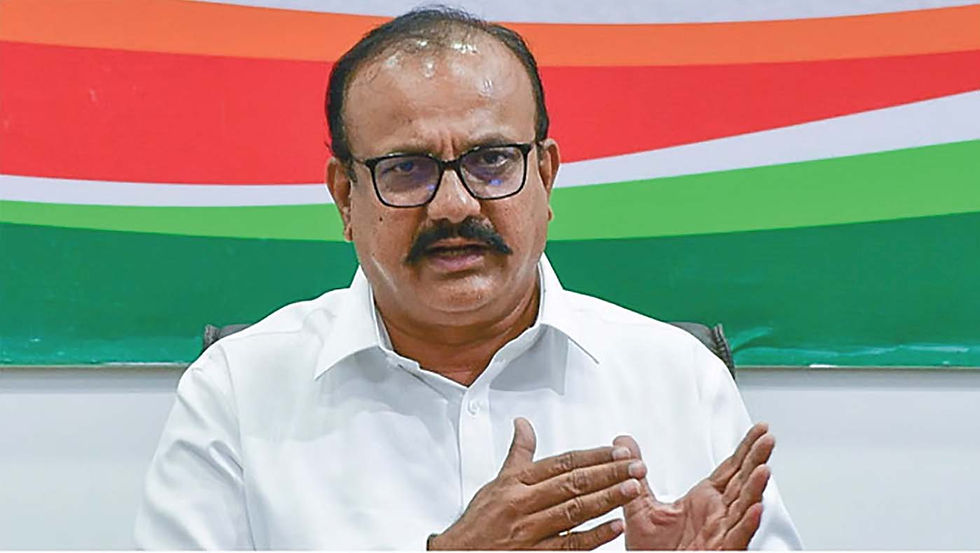
Mumbai: Rubbishing soothsayers’ predictions of political irrelevance in the just concluded polls to 288 municipal councils and Nagar Panchayats in the state, the Maharashtra Congress claimed it has made a strong comeback with a notable performance.


The party independently secured 41 posts of Municipal Presidents and 1,006 Councillor seats, plus 7 Municipal Presidents and 154 Councillors from Congress-supported local alliance, said state party President Harshwardhan Sapkal.


Conceding that polls bring both wins or losses, Sapkal said “the Congress has survived many such seasons in its long political journey”, while party leaders reiterated that it will “go solo in the BMC elections and in other civic bodies, local-level partnerships will be forged as directed by the AICC high command”.


“The results are a clear verdict in favour of democratic values over money power. Our performance again proved that ‘trust is greater than money and ideology is more important than power’. Despite limited resources and no access to state machinery, we fought with courage, conviction, grassroots mobilisation and structural strength, that have unnerved the ruling dispensation,” thundered Sapkal.


Organisational Push

The organisational push was aggressively led by Sapkal himself, along with senior leaders M. Arif Naseem Khan and Vijay Wadettiwar and a few others who campaigned vigorously across regions, including weak pockets.


“The results are a fitting reply to those who keep prophesying that the Congress is finished. The voters have decisively rejected attempts to fracture social harmony in the name of caste and religion. They have given thumbs up to the Congress ideology which alone can safeguard the nation,” Sapkal contended.


“In this ideological battle, we have not strayed even an inch. Congress lives in peoples’ hearts. We thank all our workers, candidates and voters for their support and reposing faith in us. We are now preparing for the upcoming Municipal Corporations and Zilla Parishad polls to save the state from the corrupt Mahayuti regime,” declared Sapkal.


Pep talk masks a saga of Sabotage

Behind the post-results optimism and celebratory rhetoric lies a more troubling development - of alleged sabotage and aloofness by several regional and state-level leaders during the recent civic polls, party insiders claim.


Despite the official display of ‘collective effort and ideological resolve’, the ground reality was very different and may have cost the party at least 35-40 posts of Municipal President and nearly a 1000-plus Councillors.


Multiple functionaries commended how the Sapkal-Khan-Wadettiwar trio carried out the campaign almost single-handedly, wading “neck deep” into rallies, meetings and field mobilisation, but most influential leaders chose to keep away.


“Many didn’t bother to lift a finger, even in their own strongholds. Attempts to rope them in joint rallies even in their own strongholds failed; their phones were either not-reachable or switched-off,” confided a senior office-bearer, preferring anonymity.


This proved deeply frustrating for everyone, especially grassroots workers who were valiantly battling the well-oiled Mahayuti campaign machinery on the ground, he pointed out.


Concurring, another senior functionary said that if the local satraps had given a united push, the poll results could have altered dramatically and Congress could have exceeded its 2017 performance despite fewer local bodies at the time.
Comments


bottom of page