
top of page

By:

Kiran D. Tare

21 August 2024 at 11:23:13 am

The Lady of Lord’s

Yastika Bhatia’s maiden Test century at Lord’s crowns the rise of an elegant wicketkeeper-batter who has quietly become indispensable to India’s new generation. Critics may say that there are flashier cricketers than Yastika Bhatia. She does not possess the raw power of a Smriti Mandhana or the aura of a Harmanpreet Kaur. She rarely dominates highlight reels or social media clips. Instead, she has built her reputation through reliability – a quality far more vital. At a time when white-ball...

The Lady of Lord’s

Yastika Bhatia’s maiden Test century at Lord’s crowns the rise of an elegant wicketkeeper-batter who has quietly become indispensable to India’s new generation. Critics may say that there are flashier cricketers than Yastika Bhatia. She does not possess the raw power of a Smriti Mandhana or the aura of a Harmanpreet Kaur. She rarely dominates highlight reels or social media clips. Instead, she has built her reputation through reliability – a quality far more vital. At a time when white-ball cricket prizes spectacle, the 24-year-old wicketkeeper-batter has become one of India’s finest practitioners of the understated virtues of timing, patience and composure. Bhatia’s 113 against England which powered the Indian women’s side to a historic win at Lord’s was not merely her maiden Test century but the first ever scored by a woman at cricket’s most celebrated venue. The innings helped India seal a comprehensive 270-run victory in the first women’s Test ever staged at Lord’s. Her hundred earned her a place on the Lord’s honours board, where generations of the game’s greatest names have been immortalised. Few entries have carried quite the same symbolism. Until now, no woman’s name had appeared there for a Test century because no women’s Test had ever been played at the ground. Bhatia’s career has mirrored the evolution of Indian women’s cricket itself. Born in Vadodara, she emerged through Gujarat’s domestic circuit at a time when opportunities for young women were expanding but remained far from abundant. A naturally gifted left-hander, she impressed selectors with a technique that appeared more classical than contemporary. Where modern batting often relies on innovation and improvisation, Bhatia’s game is rooted in balance. She plays late, favours placement over power and rarely appears rushed. Such attributes explain why coaches have long regarded her as especially suited to the demands of Test cricket, even though women are offered precious few opportunities to play the format. Modern wicketkeepers are expected to contribute almost as specialist batters while maintaining relentless concentration over long periods. Bhatia has embraced both responsibilities, becoming an important cog in an Indian side that has steadily shed its dependence on a handful of senior stars. That transformation has accelerated dramatically over the past year. India’s maiden Women’s ODI World Cup triumph marked a watershed for the sport, confirming that the country's women could finally translate promise into silverware. Although Bhatia missed that campaign after suffering an anterior cruciate ligament injury shortly before the tournament, her absence perhaps underscored her growing importance. Months of rehabilitation restored her confidence. If the World Cup represented the one that got away, Lord’s offered redemption. Returning to international cricket only recently, Bhatia produced an innings of remarkable maturity against England’s experienced attack. Her 113 came from 158 balls, balancing restraint with authority as India tightened their grip on the match. She admitted that six months earlier, while beginning rehabilitation, the idea of seeing her name on the Lord’s honours board would have seemed implausible. Those who know her were scarcely surprised. Former Indian wicketkeeper Kiran More, who has mentored Bhatia, has long spoken of her temperament rather than merely her talent. Scoring a century at Lord’s, he observed, is an ambition shared by virtually every cricketer. Achieving it after months away from the game simply reflected the resilience that had always underpinned her cricket. But hers was not a sentimental century assembled through fortune. It was a technically accomplished performance built on judgement outside off stump, crisp drives through the covers and the patience required by the longest format. It showcased precisely why Test cricket continues to matter. Unlike Twenty20, where brilliance can be compressed into a handful of overs, the five-day game rewards concentration accumulated over hours. For Indian women’s cricket, Bhatia’s century represents something larger than an individual milestone. It demonstrates the increasing depth of a side that is no longer defined solely by its biggest names. New heroes are emerging, backed by stronger domestic structures, better coaching and a professionalism unimaginable a decade ago. The honours board at Lord’s records statistics with characteristic restraint. It simply notes that Yastika Bhatia scored a century. Future generations may glance at the name without appreciating the path that led there. But Indian cricket will remember that the first woman to reach three figures at Lord’s was not merely making history. She was announcing that a new generation has arrived.

Jai Maharashtra!

Mumbai bids adieu to Uddhav’s 25-year rule


‘Thackeray Brand’ replaced with ‘Fiery Fadnavis’


Mumbai: The bitterly fought Brihanmumbai Municipal Corporation (BMC) election results were on anticipated and decisive lines – with sobering lessons for all the players.


The Shiv Sena (UBT) led by ex-Chief Minister Uddhav Thackeray is poised to meekly hand over the keys to the country’s richest civic body – over which it lorded for three decades - to the Bharatiya Janata Party-Shiv Sena combine.


The impending disaster loomed for days, the series of exit polls and sentiments of bookies – more than Rs One Lakh-Crore was pledged on the Mahayuti victory – plus, confident body-language of the Mahayuti leaders, that damned the fragmented Maharashtra Vikas Aghadi.


A leering BJP, which gunned for the ‘Thackeray brand’, is partly vindicated, considering SS (UBT)’s performance. The break-up of Shiv Sena engineered through Eknath Shinde in June 2022 paid rich dividends later, pushing Uddhav Thackeray out of power in the Assembly and now, even the BMC.


Deserting the BJP in October 2019 to later ally with Congress-Nationalist Congress Party as the MVA, Uddhav’s stars shone bright when he became the ‘reluctant CM’, flew high with his work during the Covid-19 Pandemic years, and even hinted for a ‘national role’ - till an eclipse on his regime suddenly started from Thane.


A betrayed Uddhav immediately threw away the trappings of power and promptly vacated ‘Varsha’ (CM official residence), as emotional supporters lined the route to ‘Matoshri’ (his private home), mourning the ‘death’ of the 30-month-old administration.


The MVA government fell, but the alliance grew in stature by humbling the BJP-NDA in the 2024 Lok Sabha elections. Owing to various factors, again the tide turned in the Assembly elections that year when the MVA was virtually erased by the BJP-led Mahayuti triumvirate.


For the past year, hectic preparations were on by all parties for the series of civic elections across the state – touted as a ‘mini-referendum’. The BJP, armed with the divided Shiv Sena-Nationalist Congress Party factions on its side, prepared for its final assault on the daunting ‘Thackeray brand’.


Genesis Of Nemesis

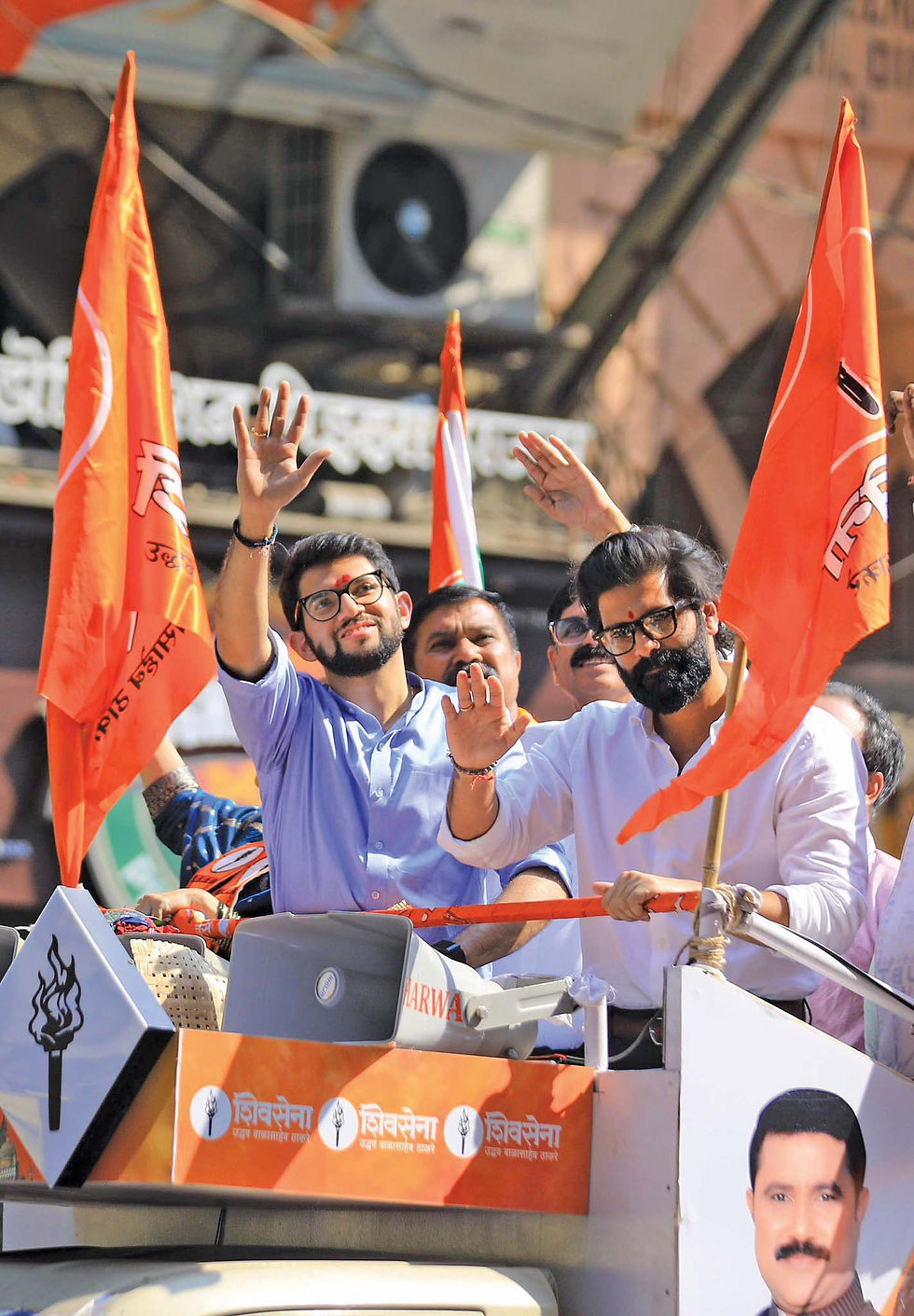
Brushing aside concerns and allies, Uddhav hurriedly patched up with his cousin and Maharashtra Navnirman Sena President Raj Thackeray, to grapple with the Mahayuti on his home-ground, Mumbai, where the Shiv Sena was founded by Balasaheb Thackeray.


A cocky Uddhav insisted on including MNS into the MVA, but the Congress stoutly refused and even parted ways to ally with Vanchit Bahujan Aghadi (VBA) of Prakash Ambedkar.


Several SS (UBT) bigwigs confided to The Perfect Voice how they had warned Uddhav on the MNS tie-up and its potential detrimental effects he airily shooed them off.


The partnership left the minorities, particularly Muslims who bore the brunt of Raj Thackeray’s mosque loudspeakers offensive, and large sections of non-Marathis in Mumbai – like UP-Biharis, Gujaratis, Marwaris – for the compulsion of speaking Marathi or shopkeepers must display Marathi signboards.


Though the final polls data will emerge over the coming days, Uddhav may have lost quite a chunk of crucial votes from the non-Marathis and minorities, who had accepted him as an unlikely ‘messiah’, till the Raj partnership was born.


Lessons For All

The BMC results indicate that the SS (UBT) notched a respectable defeat, the MNS proved an embarrassment and beneficiary, the Congress performed on expected lines, and Shiv Sena of Eknath Shinde is bereft of the much-coveted ‘Balasaheb Thackeray legacy’.


The SS (UBT) has catapulted as the second-largest party in the BMC, Shinde’s party - facing a gradual decline – stands third; the BJP is the single-largest party but way short of the magical 114-midway mark in the 227-member BMC house.


“Akin to 2019 and 2022, political jugglery of the weird kind is not ruled out. If, by some quirk of fate, the SS (UBT), Congress and Shiv Sena were to join forces, they can keep the BJP’s hands off the BMC…!” said a Congress leader.
Comments


bottom of page