top of page

By:

Akhilesh Sinha

25 June 2025 at 2:53:54 pm

Congress tries a ‘third’ hand

New Delhi: The BJP latest manoeuvre in elevating Nitin Nabin as the party’s national working president has had consequences in Maharashtra’s two biggest cities - Mumbai and Pune. The result has left the Congress party in a curiously ambivalent mood: quietly pleased by the opportunities created, yet wary of the turbulence ahead. In Maharashtra, the immediate beneficiary of the BJP’s move is Eknath Shinde’s Shiv Sena. The BJP’s organisational signal has strengthened its hand in the forthcoming...

Congress tries a ‘third’ hand

New Delhi: The BJP latest manoeuvre in elevating Nitin Nabin as the party’s national working president has had consequences in Maharashtra’s two biggest cities - Mumbai and Pune. The result has left the Congress party in a curiously ambivalent mood: quietly pleased by the opportunities created, yet wary of the turbulence ahead. In Maharashtra, the immediate beneficiary of the BJP’s move is Eknath Shinde’s Shiv Sena. The BJP’s organisational signal has strengthened its hand in the forthcoming elections to the BMC, Asia’s richest civic body, and in Pune, the state’s second city. For Shinde, whose legitimacy still rests on a contentious split with the party founded by Bal Thackeray, any reinforcement from the BJP’s formidable machine is welcome. For Uddhav Thackeray, who leads the rival Shiv Sena (UBT), the message is ominous. His party, once the natural custodian of Marathi pride in Mumbai, now faces the prospect of being squeezed between a BJP-backed Sena on one side and a revived Maharashtra Navnirman Sena (MNS) led by his cousin, Raj Thackeray, on the other. Shotgun Alliance That pressure has forced Thackeray into an awkward embrace with his estranged cousin. A reunion of the Thackeray clans, long rumoured and often aborted, has unsettled Thackeray’s MVA ally - the Congress. Signals from the party’s high command suggest a calculated distancing from Shiv Sena (UBT), particularly in Mumbai, where Congress leaders are exploring arrangements with smaller parties rather than committing to a Thackeray-led front. In Pune, the party’s pragmatism is even more pronounced. Quiet efforts are under way to entice Ajit Pawar’s NCP, currently aligned with the BJP, into a tactical understanding for the civic polls. Control of the municipal corporation, even without ideological harmony, is the immediate prize. For the embattled Congress, the civic polls offer a chance to do two things at once. First, by keeping a degree of separation from the Uddhav–Raj combine, it can strengthen its own organisational sinews, which have atrophied after years of playing junior partner. Secondly, it can allow the BJP–Shinde Sena and the Thackeray cousins to polarise the Marathi vote between them, leaving Congress to position itself as a ‘third pole.’ Such a strategy is particularly tempting in Mumbai. A tie-up with outfits like Prakash Ambedkar’s Vanchit Bahujan Aghadi (VBA) could help Congress consolidate minority, Dalit and tribal voters, constituencies it believes are more reliably mobilised without the ideological baggage of Thackeray’s Sena (UBT). Severing or loosening ties with Shiv Sena (UBT) would also simplify Congress’s messaging ahead of assembly elections elsewhere. In states such as West Bengal and Tamil Nadu, where polls loom next year, the party has historically preferred alliances that allow it to emphasise secular credentials and oppose the BJP without accommodating overtly Hindu nationalist partners. Mixed Signals The Congress’ internal signals, however, are mixed. When talk of a Thackeray reunion resurfaced, Maharashtra Congress leader Vijay Wadettiwar publicly welcomed it, arguing that Raj Thackeray’s limited but distinct vote share could help consolidate Marathi sentiment. Mumbai Congress chief Varsha Gaikwad was more circumspect, hinting that alliances with parties prone to street-level militancy deserved scrutiny. Wadettiwar swiftly clarified that decisions would rest with the party’s senior leadership, underscoring the centralised nature of Congress’s calculus. In Pune, meanwhile, senior leaders are reportedly engaged in discreet conversations with Ajit Pawar, whose defection from his uncle Sharad Pawar’s NCP last year still reverberates through state politics. The outline of a broader strategy is becoming visible. Congress appears content to let the BJP and Shinde’s Sena draw on non-Marathi and anti-dynasty voters, the Thackerays appeal to wounded Marathi pride while it quietly rebuilds among minorities and lower-caste groups. Mumbai Approach Mumbai’s demography lends some plausibility to this approach. Alongside its Marathi core, the city hosts millions of migrants from Uttar Pradesh, Bihar and Jharkhand, a constituency that has increasingly gravitated towards the BJP. Raj Thackeray’s strident rhetoric against North Indians, once electorally potent, now risks narrowing his appeal and complicating Uddhav Thackeray’s efforts to broaden his base. None of this guarantees success for Congress. Playing the ‘third pole’ is a delicate art. Yet, the Congress, struggling for survival, has few illusions about sweeping victories. Its aim, for now, is more modest – it is to survive, to remain relevant, and to exploit the cracks opened by its rivals’ rivalries. In Maharashtra’s civic chessboard, that may be advantage enough.

BJP apprehensive of Marathi-Muslim vote bloc

ree

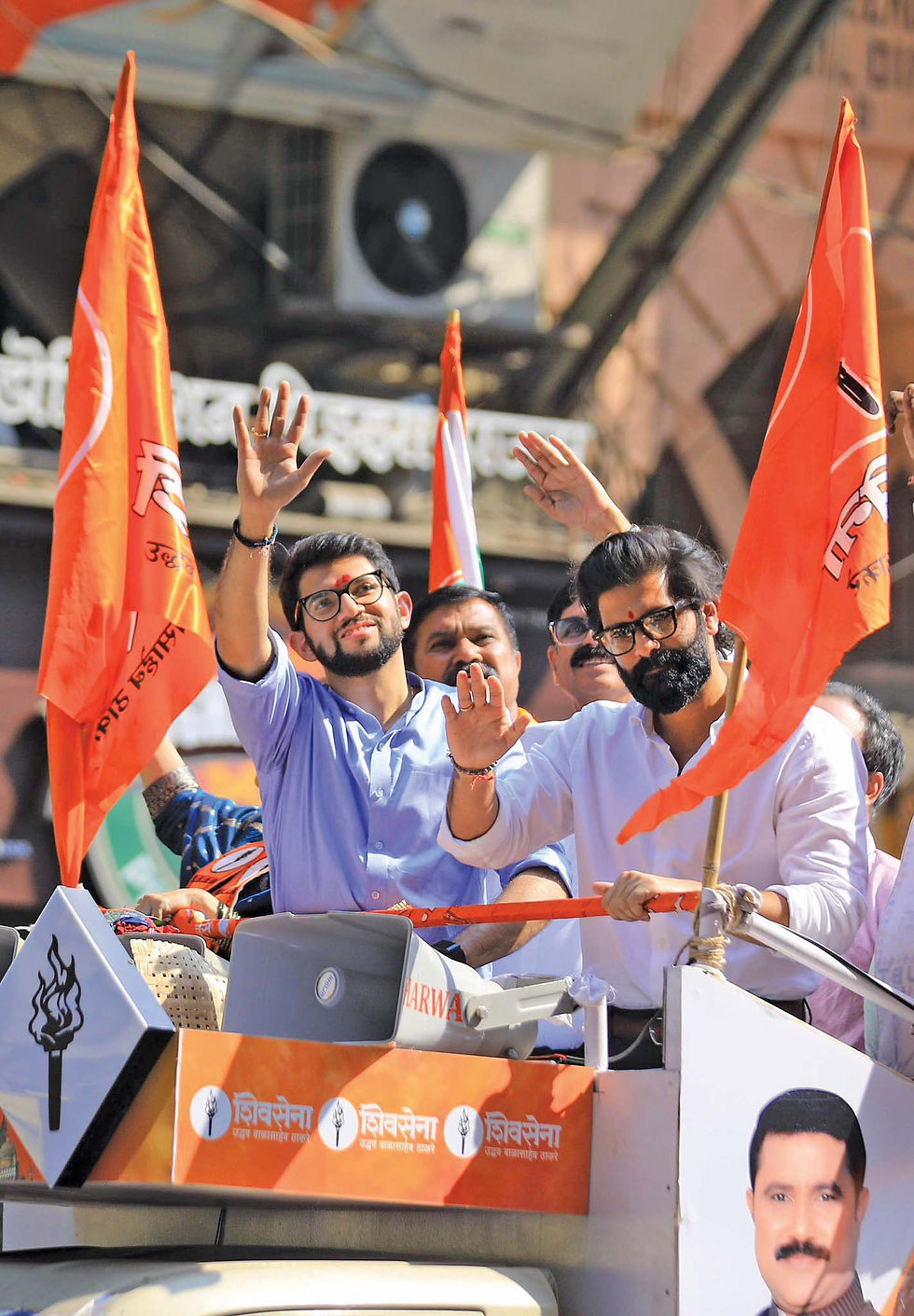
Mumbai: The strategic reunion of the Thackeray cousins marks a pivotal shift in Mumbai’s political landscape, forcing the BJP-led Mahayuti to reconsider its path toward controlling the Brihanmumbai Municipal Corporation (BMC). At the heart of the BJP’s concern is the emergence of a Marathi-Muslim voting bloc, a demographic alliance that mirrors the potent ‘Muslim-Yadav’ formula famously utilised by Lalu Prasad Yadav in Bihar. Internal assessments suggest that this cross-community alignment could influence as many as 43 seats in the city. While the BJP traditionally struggles to capture the Muslim vote, the real danger to their campaign lies in the possibility of the Muslim community voting tactically for the Shiv Sena (UBT) to prevent a BJP victory.


The formalisation of the alliance between Uddhav Thackeray and Raj Thackeray has fundamentally altered the math in 36 core ‘Marathi’ seats. Previously, the BJP had hoped that a split in the Marathi vote between various factions would allow their candidates to sail through. However, the unified ‘Brand Thackeray’ appeal now threatens to consolidate these votes under a single banner.


Sigh Of Relief

Interestingly, BJP surveys had previously indicated that if Raj Thackeray had joined Eknath Shinde’s faction, the impact would have been even more severe, potentially affecting 45 seats. While the current UBT-MNS pairing offers a slight ‘sigh of relief’ in that regard, it remains a formidable obstacle to the Mahayuti’s target of 178 seats.


Further complicating the situation is the stance of the City Congress unit, which recently severed ties with the Shiv Sena (UBT). This move was largely driven by the fear that their core Muslim support base would be alienated by an association with the MNS. The BJP’s strategy has involved highlighting this tension. City BJP Chief Ameet Satam famously warned that a UBT victory would result in the city having a ‘Khan’ as its Mayor. This was a clear attempt to polarize the electorate and pull Marathi voters away from the Thackeray camp.


Marathi Mayor

However, Raj Thackeray’s assurance at today’s press conference that the city will have a ‘Marathi Mayor’ from the UBT-MNS alliance has provided a counter-narrative. This statement serves two purposes. Firstly, it reassures the Marathi heartland of the alliance’s priorities, and secondly it gives the BJP a new rhetorical tool. The BJP now intends to use Raj Thackeray’s ‘Marathi-first’ rhetoric to suggest to Muslim voters that the alliance does not truly represent their interests, hoping this will cause them to reconsider their tactical support for the Shiv Sena (UBT).


As the January 15 elections approach, the success of the Mahayuti depends on whether they can break this budding Marathi-Muslim coalition or if the “Thackeray Factor” will successfully bridge the gap between these historically disparate voting blocs.


Seat Sharing

A senior BJP leader, while commenting on the UBT-MNS alliance asked as to why the seat-sharing formula was not declared by the two leaders, and went on to reveal the answer. According to him, the Shiv Sena (UBT) is worried as to how many seats the Shiv Sena under Eknath Shinde gets to contest and knows well that Shinde won’t settle for anything less than what the MNS gets. The BJP leader said that the MNS is asking for 80 seats and if that number is revealed, the BJP will have to leave as many seats to Shiv Sena. It’ll be better for the BJP.


Their track record is of corruption and self-interest. Their alliance is for their own political survival and it will not make any significant political difference. It is childish if anyone thinks otherwise. People will not get swayed. The television news channels were reporting as if it was the Russia-Ukaine alliance. Thackerays are not the lone representatives of Marathi people and Mumbai.

Devendra Fadnavis, Chief Minister
Comments


bottom of page