
By:
Abhijit Mulye
21 August 2024 at 11:29:11 am
Poriborton!
BJP candidate for Bhabanipur and Nandigram constituencies Suvendu Adhikari, who defeated West Bengal Chief Minister Mamata Banerjee in the prestigious Bhabanipur seat, shows a certificate of election on Monday. Pic: PTI Mumbai: The Bengali word “Poriborton” translates to profound change. While it was initially fiercely utilized as the central battle cry for the assembly elections in West Bengal, the final tally from all five state elections reveals that the spirit of the word has swept across...
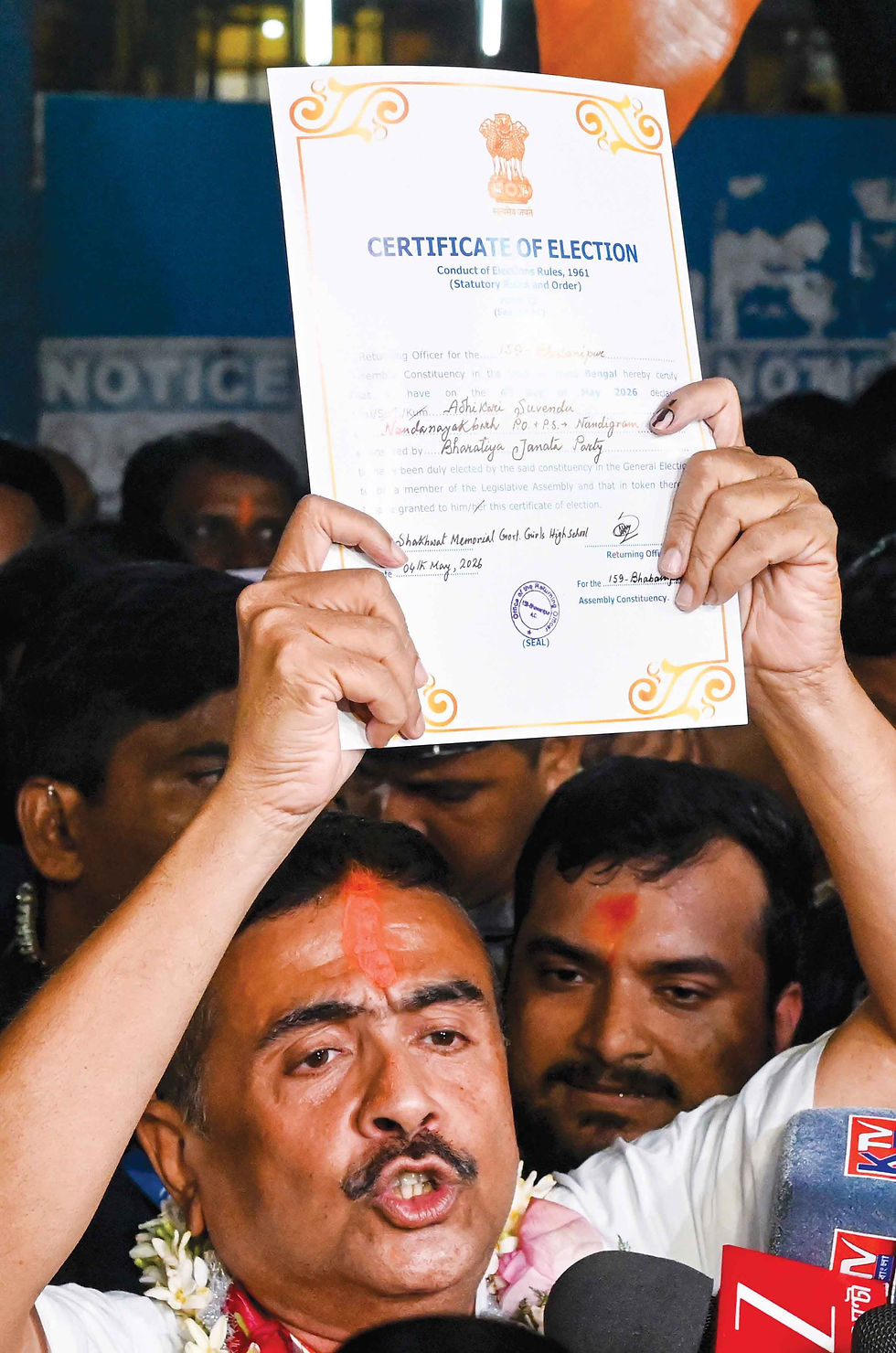
BJP candidate for Bhabanipur and Nandigram constituencies Suvendu Adhikari, who defeated West Bengal Chief Minister Mamata Banerjee in the prestigious Bhabanipur seat, shows a certificate of election on Monday. Pic: PTI Mumbai: The Bengali word “Poriborton” translates to profound change. While it was initially fiercely utilized as the central battle cry for the assembly elections in West Bengal, the final tally from all five state elections reveals that the spirit of the word has swept across the entire nation. The recent electoral outcomes have fundamentally rewritten the established rules of Indian democracy. From a massive anti-incumbency wave overturning fifteen years of rule in Bengal, to a political novice shattering a six-decade Dravidian stronghold in Tamil Nadu, and the Congress-led alliance successfully dislodging the incumbent Left in Kerala, the electorate has delivered a highly decisive mandate. Alongside sweeping consolidations of power in Assam and Puducherry, these results collectively disrupt historical traditions and reshape the national political landscape for years to come. Titan Toppled In West Bengal, the call for Poribartan finally resonated with enough force to bring down a formidable political fortress. A relentless anti-incumbency wave has overturned Mamata Banerjee’s fifteen-year rule. For a decade and a half, the Trinamool Congress maintained an iron grip on the state’s narrative, having previously ousted the Left Front on the very same promise of sweeping change. The defeat of the incumbent government signifies a monumental shift in the political psychology of Bengal. The electorate, driven by an urgent desire for a new direction, has dismantled a deeply entrenched political machine. This result forces a complete recalibration of power dynamics in eastern India, leaving a massive political vacuum that victorious forces will now rush to fill, fundamentally altering the governance trajectory of the state. Duopoly Shattered Equally seismic is the political earthquake that has struck Tamil Nadu. For six decades, the state’s political arena was fiercely guarded by a seemingly unbreakable Dravidian duopoly, with power alternating predictably between established giants. However, the emergence of the Tamilaga Vettri Kazhagam, led by cinema icon Thalapathy Vijay, has dismantled this historical dominance. By emerging as the single-largest party in the assembly count, the TVK has achieved what generations of politicians deemed impossible. This is not merely a change in government but a profound cultural and political revolution. The voters of Tamil Nadu have overwhelmingly opted for a fresh narrative, proving that star power coupled with an untested political promise can still upend deeply rooted ideological empires, ushering in an entirely new era of leadership. Absolute Dominance Meanwhile, the political landscape in the Northeast has witnessed a different kind of decisive mandate. In Assam, Chief Minister Himanta Biswa Sarma has not only retained power but has emerged significantly stronger, securing a third consecutive term. This victory effectively cements an aggressive regional hegemony and signals the near-total ouster of the Congress party from Assam’s mainstream politics. The result brings an ironclad continuity to the state, allowing the incumbent administration to push forward its agenda without any formidable legislative friction, while leaving the state’s oldest party desperately searching for political relevance. Pendulum Swings In Kerala, the electorate has delivered a decisive blow to the incumbent Left Democratic Front. The Congress-led United Democratic Front has successfully dislodged the government, claiming a vital victory in a state renowned for its fiercely contested, oscillating elections. This resurgence of the UDF injects critical new life into the state’s Congress machinery, drastically altering the governance model in Kerala. The outcome firmly proves that the traditional pendulum of Kerala politics still possesses the momentum to swing back fiercely against the incumbent, denying the Left a continued and uninterrupted grip on power. Comfortable Continuity Further down the coast in Puducherry, the mandate favored stability within a rapidly changing national map. The National Democratic Alliance government, led by the AINRC, comfortably secured its return to power. This victory ensures that the NDA maintains a crucial administrative foothold in the southern union territory, providing a steady anchor for its regional allies amid the broader national churn. When viewed collectively, these independent state results weave a complex tapestry that will inevitably reshape national politics. The fall of towering regional satraps in West Bengal and the disruption of the historic Dravidian stronghold in Tamil Nadu indicate a national electorate that is deeply restless and entirely unafraid to discard legacy systems. For the national opposition, the revival in Kerala offers a much-needed glimmer of hope, though it is heavily overshadowed by the existential crisis they face in Assam. The spectacular rise of new regional entities introduces a fresh, highly unpredictable variable into the national coalition arithmetic ahead of future general elections. Ultimately, the political center of gravity has fundamentally shifted, proving that “Poribartan” is no longer just a localized slogan, but the defining new reality of the country.