

NMIA fails to live up to the promise

Three million passengers are recorded but the tag of world-class airport remains elusive
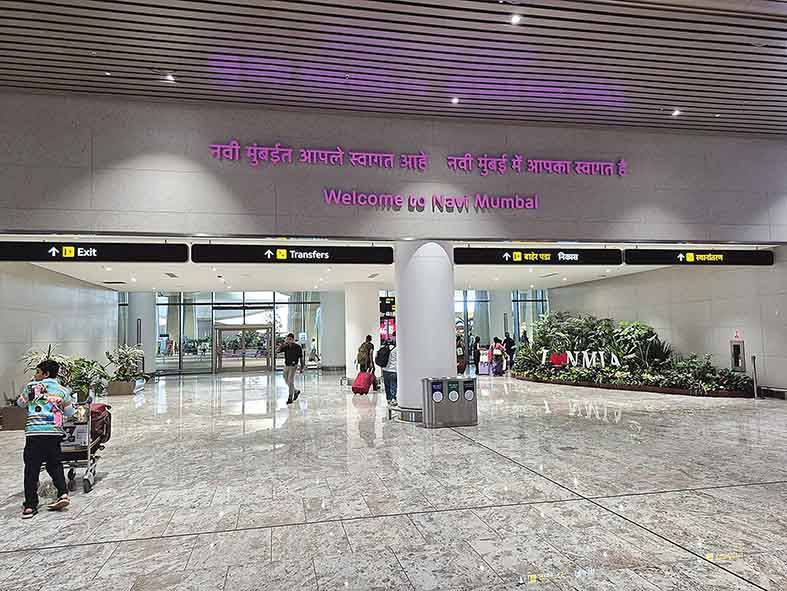
Mumbai: Less than nine months after opening its doors, Navi Mumbai International Airport (NMIA) has crossed the three-million-passenger mark, signalling strong demand for the long-awaited second airport of the Mumbai Metropolitan Region. Yet, for many passengers, the experience on the ground has been markedly different from the image of a world-class airport that accompanied the project’s launch.
NMIA crossed the milestone on September 1, having handled around 22,500 commercial flights since commencing operations on December 25, 2025. Its network has expanded from 13 destinations at launch to 46, while scheduled international operations began within 200 days. The airport also reported that the last checked-in bag reached the carousel within 30 minutes on 94% of flights in August.
On paper, therefore, the airport is making rapid progress. But passenger complaints over expensive and scarce cabs, inadequate public transport, terminal amenities, signage, connectivity and basic logistics raise a larger question: has NMIA’s infrastructure evolved as quickly as its passenger numbers?
Last-Mile Journey
The most persistent grouse remains the last-mile journey. Passengers arriving at the airport have complained of limited availability of reasonably priced taxis and app-based cabs, with some alleging that drivers push passengers towards higher-priced categories. Similar complaints about cab scarcity and steep fares have surfaced repeatedly since the airport opened.
For a passenger from Mumbai’s western suburbs, the problem is particularly acute.
“The flight may take less than an hour, but getting home can take longer and cost almost as much as the flight in some cases. The airport is beautiful in concept, but the last-mile connectivity is still not worthy of an international airport,” said Shrikant Teli, a Mumbai resident who recently travelled through NMIA.
Less Choices
Another passenger said the issue was not merely the fare but the absence of choice. “Once you come out with luggage, you don’t really have much bargaining power. If the cheaper cab is not available, you either wait or pay more. This defeats the whole purpose of having a new airport,” he said not wishing to be named.
Interestingly, the airport itself lists buses, trains, taxis and app-based cabs among its connectivity options, with Panvel and Bamandongri identified as nearby rail stations. The Maharashtra government had also launched Bharat Taxi at NMIA in July, specifically pitching it as a transparent, no-surge, no-hidden-charge alternative to conventional app-based services.
But transport experts say the issue cannot be solved merely by adding more cabs.
“An airport is not just a terminal and runway. It is a mobility system. Unless passengers can move seamlessly between the airport, rail, metro, buses and road network, the airport experience remains incomplete,” said an urban transport expert on condition of anonymity.
Under Scrutiny
The terminal itself has also come under scrutiny. Passengers have earlier flagged inadequate signage, poor mobile connectivity, difficulties with app-based payments and a lack of basic passenger services. More recent complaints have included expensive food, non-functional charging points and irregular availability of drinking water.
“For a brand-new airport, passengers naturally expect everything to work from day one. Some teething problems are understandable, but after eight months, basic facilities should not be a recurring complaint,” said Kaustubh Pande, a Navi Mumbai resident who frequently travels by air.
There is also a logistical irony. NMIA was conceived not merely as another airport but as a solution to Mumbai’s capacity constraints and eventually as a major aviation and cargo hub. The airport’s first phase is designed for 20 million passengers annually, with the ultimate capacity planned at 90 million.
The pressure on the new facility is only set to increase. From October 1, around 30 per cent of international traffic is scheduled to shift from Chhatrapati Shivaji Maharaj International Airport to NMIA, making efficient connectivity and passenger handling even more critical.
The three-million passenger milestone therefore tells only half the story. It proves that travellers are willing to use NMIA; it does not necessarily prove that they are satisfied with it.
For an airport intended to redefine Mumbai’s aviation ecosystem, the real test will be whether the passenger journey—from home to terminal and back—is as seamless as the vision promised.
At present, NMIA appears to have won the demand test, but is still struggling with the experience test.


Comments