top of page

By:

Akhilesh Sinha

25 June 2025 at 2:53:54 pm

Nadda's strategic meet signals urgency for chemical sector

New Delhi: As war simmers across the volatile landscape of West Asia, whether in the form of a direct confrontation between Israel, United States and Iran, or through Iran's hybrid warfare involving groups like Hezbollah and the Houthis, the tremors are no longer confined to the region's borders. They are coursing through the arteries of the global economy. India's chemicals and petrochemicals sector, heavily dependent on this region for critical raw materials, finds itself among the earliest...

Nadda's strategic meet signals urgency for chemical sector

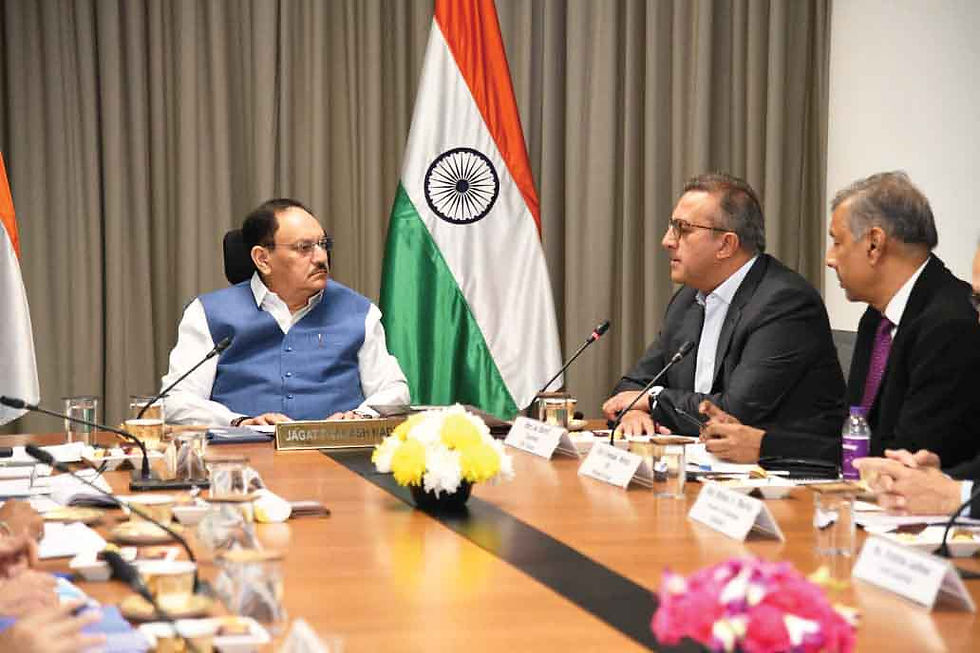
New Delhi: As war simmers across the volatile landscape of West Asia, whether in the form of a direct confrontation between Israel, United States and Iran, or through Iran's hybrid warfare involving groups like Hezbollah and the Houthis, the tremors are no longer confined to the region's borders. They are coursing through the arteries of the global economy. India's chemicals and petrochemicals sector, heavily dependent on this region for critical raw materials, finds itself among the earliest and hardest hit by this geopolitical turbulence. It is in this backdrop that the recent meeting convened by Union Minister for Chemicals and Fertilisers J. P. Nadda at Kartavya Bhavan must be seen not as a routine consultation, but as a signal of strategic urgency. India's ambition to scale this sector from its current valuation of $220 billion to $1 trillion by 2040, and further to $1.5 trillion by 2047, will remain aspirational unless the country confronts its structural vulnerabilities with clarity and resolve. India today ranks as the world's sixth-largest producer of chemicals and the third-largest in Asia. The sector contributes 6-7 percent to GDP and underpins a wide spectrum of industries, from agriculture and pharmaceuticals to automobiles, construction, and electronics. It would be no exaggeration to call it the backbone of modern industrial India. Yet, embedded within this strength is a paradox. India's share in the global chemical value chain (GVC) stands at a modest 3.5 percent. A trade deficit of $31 billion in 2023 underscores a deeper issue: while India produces at scale, it remains marginal in high-value segments. This imbalance becomes starkly visible when disruptions in West Asia choke the supply of key feedstocks, shaking the very foundations of domestic industry. Supply Disruption The current crisis has laid this fragility bare. Disruptions in the supply of LNG, LPG, and sulfur have led to production cuts of 30-50 percent in several segments. With nearly 65 percent of sulfur imports sourced from the Middle East, the ripple effects have extended beyond chemicals to fertilisers, plastics, textiles, and other downstream industries. Strategic chokepoints such as the Strait of Hormuz have witnessed disruptions, pushing shipping costs up by 20-30 percent and adding further strain to cost structures. This is precisely where Nadda's emphasis on supply chain diversification and resilience appears prescient. In today's world, self-reliance cannot mean isolation; it must translate into strategic flexibility. While India imports crude oil from as many as 41 countries, several critical inputs for the chemical industry remain concentrated in a handful of sources, arguably the sector's most significant vulnerability. Opportunity Ahead A recent report by NITI Aayog outlines a pathway to convert this vulnerability into opportunity. It envisions raising India's GVC share to 5-6 percent by 2030 and to 12 percent by 2040. If achieved, the sector could not only reach the $1 trillion mark but also generate over 700,000 jobs. However, this transformation will demand more than policy intent, it will require sustained investment and disciplined execution. The most pressing challenge lies in research and innovation. India currently spends just 0.7 percent of industry revenue on R&D, compared to a global average of 2.3 percent. This gap explains why the country remains largely confined to basic chemicals, even as the world moves toward specialty and high-value products. Bridging this divide is essential if India is to climb the value chain. Equally constraining is the fragmented nature of the industry. Dominated by MSMEs with limited access to capital and technology, the sector struggles to compete globally. Cluster-based development models offer a pragmatic way forward, such as PCPIRs and the proposed chemical parks.

Pahalgam Terror Attack: Airlines told to keep fares to Srinagar in check, extra flights deployed for evacuation


SRINAGAR: Following the deadly militant attack in Pahalgam, Jammu & Kashmir, that killed 26 tourists and two local residents, the civil aviation ministry has directed airlines not to increase airfares on the Srinagar route.


Airlines have also been asked to run extra flights to help passengers leave the city.


Air India and IndiGo will operate four additional flights on Wednesday—two to Delhi and two to Mumbai.


Air India announced it will run two extra flights from Srinagar—one to Delhi at 11:30 am and another to Mumbai at 12:00 noon—due to the current situation.


“Booking for these flights is now open,” the airline said, adding that all other scheduled flights to and from Srinagar will continue as planned.


Air India also stated it is offering free rescheduling and full refunds on cancellations for passengers with confirmed tickets on these routes till April 30. Both Air India and IndiGo have waived charges for rescheduling and cancellations.


Civil Aviation Minister K Rammohan Naidu held an urgent meeting with airline representatives and issued a strong advisory against raising prices on the Srinagar route.


According to an official release on Wednesday, airlines have been instructed to keep fares at regular levels to avoid putting additional burden on passengers during this difficult time.


Naidu also spoke with Home Minister Amit Shah and is closely monitoring the situation with the help of concerned authorities.


“As part of immediate relief efforts, four special flights from Srinagar—two to Delhi and two to Mumbai—have been arranged. More flights are on standby if needed for evacuation,” the release added.


The militant attack took place on Tuesday at Baisaran, a popular tourist spot near Pahalgam in south Kashmir. At least 26 people, most of them tourists, were killed and many others injured.


The attack has left tourists frightened, and many are now preparing to leave the region.


Baisaran, often called ‘mini Switzerland,’ is only accessible by foot or horseback, as there is no motorable road leading to it.


Two foreign nationals—one from the UAE and another from Nepal—are among those killed.


The deceased also include Lieutenant Vinay Narwal, an officer of the Indian Navy, and businessman Manjunath Rao from Shivamogga, Karnataka.

4o

Comments


bottom of page