top of page

By:

Quaid Najmi

4 January 2025 at 3:26:24 pm

Seventy-six mayors ruled BMC since 1931

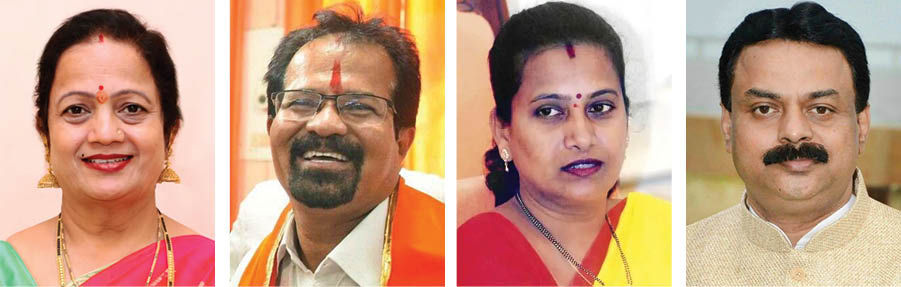
After four years, Mumbai to salute its first citizen Kishori Pednekar Vishwanath Mahadeshwar Snehal Ambekar Sunil Prabhu Mumbai: As the date for appointing Mumbai’s First Citizen looms closer, various political parties have adopted tough posturing to foist their own person for the coveted post of Mayor – the ‘face’ of the country’s commercial capital. Ruling Mahayuti allies Bharatiya Janata Party (BJP) and Shiv Sena have vowed that the city...

Seventy-six mayors ruled BMC since 1931

After four years, Mumbai to salute its first citizen Kishori Pednekar Vishwanath Mahadeshwar Snehal Ambekar Sunil Prabhu Mumbai: As the date for appointing Mumbai’s First Citizen looms closer, various political parties have adopted tough posturing to foist their own person for the coveted post of Mayor – the ‘face’ of the country’s commercial capital. Ruling Mahayuti allies Bharatiya Janata Party (BJP) and Shiv Sena have vowed that the city will get a ‘Hindu Marathi’ person to head India’s richest civic body, while the Opposition Shiv Sena (UBT)-Maharashtra Navnirman Sena also harbour fond hopes of a miracle that could ensure their own person for the post. The Maharashtra Vikas Aghadi (MVA) optimism stems from expectations of possible political permutations-combinations that could develop with a realignment of forces as the Supreme Court is hearing the cases involving the Shiv Sena-Nationalist Congress Party this week. Catapulted as the largest single party, the BJP hopes to install a first ever party-man as Mayor, but that may not create history. Way back in 1982-1983, a BJP leader Dr. Prabhakar Pai had served in the top post in Mumbai (then Bombay). Incidentally, Dr. Pai hailed from Udupi district of Karnataka, and his appointment came barely a couple of years after the BJP was formed (1980), capping a distinguished career as a city father, said experts. Originally a Congressman, Dr. Pai later shifted to the Bharatiya Janata Party, then back to Congress briefly, founded the Janata Seva Sangh before immersing himself in social activities. Second Administrator The 2026 Mayoral elections have evoked huge interest not only among Mumbaikars but across the country as it comes after nearly four years since the BMC was governed by an Administrator. This was only the second time in the BMC history that an Administrator was named after April 1984-May 1985. On both occasions, there were election-related issues, the first time the elections got delayed for certain reasons and the second time the polling was put off owing to Ward delimitations and OBC quotas as the matter was pending in the courts. From 1931 till 2022, Mumbai has been lorded over by 76 Mayors, men and women, hailing from various regions, backgrounds, castes and communities. They included Hindus, Muslims, Christians, Parsis, Sikhs, even a Jew, etc., truly reflecting the cosmopolitan personality of the coastal city and India’s financial powerhouse. In 1931-1932, the Mayor was a Parsi, J. B. Boman Behram, and others from his community followed like Khurshed Framji Nariman (after whom Nariman Point is named), E. A. Bandukwala, Minoo Masani, B. N. Karanjia and other bigwigs. There were Muslims like Hoosenally Rahimtoola, Sultan M. Chinoy, the legendary Yusuf Meherally, Dr. A. U. Memon and others. The Christian community got a fair share of Mayors with Joseph A. D’Souza – who was Member of Constituent Assembly representing Bombay Province for writing-approving the Constitution of India, M. U. Mascarenhas, P. A. Dias, Simon C. Fernandes, J. Leon D’Souza, et al. A Jew Elijah Moses (1937-1938) and a Sikh M. H. Bedi (1983-1984), served as Mayors, but post-1985, for the past 40 years, nobody from any minority community occupied the august post. During the silver jubilee year of the post, Sulochana M. Modi became the first woman Mayor of Mumbai (1956), and later with tweaks in the rules, many women ruled in this post – Nirmala Samant-Prabhavalkar (1994-1995), Vishakha Raut (997-1998), Dr. Shubha Raul (March 2007-Nov. 2009), Shraddha Jadhav (Dec. 2009-March 2012), Snehal Ambedkar (Sep. 2014-March 2017). The last incumbent (before the Administrator) was a government nurse, Kishori Pednekar (Nov. 2019-March 2022) - who earned the sobriquet of ‘Florence Nightingale’ of Mumbai - as she flitted around in her full white uniform at the height of the Covid-19 Pandemic, earning the admiration of the citizens. Mumbai Mayor – high-profile post The Mumbai Mayor’s post is considered a crucial step in the political ladder and many went on to become MLAs, MPs, state-central ministers, a Lok Sabha Speaker, Chief Ministers and union ministers. The formidable S. K. Patil was Mayor (1949-1952) and later served in the union cabinets of PMs Jawaharlal Nehru, Lah Bahadur Shastri and Indira Gandhi; Dahyabhai V. Patel (1954-1955) was the son of India’s first Home Minister Sardar Vallabhbhai Patel; Manohar Joshi (1976-1977) became the CM of Maharashtra, later union minister and Speaker of Lok Sabha; Chhagan Bhujbal (1985-1986 – 1990-1991) became a Deputy CM.

Inclusive RSS bats for regional languages

Outreach across professions, geographies, and communities Sangh's main goal

New Delhi: The Rashtriya Swayamsevak Sangh (RSS) on Monday reiterated its stand that all Indian languages are national languages and the primary education should be taught in the local language.


The RSS stand has come amid the language row in Maharashtra, Karnataka, and Tamil Nadu where the “imposition” of Hindi as the third language in school curriculum was fiercely opposed.


Sunil Ambekar, the RSS Akhil Bharatiya Prachar Pramukh, said, “Sangh has always had the stand that all languages of India are national languages. People speak their languages in their own places. Primary education should be disseminated in the same language, this is what everyone has been requesting. This is already established."


He was addressing the reporters informing them about the decisions taken at the Pracharak Baithak that was held last week.


The language controversy emerged following the introduction of the Three-Language Policy under the National Education Policy (NEP) 2020. This policy requires students to learn three languages during their schooling years. It aims to foster multilingualism while balancing national unity with regional diversity. The policy provides states and institutions with flexibility in selecting which languages to teach, ensuring at least two of them are native to India.


During the baithak, the roadmap for the RSS Centenary Year was discussed in depth. Hindu Sammelans will be held in every mandal and basti, covering 58,964 mandals and 43,000 bastis. 11,360 places, including every khand and nagar, will host Samajik Sadbhav Baithaks with participation from all communities to discuss positive societal work. A Ghar-Ghar Sampark Abhiyan will be launched, aiming to reach every house and every village. In all 924 Zilhas, meetings will be organised with prominent citizens, professionals, and organisations, focusing on themes like Bharat, Hindu, and national unity.


These Hindu Sammelans will not only aim at broader unity but also focus on Hindu ekta through dialogue. In these gatherings, special discussions will be held on the internal misconceptions or misunderstandings within the Hindu society in specific areas, and how to overcome them with mutual respect, awareness, and organisation, Ambekar informed.


Social Integration

The main goal for the centenary year is inclusive outreach across professions, geographies, and communities to foster holistic social integration.


Ambekdar said that, the idea of Bharat Mata is not a Sangh creation, but a part of our civilisational tradition. Freedom fighters visualised the motherland as a divine mother, an image to be respected, revered, and protected. Everyone must be envisioned Bharat Mata with dignity and devotion. These values will be actively carried to the masses during the upcoming Ghar Sampark Abhiyan.


As part of the year-long centenary year celebrations, a Grah Sampark Abhiyan will be launched in November 2025. For 21 days, swayamsevaks from every shakha will go door-to-door with literature and information about the Sangh’s work, engaging with society directly. In addition, Samajik Sadbhav Baithaks will be conducted across the nation to foster harmony different communities.


Meitei-Kuki dialogue being encouraged

RSS volunteers are making efforts to reduce tension in Manipur by promoting dialogue between Meitei and Kuki communities, Sunil Ambekar said on Monday, asserting that peace is gradually returning to the state.


“RSS swayamsevaks are promoting talks between their Meitei and Kuki communities, and all the people, so that there is a good atmosphere among them. They are trying for this,” he said.


Ambekar said that the situation in Manipur has improved compared to last year.


Replying to a question on the opposition's claim that there is no normalcy in the state, Ambekar said, “When conditions worsen anywhere, it does not get better in a day. But definitely, if we compare it with the previous years, peace has started returning to some extent.


"The peace process has begun. The dialogues happening between the two sides will progress.”


More than 260 people have been killed and thousands rendered homeless in ethnic violence between Meiteis and Kuki-Zo groups since May 2023.

The Centre had on February 13 imposed the President's rule in Manipur after the then chief minister N Biren Singh resigned. The state assembly, which has a tenure till 2027, has been put under suspended animation.

Comments


bottom of page