

The Ancient Greek War Haunting Washington and Beijing

Xi Jinping’s invocation of the ‘Thucydides Trap’ revives the long shadow of the Peloponnesian War and asks whether America and China are repeating history’s oldest great-power mistakes.

During last week’s summit in Beijing with U.S. President Donald Trump, Xi Jinping once again summoned the ghosts of ancient Greece. The Chinese leader warned that Beijing and Washington must avoid falling into the ‘Thucydides Trap,’ the now-famous formulation popularised by political scientist Graham Allison in the 2010s to describe the peril that emerges when a rising power unsettles an established one. Xi cautioned that Taiwan remained the most combustible question in Sino-American relations, one capable, if mishandled, of pushing the two powers toward “conflict.”
Brushing aside the premise underlying the Chinese President’s analogy, Trump implied that America’s recent troubles were not symptoms of imperial decline but merely the temporary detour of a weak administration, namely that of his predecessor Joe Biden’s.
The United States, in this telling, was not Sparta nervously watching a younger Athens ascend. It remained the dominant power, fully capable of preserving its primacy in the Pacific and beyond.
But Xi’s invocation of the Thucydides Trap raises a more interesting question of whether the historical analogy itself obscures more than it reveals.
Defining Metaphor
The term has become one of the defining metaphors of 21st-century geopolitics because offering a terrifyingly simple proposition that when a rising power disrupts the position of a ruling power, war becomes likely.
Graham Allison’s Harvard study of sixteen power transitions over five centuries concluded that most ended in conflict, from Imperial Germany challenging Britain to Japan challenging the United States.

Yet history is rarely so tidy. Thucydides’ began composing his ‘History of the Peloponnesian War’ during the catastrophic war between Athens and Sparta (that raged from 431 to 404 BC) that destroyed the Greek world and in which the historian himself was a participant.
The work, often regarded as the first modern work of political history to jettison mythological explanations and divine intervention common in earlier histories in favour of causation and political psychology, is less a deterministic theory of power transition than a vast anatomy of how civilizations lose their balance.
Its pages teem with ego, factionalism, prestige, revenge, democratic frenzy, plague and strategic paranoia. Besides chronicling the collision of Athens and Sparta, Thucydides was simultaneously dissecting the psychology of imperial overconfidence and imperial fear.
To understand the Peloponnesian War simply as a ‘Sparta versus rising Athens’ binary is to miss what Athens had become after the Persian Wars, when the two states were united against a common enemy.
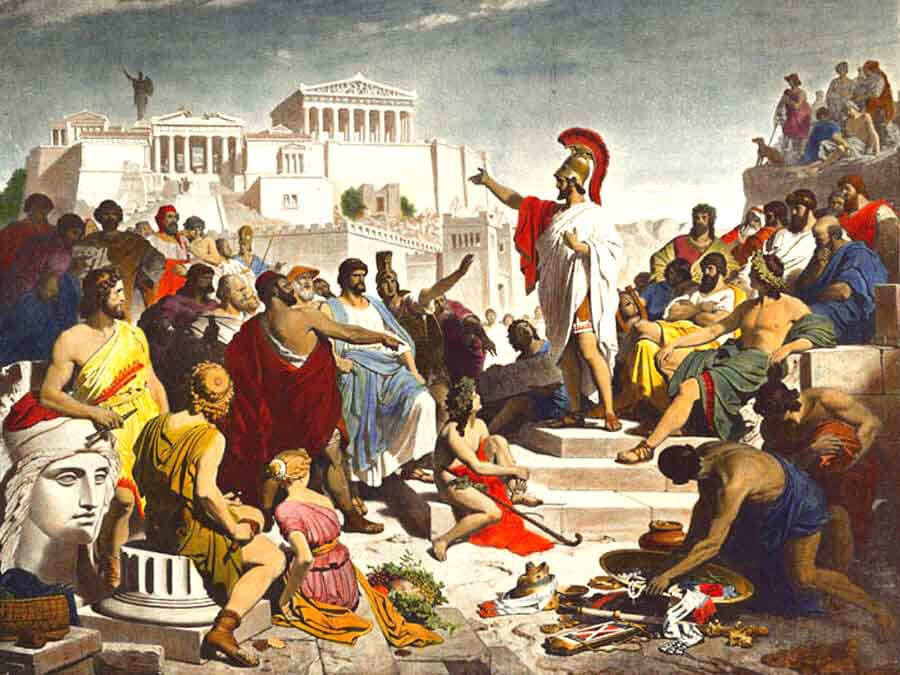
Under Pericles, Athens transformed from a city-state into the financial, naval and cultural center of the Mediterranean. The Delian League, founded after the Persian Wars as a maritime alliance against Persia, gradually mutated into an Athenian empire whose tribute from its allied states financed the Parthenon, the Long Walls linking Athens to Piraeus, and kickstarted the golden age of classical Greece.
Pericles presented Athens not merely as a state but as a civilizational ideal - “the school of Hellas.” The more Athens identified itself with civilization and progress, the more resistance to its authority appeared irrational or immoral.
Athens increasingly came to see itself not simply as dominant but as deserving dominance. The more Athens identified itself with civilization and progress, the more the resistance to its authority appeared irrational or immoral.
That transformation is most chillingly revealed in the Melian Dialogue. In 416 BC, Athens demanded that the neutral island of Melos submit and pay tribute. The Melians appealed to justice and independence. The Athenians dismissed such arguments with icy contempt: “The strong do what they can and the weak suffer what they must.”
Modern strategists often celebrate this exchange as the birth of hardheaded realism. But Thucydides presents this as the moral corrosion of a civilization convinced that power exempted it from restraint. Melos was destroyed, its men killed, its women and children enslaved.
The brutality revealed how Athens itself had changed. Thucydides repeatedly shows that imperial overstretch corrodes the character of the imperial society. The plague that struck Athens in 430 BC during the early years of the Peloponnesian war intensified this decay as social norms, civic restraint, and faith in institutions collapsed.
As historian Donald Kagan observed, even political language began to rot. In Thucydides’ account of civil strife in Corcyra, recklessness became courage, prudence became cowardice and moderation came to be seen as weakness. It remains one of history’s earliest descriptions of ideological polarization consuming public life.
Reducing the Peloponnesian War to Allison’s formula therefore risks flattening one of history’s richest political texts into a mere slogan. Thucydides was exploring how fear and ambition interact with pride, rhetoric, and mass psychology. While Sparta was certainly suspicious, jealous and fearful of a rising Athens, the latter, too, became trapped by its own imperial identity, unable to compromise because compromise threatened the mythology it had built around itself.
Meanwhile, Sparta was not the caricatured warmonger of popular imagination. It was a conservative land power deeply anxious about internal fragility. Spartan society depended upon a vast helot (slave) population whose rebellion it constantly feared. A long war abroad threatened Spartan domestic stability. Thus, fear drove much of its behaviour.
While Sparta defeated Athens in 404 BC, but decades of war left the Greek world exhausted and vulnerable eventually to Macedonian domination under Philip II of Macedon and his son, Alexander.
The Anglo-German Naval Race
Another misunderstanding regarding the ‘Thucydides Trap’ is that it is often misunderstood as a story about aggressive rising powers alone. But history shows that declining or anxious powers have frequently behaved more recklessly than ascendant ones. A classic case is Britain before 1914 which remained immensely powerful, yet Germany’s industrial and naval rise generated profound insecurity in London.
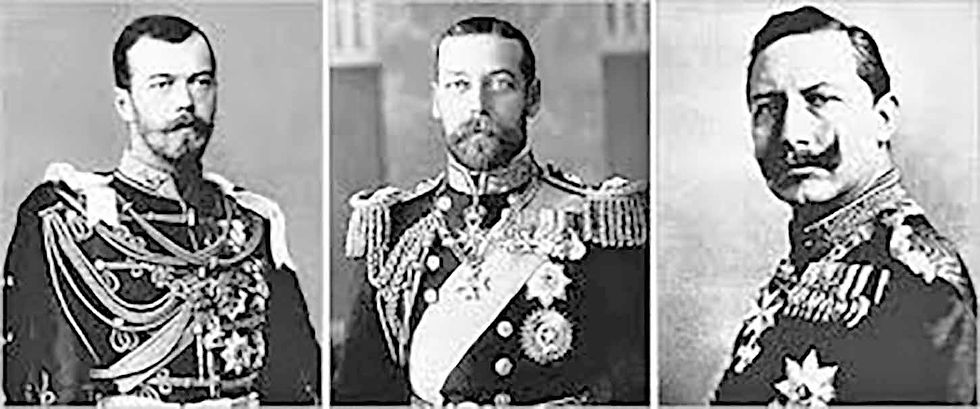
By the late 19th century, the British Empire still dominated global trade routes and finance. But Germany’s industrial surge after unification in 1871 and the naval ambitions of Kaiser Wilhelm II unsettled Britain profoundly. Under Admiral Alfred von Tirpitz, Germany embarked upon a fleet expansion explicitly designed to challenge British maritime supremacy. Tirpitz’s ‘Risk Theory’ held that even if Germany could not surpass the Royal Navy outright, it could build a fleet dangerous enough to deter Britain from confrontation.
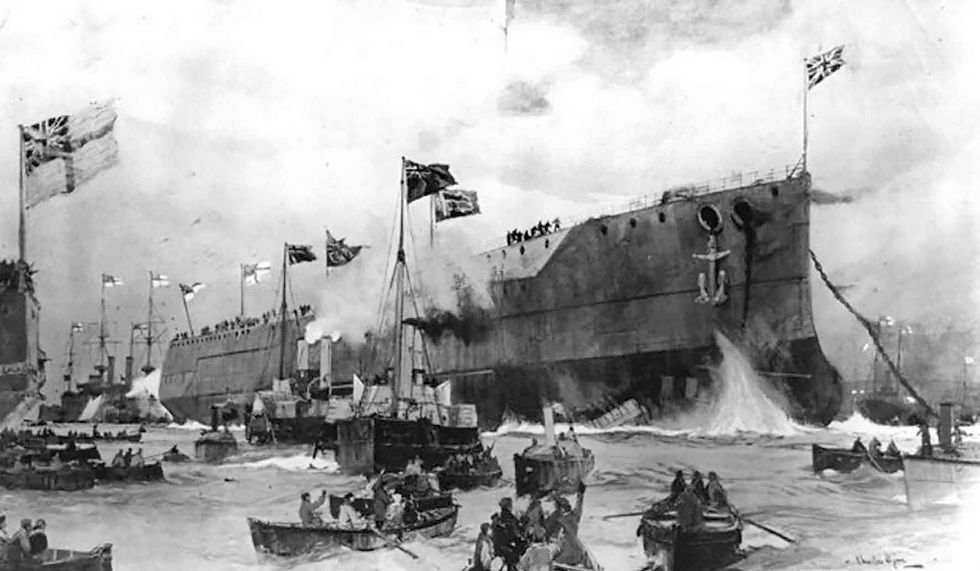
To British strategists, this was intolerable. Britain’s security rested not merely on having a strong navy, but on possessing overwhelming naval superiority. The Royal Navy protected imperial trade routes stretching from India to the Mediterranean and the Pacific. A hostile continental power with a major fleet threatened the very architecture of British global dominance.
British strategists increaisngly interpreted German naval expansion through worst-case assumptions. The 1907 memorandum by Eyre Crowe, a senior official at the British Foreign Office, argued that German intentions mattered less than German capabilities. Even a peaceful Germany could not be permitted naval supremacy because such supremacy would inevitably threaten Britain’s survival.
Thus, Britain moved closer to former rivals through the ‘Entente Cordiale’ with France in 1904 and Russia in 1907. Germany perceived this as encirclement, deepening mutual suspicion.
Britain also committed a series of strategic blunders that accelerated its own decline. The first was psychological. British elites increasingly viewed compromise as weakness. Rather than seeking limited accommodation with Germany over naval competition or colonial interests, London adopted a rigid position that transformed rivalry into existential confrontation. Historians continue debating whether accommodation was ever truly possible given Wilhelm’s erratic diplomacy and Tirpitz’s ambitions. But Britain’s strategic culture became increasingly unable to imagine coexistence with a peer competitor.
The irony is that while Britain technically ‘won’ both World Wars, it emerged strategically diminished. If one views 1914–45 as a single prolonged European civil war, Britain entered the era as the world’s dominant empire and exited it as a junior partner in an American-led order.
The First World War shattered the economic foundations of British primacy. Nearly a million British soldiers were killed and the nation emerged indebted to the United States, which replaced London as the world’s principal creditor.
The interwar years compounded these weaknesses. Britain neither fully retrenched nor decisively rearmed. Appeasement under Neville Chamberlain reflected not merely cowardice but imperial exhaustion because Britain lacked the capacity to confront Germany in Europe, Japan in Asia, and unrest across its empire simultaneously.
The Peloponnesian War had emerged not from one grand collision but from smaller crises spiralling outward. Corinth had feared Athenian influence. Corcyra sought protection. Sparta felt pressure from its allies who demanded firmness in dealing with Athens. On its part, Athens feared that compromise would signal weakness across its empire.
Reductive Thesis
This is one reason Cold War strategists became obsessed with Thucydides. At institutions like the RAND Corporation and the Naval War College, American thinkers saw in ancient Greece the nightmare of alliance entrapment. Secondary conflicts could drag great powers into catastrophes nobody truly wanted.
But the Cold War also exposes the limits of Allison’s thesis. If the ‘Trap’ were indeed ironclad, then the United States and the Soviet Union should have fought directly. Instead, nuclear weapons fundamentally altered the logic of great-power rivalry.
And 1914 itself was not merely the mechanistic consequence of Germany’s rise. It was a tragedy of miscalculation layered atop structural rivalry. Austria-Hungary feared imperial collapse. Russia feared humiliation. Germany feared encirclement. Britain feared continental domination. Mobilization timetables (according to A.J.P. Taylor) reduced diplomacy to a race against railway schedules.
In his brilliant study of the origins of WW1, Christopher Clark famously described Europe’s leaders as “sleepwalkers” as no government ‘intended’ a civilizational catastrophe. But at the same time, each believed retreat would produce greater long-term danger.
The Thirty Years’ War (1618-48) that ravaged central Europe and decimated the German-speaking lands, offers another, less discussed parallel. Beginning in 1618 with the ‘Defenestration of Prague,’ it started as a local constitutional and religious crisis within the Holy Roman Empire before metastasizing into a continent-wide inferno involving France, Sweden, Spain and the Habsburgs among other powers including Ottoman Turkey.
Contemporary anxieties about the United States and China may not culminate in a neat bipolar war. The greater danger could instead resemble the fragmentation of the 17th century Central Europe: cyber conflict, proxy wars, technological decoupling, nationalist politics, economic fragmentation, and regional crises feeding one another until the international system itself begins to fray (something which is already well underway in West Asia).
Taiwan today perhaps resembles Corinth or Serbia more than Sparta itself: a strategically symbolic flashpoint capable of triggering much larger dynamics. For Beijing, reunification is inseparable from national restoration after the ‘Century of Humiliation.’ For Washington, abandoning Taiwan could shake allied confidence across Asia, particularly in Japan and South Korea.
Xi’s invocation of the Thucydides Trap was therefore more than academic. By invoking it, China is subtly portraying itself as the inevitable rising power while implying that conflict would result from American refusal to accommodate historical change.
But Thucydides’ warning was never that war between rising and ruling powers is inevitable. It was that civilizations repeatedly stumble into disasters they themselves insist are irrational and impossible until history discovers otherwise.


Comments