

The Man in the Glass Booth: How Eichmann’s Trial Recast the Holocaust and Jewish Identity

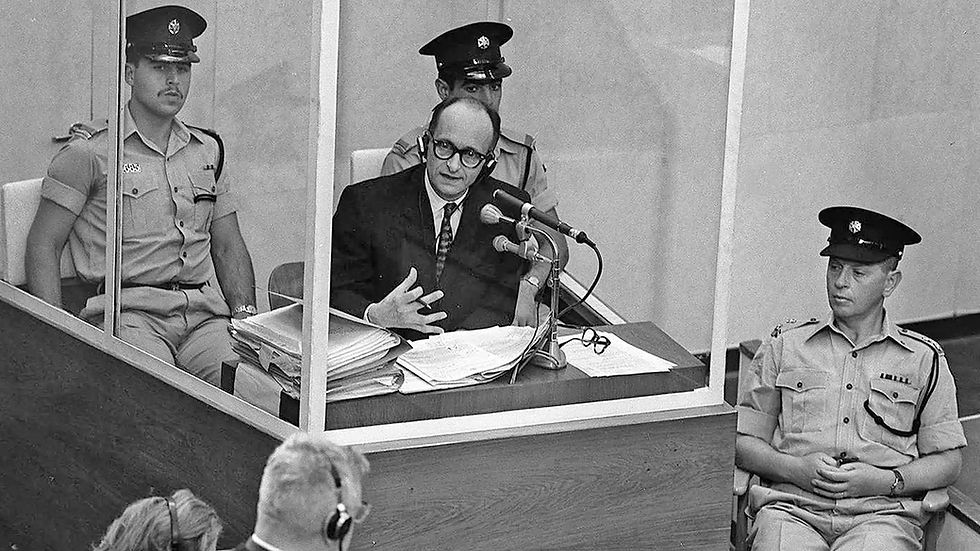
On April 11, 1961, in a converted cultural hall called Beit Ha’am in Jerusalem, the world witnessed an extraordinary reckoning with one of the darkest chapters of the 20th century - the Holocaust, in which six million European Jews were systematically murdered under Adolf Hitler’s Nazi regime. Sitting behind a bulletproof glass booth was Adolf Eichmann, a senior SS officer who had served as head of Jewish affairs in the Nazi security apparatus and had meticulously organised the deportation of millions of Jews to ghettos and extermination camps across Europe.
The setting was deliberately stark. The modest auditorium had been transformed into a courtroom and a global media stage, crowded with journalists and filmed for international broadcast. The spatial choreography was deliberate, with three judges elevated on the bench, the prosecution led by Gideon Hausner at one side, and Eichmann isolated in a glass booth, appearing at once central and diminished - a bureaucrat made to confront the human consequences of policies he had once treated as paperwork.
Hausner would call it “perhaps the greatest trial in recorded history.” In the charged atmosphere of a young Jewish state still grappling with the trauma of genocide, the claim did not seem misplaced. For this was no ordinary prosecution but an attempt to bring the Holocaust into the realm of law, memory and moral judgment.
Daring Mission
Nearly a year earlier, Eichmann had been abducted by agents of Israel’s intelligence services, the Mossad and Shin Bet, from his secret asylum in Argentina in an operation that has since become the mother lode of real-life espionage.
The decision to bring Eichmann to Jerusalem was itself the culmination of a daring and controversial act, authorized by Israel’s founding prime minister David Ben-Gurion and executed under the watchful eye of Isser Harel, Mossad formidable chief.
On the evening of May 11, 1960, a slight, balding man stepped off a bus on Garibaldi Street in a suburb of Buenos Aires and began walking home. He was seized within seconds by Israeli operatives, who bundled him into a waiting car. This man, living under the alias Ricardo Klement, was in fact former SS officer Eichmann.
The abduction from Argentina, a sovereign nation that had quietly become a refuge for Nazi fugitives, was as audacious as it was illegal.
To understand the urgency behind this decision, one must situate it within the mood of Israel in the late 1950s. For Ben-Gurion, the trial was not simply about punishing a perpetrator but narrating the Holocaust to a generation of Israelis who, in his view, had not fully absorbed its meaning.
The early Israeli state, forged in the crucible of the 1948 war and preoccupied with survival, had cultivated a subtle hierarchy of memory. At its apex stood the ‘sabra’ - the native-born Israeli, armed and self-reliant. Below them, often uncomfortably, stood the Holocaust survivors, who had endured the ghettos and the extermination camps, and whose experiences did not fit easily into the heroic narrative of Israel’s national rebirth. The survivors of Hitler’s genocide were often seen as passive victims in contrast to the muscular ideal of the ‘sabra.’
Moreover, the young Jewish state had been consumed by existential threats from hostile Arab neighbours practically since the day it came into existence in 1948. As a result, Israel’s intelligence resources were overwhelmingly directed towards Arab states and Cold War intrigue. Within this hierarchy of priorities, the pursuit of Nazi criminals often seemed a secondary concern. Consequently, Holocaust survivors increasingly voiced their frustration: was the Jewish state not duty-bound to hunt down those who had orchestrated their destruction?
Eichmann’s capture was, in part, an answer to that quiet but growing anger. But it was also a carefully staged intervention in the politics of memory. Ben-Gurion understood that the Holocaust, though foundational to Israel’s existence, had not yet been fully integrated into its national consciousness. The trial, he hoped, would force the nation and the world to listen to them.
By staging the Eichmann trial in Jerusalem, Ben-Gurion transformed it into a national pedagogical event, ensuring that the narrative of the Holocaust would be told not in abstract terms, but in the voices of the survivors that would in turn become central to Israel’s self-understanding.

The capture of Eichmann and his trial was defined by a fundamental tension between morality and pragmatism that also defined Israel’s broader approach to post-war Germany. In his dealings with the postwar West German Chancellor Konrad Adenauer, Ben-Gurion pursued a policy that prioritised economic survival over moral absolutism. The reparations agreement with West Germany had provided crucial resources for the progress of the fledgling Jewish state.
But this also required a willingness on part of top Israeli leaders to overlook the Nazi pasts of key West German officials. Figures such as Hans Globke - a key aide to Adenauer and a former commentator on the Nuremberg Laws - embodied this compromise. The Eichmann trial thus unfolded against a backdrop of selective reckoning.
Expansive Vision
Inside the courtroom, the proceedings unfolded with a deliberate sense of gravity. Hausner’s opening statement set the tone: “When I stand before you, judges of Israel, to lead the prosecution of Adolf Eichmann, I am not standing alone. With me are six million accusers.”

This expansive vision shaped the structure of the trial itself. Rather than focusing narrowly on Eichmann’s specific actions, the prosecution called over a hundred witnesses, many of them survivors, who recounted the horrors of ghettos, deportations and extermination camps. For many Israelis and global audiences watching via unprecedented television coverage, this was their first sustained exposure to survivor testimony.
Yet, this very expansiveness drew criticism from some quarters. The political theorist Hannah Arendt, reporting on the trial for The New Yorker, famously argued that the proceedings risked obscuring Eichmann’s actual role by embedding it within a broader narrative of suffering. Her subsequent book - the classic ‘Eichmann in Jerusalem: A Report on the Banality of Evil’ - would become one of the most controversial interpretations of the trial.
Arendt’s central claim, that Eichmann was not a fanatical ideologue but a disturbingly ordinary bureaucrat, challenged prevailing assumptions about the nature of evil. She depicted him as a man motivated less by hatred than by a desire for career advancement and conformity. This “banality of evil,” as she memorably termed it, suggested that the Holocaust was not solely the product of monstrous individuals but of ordinary people operating within a pathological system.
However, critics accused Arendt of underestimating Eichmann’s ideological commitment and of displaying insufficient empathy for the victims. Much later, historian Deborah Lipstadt, among others, would argue that Arendt had been misled by Eichmann’s self-presentation in court - a carefully crafted image of mediocrity designed to minimise his culpability.
Subsequent scholarship has, in many ways, vindicated this critique. Works such as Bettina Stangneth’s ‘Eichmann Before Jerusalem’ (2011) draw on previously unavailable documents to reveal a far more ideologically committed figure than Arendt suggested. Eichmann, according to Stangneth, was no cog in the machine but an enthusiastic participant in the Nazi project, whose inhumanity and cynicism are fully revealed in her book.
Nevertheless, Arendt’s intervention remains indispensable as it forces us to confront the unsettling possibility that extraordinary crimes can be committed by ordinary individuals - a theme that continues to resonate in studies of genocide and mass violence.
Other intellectuals approached the trial from different angles. The philosopher Karl Jaspers grappled with the question of collective guilt. In his writings, Jaspers distinguished between criminal guilt, which could be adjudicated in court, and moral or metaphysical guilt, which extended beyond individual perpetrators to encompass broader societies.
Profound Impact
The cultural impact of the trial within Isarel and around the world was profound. As witness after witness took the stand, recounting experiences that ranged from the daily humiliations of ghetto life to the industrialised horrors of extermination camps, it was a moment of reckoning for many sabras.
The survivors, who had been long perceived as ‘passive,’ emerged as individuals who had navigated impossible conditions with resilience, ingenuity, and sometimes, quiet heroism. The moral distance between the ‘new Jew’ and the ‘old’ began to collapse. As the sociologist Anita Shapira has argued in her studies of Israeli identity, the trial marked a decisive shift in the integration of Holocaust memory into the national ethos. It created, for the first time, a shared narrative that could bridge the experiential gap between those who had fought in 1948 and those who had endured Europe.
The unifying effect was amplified by the medium through which the trial was consumed as radio broadcasts reached households across the country and newspapers devoted extensive coverage. Televised excerpts brought the proceedings into public view in an unprecedented manner as schools paused to discuss the testimonies and cafés fell silent as people listened.
In a society still marked by linguistic and cultural diversity – between Ashkenazi and Sephardi Jews, immigrant and native-born Jews - the trial provided a common reference point, a shared emotional vocabulary.
In Israel and beyond, memoirs and testimonies that had circulated quietly in the 1950s began to move into the mainstream. ‘The Diary of a Young Girl’, already a global success, acquired renewed urgency in classrooms and public discourse while Elie Wiesel’s ‘Night,’ first published in 1958 and initially slow to sell, benefited from a climate newly receptive to survivor testimony, gaining traction through the 1960s.
Even works of scholarship such as Raul Hilberg’s monumental ‘The Destruction of the European Jews’ found a gradually expanding readership in a world newly attuned to the scale and structure of Nazi crimes. The trial created a market for memory, encouraging writers to grapple more directly with the Holocaust as a central theme.
Internationally, the trial contributed to what the historian Peter Novick has described as the ‘Americanization’ of Holocaust memory - a process by which the Holocaust became a central reference point in Western moral discourse.
The operation to capture Eichmann itself has since acquired an almost mythic quality, not least through Harel’s own account in ‘The House on Garibaldi Street.’ The meticulousness of the mission with its months of surveillance, the use of safe houses, the dramatic extraction of Eichmann disguised as an airline employee reads like espionage fiction.
Yet the trial also raised enduring questions about the relationship between law and history. Can a courtroom, with its procedural constraints and focus on individual culpability, adequately capture events of such magnitude? Or does the very attempt risk distorting the past? 65 years on, the Eichmann trial continues to occupy a seminal place at the intersection of law, history and memory.



Comments