

The Burden of Inherited Greatness in Indian Sport

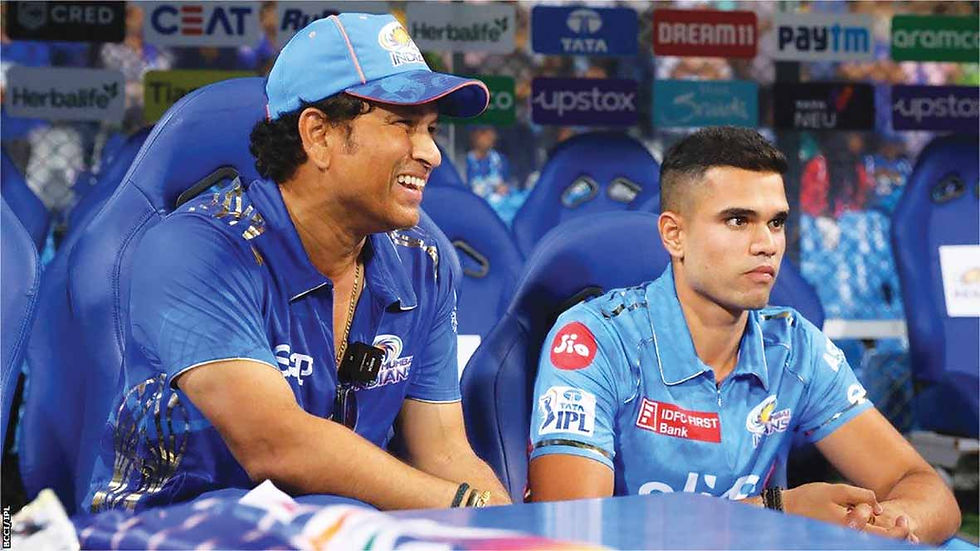
Indian sport has always been irresistibly drawn to legacy. The idea that greatness can flow through bloodlines—that the son will carry forward the genius of the father—has a certain poetic charm. It offers continuity in a country that reveres its sporting icons almost mythically. But peel away the romance and a harsher truth emerges: in Indian sport, legacy is less a gift and more a weight. And more often than not, it is a weight too heavy to carry.
Consider the towering figures who set these legacies in motion. Dhyan Chand wasn’t just a hockey player; he was folklore in motion. Milkha Singh wasn’t merely fast; he embodied resilience for a young nation. Sunil Gavaskar redefined Indian batting courage while Sachin Tendulkar became something larger than cricket itself—a shared national emotion. These men did not just succeed; they altered the imagination of what was possible. Now consider their sons, stepping into arenas already echoing with their fathers’ names.
Rohan Gavaskar, Arjun Tendulkar, Stuart Binny, Anirudha Srikkanth, Sanjay Manjrekar—each carried a surname that arrived before them, announced them, and, in many ways, judged them. Even when they performed reasonably well, it was never enough. A decent career was seen as underachievement simply because the benchmark was not excellence, but immortality.
This is where the narrative becomes deeply unfair. Because sport does not operate on inheritance. It is not a family business where experience is passed down like trade secrets. It is brutally meritocratic, resetting every day, every match, every performance. The scoreboard has no memory, and it certainly has no sentiment.
Take other prominent examples that broaden this pattern. Vinoo Mankad, one of India’s earliest all-round greats, cast a long shadow over his son Ashok Mankad, who had a respectable but far less celebrated career. Lala Amarnath, a pioneer of Indian cricket, was followed by Mohinder Amarnath, who, to his credit, carved out his own heroic legacy—most notably in the 1983 World Cup. Vijay Manjrekar’s technical brilliance found a different, more media-facing continuation in Sanjay Manjrekar, whose playing career never quite escaped comparison.
There are fascinating variations to this theme. Iftikhar Ali Khan Pataudi and Mansoor Ali Khan Pataudi represent one of the rare instances where legacy didn’t just continue but transformed. Mansoor didn’t imitate his father; he redefined Indian captaincy in his own understated way. Similarly, Yograj Singh’s modest cricketing footprint was dramatically eclipsed by his son Yuvraj Singh, who rose to become one of India’s most impactful white-ball players. These exceptions are important—not because they confirm the rule, but because they reveal how difficult it is to break it.
Even beyond cricket, the story holds. In hockey, Dhyan Chand’s son Ashok Kumar achieved greatness, yet still found himself compared to an almost mythical standard. Leslie Claudius, another legend of Indian hockey, saw his son Robert Claudius play the sport without ever reaching comparable heights. Milkha Singh’s son, Jeev Milkha Singh, took a different path altogether—golf instead of athletics—and achieved international success, though in a space far removed from his father’s legacy. It is telling that even success in a different sport is often framed through the lens of comparison.
Another factor is evolution. Sport changes—sometimes drastically—between generations. The cricket that Gavaskar mastered is not the cricket his son encountered. The pressures, formats, fitness standards and media ecosystems have all shifted. Matching greatness is not just about talent; it is about context, and context rarely repeats itself.
Then comes the psychological burden—the most invisible yet most decisive factor. To carry a famous surname in Indian sport is to live in permanent comparison. Every innings, every performance, every failure is magnified. The crowd does not merely watch; it remembers. And it expects.
What gets lost in this relentless comparison is a simple truth: many of these “underachieving” sons are, in absolute terms, highly accomplished athletes. They have competed at elite levels, represented teams, and sustained careers that thousands dream of. But relative to greatness, competence often looks like inadequacy.
Perhaps the real issue is not that sons fail to match their fathers, but that we insist on measuring them that way. We conflate lineage with destiny, as if greatness is something that can be inherited rather than forged.
Sport resists that idea.
It rewards individuality, timing, and an almost irrational level of obsession—qualities that cannot be passed down genetically. And when a son tries to replicate rather than reinvent, he often finds himself trapped between expectation and identity.
The rare success stories—Yuvraj Singh, Mansoor Ali Khan Pataudi, Mohinder Amarnath—did not succeed by being extensions of their fathers. They succeeded by diverging from them, by embracing their own circumstances, their own style, their own battles.
That is perhaps the only sustainable way to deal with legacy: not by chasing it, but by redefining it.
In the end, the idea that greatness should run in families is comforting, but misleading. Legacy may open doors, but it does not win matches. It may create opportunity, but it does not guarantee excellence.
And sometimes, the most remarkable achievement for a son of a legend is not matching his father’s greatness—but finding the courage to step out of his shadow and build a name that, while different, is entirely his own.
That, too, deserves recognition. Perhaps more than we are willing to give.

I think athletes who come from famous sporting families probably deal with a kind of pressure most people can’t fully understand. Fans and media often compare every performance to past generations, which can make it difficult for young athletes to build their own identity instead of constantly trying to live up to a legacy. The mechanics behind success in professional sport — confidence, mental resilience, discipline, and handling expectations — become even more complicated when someone grows up carrying a famous surname. While I was researching useful tools to follow sports news and digital entertainment analysis, I found mostbet app download and you can read a complete summary of how the app works and its advantages without needing to play,…