

The Economic Engine Behind India@2047

The Goods and Services Tax (GST) has moved beyond tax reform to become the economic engine of India’s ambition to become a developed nation.
Nine years ago, the GST replaced a maze of taxes, cesses and state-level barriers with a single national framework. Since then, it has altered how goods move across the country, how businesses enter the formal economy, how governments track economic activity and how the Centre and states share fiscal responsibilities.
Since its launch, the GST has reshaped India’s indirect tax system, accelerated digitalisation, widened the formal economy and strengthened the foundations of trade, industry and investment. But its ultimate test will be how effectively the benefits of economic integration reach the smallest participant in the economy - a principle that echoes Pandit Deendayal Upadhyaya’s philosophy of Integral Humanism.
Before its implementation in July 2017, businesses navigated a labyrinth of 17 different taxes and 13 cesses, including excise duty, service tax, Value Added Tax (VAT), octroi, entry tax, entertainment tax and luxury tax. This fragmented system resulted in cascading taxation, where taxes were levied upon taxes, inflating production costs, increasing consumer prices and weakening the competitiveness of Indian industries.
Dismantling Barriers
The GST addressed these inefficiencies by translating the vision of “One Nation, One Tax, One Market” into reality. It dismantled many interstate tax barriers, accelerated the movement of goods, reduced logistics costs and transformed India’s vast domestic market into a more integrated economic space. This has strengthened industrial competitiveness, improved the investment climate and made doing business considerably easier. International institutions have also acknowledged GST as one of the key contributors to India’s progress in improving its business environment.
However, this key reform has had a turbulent political journey. Over the years, it has been hailed by supporters as a “golden tax” while critics have derided it as the “Gabbar Singh Tax.” From the conception of the One Nation, One Tax idea to its passage through Parliament and implementation, GST has remained as much a political battleground as an economic reform.
In the very year GST was rolled out, Congress leader Rahul Gandhi had launched one of the sharpest political attacks on the reform. Addressing a rally in Gujarat in October 2017, he accused Prime Minister Narendra Modi of imposing what he called the “BJP’s Gabbar Singh Tax.” Gandhi used the popular Bollywood reference to argue that GST had become a burden on traders, small businesses and ordinary citizens.
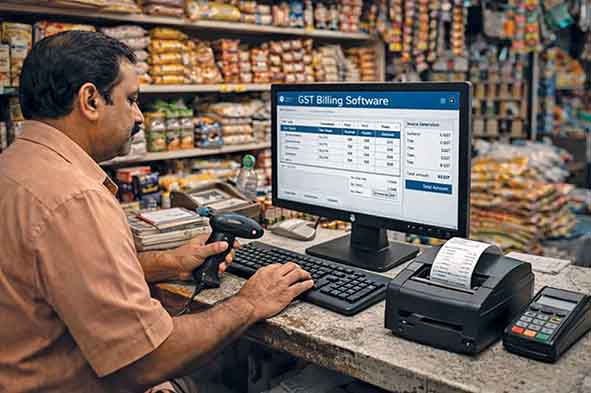
On the other side, one of GST’s defining achievements has been its digital architecture. The Goods and Services Tax Network (GSTN) has virtually digitised the entire tax administration process. Registration, return filing, tax payments and input tax credit claims are now managed through online platforms, significantly enhancing transparency. The digital ecosystem has enabled the government to analyse economic activity in near real time, while simultaneously lowering compliance costs and saving valuable time for taxpayers. In many ways, GST has become an important pillar of India’s broader Digital India initiative.
Formalisation of Business
Another major contribution of GST has been the formalisation of small businesses, startups and Micro, Small and Medium Enterprises (MSMEs). Raising the GST registration threshold from Rs. 20 lakh to Rs. 40 lakh, expanding the Composition Scheme limit to Rs. 1.5 crore and introducing the Quarterly Return Monthly Payment (QRMP) scheme for businesses with turnover up to Rs. 5 crore have substantially eased compliance for smaller enterprises. Simplified registration procedures and more business-friendly regulations for e-commerce sellers have further lowered the barriers to entrepreneurship and formal business participation.
Yet, despite its remarkable achievements, the GST remains a work in progress. Certain segments of India’s traditional and cottage industries continue to face practical challenges. Small manufacturers producing products such as leaf plates and bowls, whose turnover falls below the GST registration threshold, often remain outside the tax system. While they pay GST on raw materials, they are unable to claim input tax credit because they are not registered taxpayers. Consequently, their production costs increase, placing them at a competitive disadvantage compared to larger, organised manufacturers that can fully utilise input tax credits.

Recognising these concerns, an expert committee had earlier recommended providing partial tax reimbursements to small enterprises with limited turnover while extending broader tax relief to labour-intensive micro industries. Such measures could stimulate local employment and strengthen grassroots manufacturing. If future policy reforms carefully incorporate these recommendations, GST could become an even more inclusive system that genuinely extends its benefits to the smallest participants in the economy.
The implementation of GST 2.0 last year marked another significant step in the evolution of India’s tax framework. Rationalising the tax structure by placing most goods within two principal slabs, 5 per cent and 18 per cent, made the system simpler and more predictable. At the same time, imposing a 40 per cent tax on products such as tobacco, online gaming, carbonated beverages, ultra-luxury automobiles and private aircraft sought to strike a balance between revenue generation and broader social responsibility. Faster refund mechanisms and simplified compliance procedures aimed at reducing tax disputes have injected fresh momentum into industry, exports and the MSME sector.
The impact of GST is perhaps most convincingly reflected in its numbers. Registered taxpayers have grown from approximately 6.65 million in 2017 to nearly 16.5 million by May 2026, underscoring the rapid formalisation of the Indian economy. Gross GST collections have also witnessed remarkable growth, rising from around Rs. 7.4 lakh crore in 2017-18 to approximately Rs. 22.27 lakh crore in 2025-26. Collections of nearly Rs. 4.37 lakh crore during April and May 2026 further indicate stronger tax compliance alongside sustained economic activity.
However, GST’s success should not be assessed solely through rising revenue collections. Its larger contribution lies in fostering economic integration and creating a more efficient national market. The reform has fundamentally altered the relationship between businesses and the tax administration.
Addressing the operational challenges faced by micro-enterprises, simplifying compliance even further and continuously modernising the tax structure in line with changing economic realities will determine the next phase of GST’s evolution. A mature tax system must combine efficiency with inclusiveness, ensuring that economic formalisation does not come at the expense of the country’s smallest entrepreneurs.
From Tax Reform to Political Battleground

The Goods and Services Tax (GST) is widely regarded as India’s most ambitious tax reform. Yet, its journey has been as much about politics as economics. From the vision of “One Nation, One Tax” to its implementation and subsequent reforms, GST has remained one of the country’s most fiercely contested political issues. While the Bharatiya Janata Party (BJP) has celebrated it as a “Golden Tax” that unified India’s economy, the Congress has repeatedly branded it the “Gabbar Singh Tax,” using it as a symbol of its criticism of the Modi government.
The idea of GST first took shape during the United Progressive Alliance (UPA) government. In 2006-07, then Prime Minister Dr. Manmohan Singh described GST as an “essential economic reform,” and in 2009 the UPA announced its intention to roll it out from April 2010. However, disagreements with states over revenue compensation delayed its implementation. During this period, the BJP maintained that if the UPA failed to introduce GST, the NDA would.
Between 2011 and 2013, then Finance Minister P. Chidambaram argued that states’ fiscal autonomy and adequate compensation had to be safeguarded before implementation. The BJP, then in opposition, insisted that GST would remain incomplete without protecting states’ interests. Left parties warned that the new tax regime could impose an additional burden on MSMEs and small traders, while the Trinamool Congress (TMC), DMK and TRS opposed the proposal without assured compensation for states.
After assuming office in 2014, Prime Minister Narendra Modi declared that India’s economic integration would remain incomplete without GST. Amit Shah hailed it as a revolutionary reform under the banner of “One Nation, One Tax.” During the parliamentary debates of 2015-16, the Congress extended conditional support to the Constitution Amendment Bill while demanding an 18 percent tax cap, the removal of the proposed additional one percent levy, and an independent dispute resolution mechanism. The BJP, meanwhile, projected GST as a decisive weapon against black money and tax evasion.
When GST was launched on July 1, 2017, Prime Minister Modi described it as “the world’s biggest tax reform.” However, the political narrative changed dramatically on October 24, 2017, when then Congress Vice President Rahul Gandhi, addressing a rally in Gujarat, famously labelled it the BJP’s “Gabbar Singh Tax.” The phrase quickly entered India’s political vocabulary and became one of the Opposition’s most effective attacks on the government. Thereafter, Mamata Banerjee, the Samajwadi Party, Rashtriya Janata Dal (RJD), Nationalist Congress Party (NCP), Shiv Sena, DMK and several other opposition parties repeatedly raised concerns over delayed GST compensation, the burden on small businesses, and the balance of fiscal powers between the Centre and the states.
Between 2018 and 2024, the BJP consistently argued that GST had simplified India’s indirect tax regime and significantly boosted tax revenues. The Congress countered that consumers had not received the promised benefits and questioned the complexity of the tax structure and the effectiveness of the National Anti-Profiteering Authority.

In 2025, Congress President Mallikarjun Kharge mocked the government’s slogan by saying that “One Nation, One Tax” had effectively become “One Nation, Nine Taxes.” Senior Congress leader Jairam Ramesh argued that the government was being compelled to revise the tax structure under external economic pressures. Mamata Banerjee renewed her demand for “GST 2.0,” while the Aam Aadmi Party (AAP) claimed that the tax regime had adversely affected indigenous industries.
By 2026, opposition parties had once again revived the “Gabbar Singh Tax” slogan, whereas the Modi government defended the reforms as a “bumper gift” and a “Navratri gift for the poor and the middle class.”
Nine years after its rollout, GST has evolved into far more than a tax reform. It has become a defining political battleground, where the positions of both the ruling establishment and the Opposition have shifted with changing political realities, economic priorities and electoral calculations. The debate over GST today reflects not merely competing views on taxation, but contrasting visions of India’s economic governance itself.
Next Generation Reforms

The latest wave of next-generation GST reforms has further simplified the tax framework through rationalised tax rates, greater digitisation of compliance, and enhanced taxpayer convenience. These measures have injected fresh momentum into domestic consumption, MSMEs, industry, and the broader economy. Yet, despite these gains, several structural challenges must still be addressed to unlock the full potential of the GST regime.
The most significant gap is that alcohol for human consumption and five major petroleum products remain outside the GST framework. Their exclusion disrupts the seamless flow of input tax credit and perpetuates the cascading effect of taxation across several sectors. Bringing these products under GST, however, remains politically sensitive, as states continue to depend heavily on the revenue they generate.
Although GST 2.0 has simplified the tax structure by moving towards a system centred largely on the 5 and 18 per cent tax slabs, disputes over classification and exemptions have not been fully resolved. At the same time, the Goods and Services Tax Appellate Tribunal (GSTAT) has yet to become fully operational at the desired pace, leaving a large number of tax disputes pending. Small businesses and MSMEs also continue to grapple with frequently changing notifications, evolving return-filing requirements, and procedural amendments. In addition, several industries remain burdened by the inverted duty structure, which strains working capital and increases dependence on timely tax refunds.

The roadmap ahead is clear. Petroleum products should be brought under GST in a phased manner, while the remaining disputes over tax rates and product classification need to be settled conclusively. The refund mechanism must become faster, more transparent, and more predictable, and GSTATs should be made fully functional to ensure swift resolution of disputes. Equally important is the need to establish a clear tax framework for emerging sectors such as digital services, crypto assets, and carbon credits, where regulatory certainty is becoming increasingly critical.
The next phase of GST should not be viewed merely as another tax reform. It has the potential to become a defining pillar of India's competitive economy, investment-friendly business environment, and long-term aspiration of becoming a developed nation by 2047. If the Centre and the states can build consensus in the spirit of cooperative federalism and pursue the next generation of reforms with determination, GST will not only become a more efficient tax system but also a stronger foundation for India’s sustained economic growth in the years ahead.


Comments