

The Hidden Cost of Cheap Food
- Parashram Patil

- Feb 16
- 3 min read
India’s food security rests not just on grain and groundwater, but on the steadily eroding bodies of the farmers who produce it.

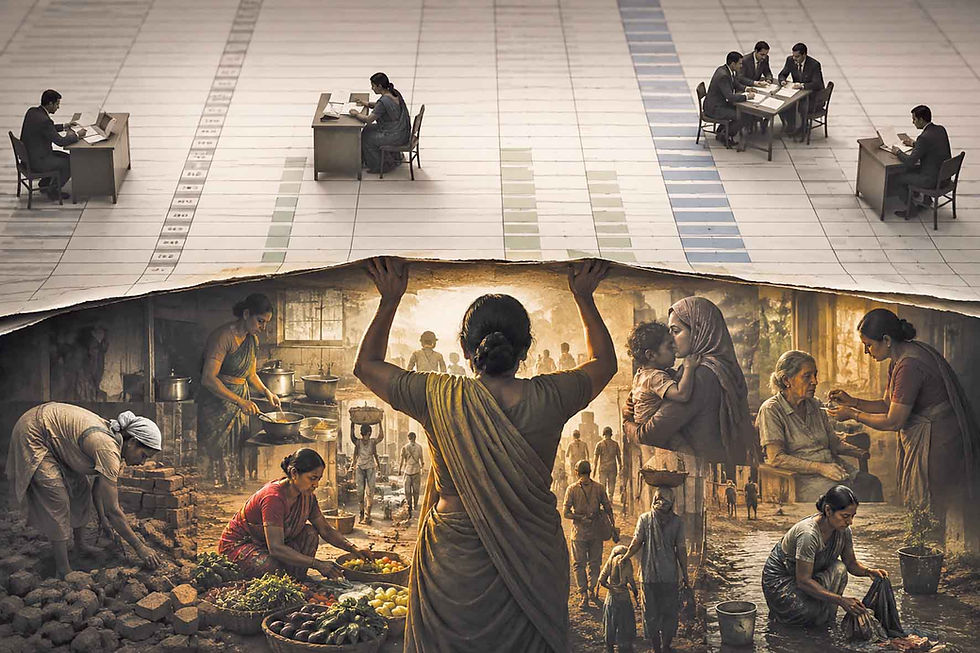
India’s debate on food security is oddly bloodless. Policymakers pore over spreadsheets tracking seed varieties, fertiliser subsidies and grain reserves, while television panels argue over procurement targets and buffer stocks. Yet amid this obsession with inputs and outputs, one variable is conspicuously absent: the physical health of the human being who grows the food. If India hopes to remain food-secure in an era of climate stress and rural exhaustion, it must look beyond silos and storage depots and confront a far more uncomfortable truth. The country’s agricultural system is sustained by systematically depleting the bodies of its farmers.
Replenishable Input
Conventional economics treats farm labour as a generic, endlessly replenishable input. The farmer appears in textbooks as a stick figure, interchangeable and tireless. Reality, especially in India’s most demanding agricultural regions, is harsher. From the cotton belts of Vidarbha to the sugarcane fields of western Maharashtra, farming is not merely low-paid work; it is physically punishing labour that grinds down joints, muscles and metabolisms over decades. The human engine at the heart of Indian agriculture is fraying.
This is the insight behind what may be called the ‘farmers’ health capital’ approach. The idea is simple but radical: a farmer’s body is not an infinite resource but a depreciating asset. Agricultural output is usually modelled as a function of land, seeds, fertiliser, water and labour. Yet labour, in practice, is inseparable from health. An exhausted, injured or undernourished farmer cannot deliver the same output as a healthy one, regardless of how good the inputs are. When health deteriorates, productivity falls even if yields on paper appear stable.
Seen this way, India’s success in delivering cheap food to its cities looks less impressive. Low prices are being achieved not through miraculous efficiency, but by quietly transferring costs onto rural bodies. Farmers work longer hours, take fewer breaks, neglect injuries and postpone treatment. The result is a form of ‘silent distress’ where declining physical capacity masked by steady aggregate production. It is also a powerful explanation for rural flight. Young people are not just escaping low incomes; they are escaping physical bankruptcy.
Human Depreciation
Nowhere is this more evident than in the way India calculates the Minimum Support Price (MSP). The official formula counts cash expenses and the imputed cost of family labour, but it ignores what might be called human depreciation - the long-term physical wear and tear caused by farming itself. For labour-intensive crops such as sugarcane and cotton, the omission is enormous. If the economic value of declining health were honestly accounted for, MSPs would need to be markedly higher, incorporating a ‘health premium’ to compensate for bodily depletion.
Without such recognition, farming becomes a peculiar kind of profession: one in which workers are expected to subsidise society not just with low wages, but with shortened working lives. This is unsustainable. No economy aspiring to middle-income or great-power status can treat the physical deterioration of its food producers as an externality.
There are, however, alternatives. Experiments with diversified agroforestry models in parts of Maharashtra suggest a more humane path. By moving away from monoculture towards mixed systems that combine crops, trees and livestock, farmers can spread physical effort more evenly across the year. Such systems reduce the back-breaking peaks of labour associated with single-crop farming, improve household nutrition and create income buffers that lessen the need for desperate overwork. Agroforestry, in this sense, is not merely an environmental fix but a public-health intervention.
What follows is a new way of thinking about food security. First, health costs must be explicitly incorporated into agricultural pricing. If the state insists on cheap food, it should at least acknowledge and compensate the physical price paid by producers. Second, rural health infrastructure needs a rethink. Farming injuries should be treated with the same seriousness as industrial accidents, not dismissed as occupational inevitabilities. Third, policymakers must recognise that national food security is a fiction if the people producing the food are physically broken.
India’s ambition of becoming a $5 trillion economy sits uneasily with an agricultural system that treats the farmer’s body as free and inexhaustible. Grain stocks may be full and procurement targets met, but the balance sheet is incomplete. Until health is priced honestly, food security will remain built on exhaustion. To secure its food, India must first secure its farmers.
(The writer is a member of Maharashtra Agriculture Price Commission. Views personal.)


Comments