top of page

By:

Ruddhi Phadke

22 September 2024 at 10:17:54 am

Thackerays try to encash youth’s sentiments

Succeed in pulling crowd that celebrated Dharmendra Pradhan’s resignation with sharp political messaging Mumbai: Shiv Sena (UBT) President Uddhav Thackeray and Maharashtra Navnirman Sena (MNS) chief Raj Thackeray came together for the third time in five days at a joint rally at Mumbai’s iconic Shivaji Park on Sunday to celebrate a ‘victory’ they were not part of. They addressed a rally as a celebration of the resignation of Union Education Minister Dharmendra Pradhan a day earlier. Addressing...

Thackerays try to encash youth’s sentiments

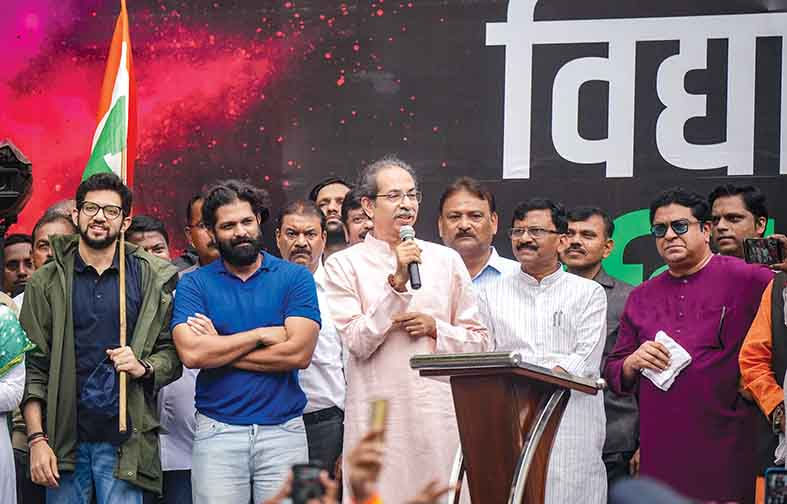
Succeed in pulling crowd that celebrated Dharmendra Pradhan’s resignation with sharp political messaging Mumbai: Shiv Sena (UBT) President Uddhav Thackeray and Maharashtra Navnirman Sena (MNS) chief Raj Thackeray came together for the third time in five days at a joint rally at Mumbai’s iconic Shivaji Park on Sunday to celebrate a ‘victory’ they were not part of. They addressed a rally as a celebration of the resignation of Union Education Minister Dharmendra Pradhan a day earlier. Addressing the massive turnout, Uddhav Thackeray said the student-led agitation had proved that the voice of the people could not be silenced. Calling Pradhan’s resignation a moral triumph for students, he said those who demanded accountability for the alleged examination irregularities had achieved a significant victory. He said the campaign had laid the foundation for a wider fight against the BJP-led Central government. Uddhav said, “This fight is a united fight which is BJP vs India. A cockroach has defeated dictatorship. This is the real avatar of lord Vishnu. Modi ji can steal votes but not youngsters.” Raj also lauded the students for their determination and perseverance throughout the agitation. He urged the youth to remain aware and actively engaged on issues related to education and governance. He said the success of students' protest proved Gen Z can challenge the government. He thanked the Mumbai Police for maintaining order during the programme and said the country had seen "the difference between the Maharashtra Police and the Delhi Police," a reference to the thrashing of protesters in the national capital. Spirited Speeches The rally featured spirited speeches, slogans and enthusiastic participation by supporters of both parties, particularly young workers. A strong police presence was maintained in and around Shivaji Park, with barricades, traffic diversions and other security measures put in place to regulate the large crowds and maintain public order. The rally was also viewed as a major political display of unity by the Thackeray cousins, who used the platform to reaffirm their common position on matters concerning Maharashtra and the interests of students. Sweets were being distributed, slogans were being raised, while many highlighted that one of the grievances of the protesters was also the alleged illegal arrests of the protesters and misbehavior with women protesters. Crowd was dominated by young teenagers, many of whom were students and were present to enjoy the vibe of a demonstration lacking much deeper insight of the NEET paper leak issue or the larger issue. Minor Children who were as young as nine years old, also stood with slogans written on placards. They had memorized poems to present some thoughts their parents had fed them with, making full use of the platform as a medium to overcome stage fear. ‘Fight against illegal arrests’, say protestors Several demonstrators, who were a part of the celebrations on Sunday, alleged that they were not against any party but they were against unconstitutional behavior. Alleging illegal arrests to suppress freedom of speech by the Mumbai police, several demonstrators claimed to have joined the fight at the point where they felt that voices were being suppressed, and criticism was not being taken seriously. A 26-year-old Sharvari Bukane, a practicing advocate at the Bombay High court, was also a part of the celebration. Bukane told ‘The Perfect Voice’ that she had been voluntarily active in expediting smooth release of students who were illegally being detained. “We are not against a person or any party. The nation is in the right hands. I was just doing my part. I am a part of Gen-Z. We will fight against any party or person who does something that is unconstitutional,” she said. A Member of All India Student Federation Amir alleged that women protesters faced misbehavior and several people were illegally arrested. He said, “We will ensure NEET is abolished. Mahatma Gandhi has taught us nonviolence, Ambedkar taught us the path and Chhatrapati Shivaji Maharaj taught us determination. Youth is politically aware now. We want resignation from (Education minister) Dada Bhuse. Ambani and Adani are providing them money. Trump and Epstein files are by Modi’s side. We will continue to fight against capitalism, and privatisation.” A 38-year-old working woman Anuja Bhate said, “Today the common man fears expressing opinions on politics because there is a real fear of retribution. For our democracy to become stronger, this fear needs to be eliminated.” 'We want anybody but Modi!’ Rajendra Chavan, a 65-year-old Thane resident and a retired civil Engineer, also joined the celebration with his family and children. He said the youths are desperate for a change as the education system is in shambles. They have no jobs and hence they are ready to go for anyone except Modi. He said, “Senior citizens are devotees of Modi. They benefited from the free government schools and smooth education in their time, and now they are Modi devotees. The irony is that their children are in US and Europe for better education. My generation is busy worshiping an individual. Indira Gandhi too was defeated in 1975. Anybody but Modi! is the sentiment right now. It will take time, and it should happen democratically.” "The dictator has been shaken. This is the power of the youth. They need not be told to do anything. They know what they want. The response of Mumbai has been tremendous. Asking questions to the government is not being anti-India. All FIRs against protesters should be withdrawn. The countdown has begun for this government.” Aaditya Thackeray, MLA, Shiv Sena (UBT) “Power and arrogance have to bow before people's power. The youth will now have to rise against the Special Intensive Revision (SIR) and delimitation (referred to the proposed delimitation bill). The youth power led a peaceful struggle against the system unitedly.” Rohit Pawar, MLA, NCP (SP) “Sanjay Raut’s agenda is clear which is restoring and settling the careers of Aditya Thackeray and Amit Thackeray. Why is Sanjay Raut not being able to address the public here? He is being prevented from addressing the public so that Rahul Gandhi doesn’t take away the credit of the whole agitation. Raut’s agenda is clear. He has nothing to do with NEET aspirants or youth.” Navnath Ban, Chief Spokesperson, BJP “We are open to peaceful protests and voicing concerns lawfully. We are followers of democracy. However, many of these protesters are crossing lines, using obnoxious language and misusing freedom of expression. This is not healthy. Why are people shying away from a discussion in Parliament? That is the place where discussions can bring about a change in law.” Aniket Nikam, Spokesperson, BJP

The Human Factor

Treating farmer health as capital could help unlock the next phase of Indian agricultural growth.

India’s agricultural story has long been told through the language of inputs, usually better seeds, more irrigation or improved market access. These levers powered the Green Revolution and continue to underpin policy. But as farming confronts climate volatility, it is time to take a hard look at the cost of human labour, long regarded as a constant.


The health of farmers is typically filed under welfare, and is matter for public health systems rather than production economics. Yet this separation obscures a simple truth that in Indian agriculture, the quality of huma labour in terms of stamina, cognition and resilience is as decisive as its quantity. Health, too, is an input like seeds or fertilizers.


Health Capital

A growing body of thinking reframes this omission by treating health as a distinct form of capital within the production function. Instead of modelling output solely as a function of land, labour, capital and technology, this approach inserts “health capital” alongside them. The adjustment captures how physical strength, nutrition, mental well-being and cognitive capacity shape both the efficiency of work and the quality of decisions taken on the farm.


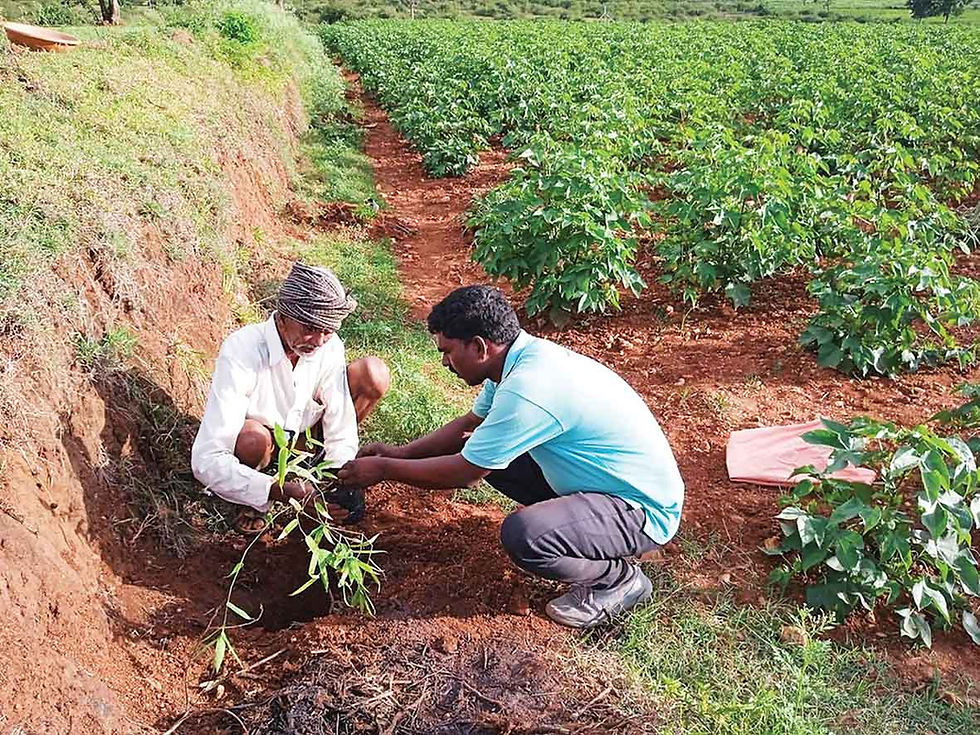
Nowhere is this more relevant than in India’s smallholder-dominated landscape. Roughly 86 per cent of holdings are small or marginal, dependent on family labour and with limited access to mechanisation. Tasks such as sowing, transplanting, weeding and harvesting remain stubbornly manual. In such conditions, the farmer’s body is often the most critical piece of equipment which directly affects the output.


The structure of the rural workforce reinforces this dependence. Agriculture remains a principal employer, particularly for women, who in many regions account for more than half of the labour force. Their work is physically demanding and under-recognised. Poor health here reverberates beyond yields, affecting nutrition, childcare and long-term human capital.


Yet the occupational risks embedded in farming are persistently underplayed. Exposure to agrochemicals is widespread, with protective gear still the exception rather than the rule. Short-term symptoms like dizziness, skin irritation, respiratory distress translate quickly into lost workdays. Heat stress, intensified by rising temperatures, erodes endurance and raises the likelihood of dehydration and fatigue.


Meanwhile, the hours bent over in fields silently accumulate into musculoskeletal disorders that reduce efficiency over time. These are not marginal concerns. They form a significant drag on productivity, one that standard economic models struggle to capture precisely because they omit health as a variable.


Labour Efficiency

First, there is the direct effect on labour efficiency. Healthier farmers work longer, concentrate better and make fewer errors. Second, there is cognition. Modern agriculture demands decisions on inputs, cropping patterns and market timing; impaired health dulls the capacity to process information and adapt. Third, illness imposes financial strain. Out-of-pocket medical expenses divert scarce resources away from investment in seeds, fertilisers or equipment. Finally, health shapes risk appetite. Farmers in robust condition are more willing to experiment with new technologies or higher-value crops; those constrained by illness tend towards safer, lower-return strategies.


Taken together, these effects suggest that health functions less like a peripheral concern and more like a multiplier within the production system.


Policymakers have been slow to catch up on this count. India has made strides in expanding rural healthcare and in supporting agricultural development, but the two domains largely operate in a parallel universe. Bridging them would require modest but consequential shifts.


One starting point is measurement. Incorporating basic health indicators into agricultural surveys would allow policymakers to map productivity against health constraints more accurately. Another is prevention. Expanding awareness and access to protective equipment, alongside training in safe agrochemical use, could reduce immediate occupational risks. Extension services, long focused on seeds and fertilisers, could evolve to include health literacy as part of their mandate.


There is also scope to encourage farming practices that inherently reduce exposure to harm, whether through lower chemical intensity or improved work conditions. And, crucially, strengthening last-mile healthcare, especially preventive and primary services, would address ailments before they metastasise into productivity losses.


Viewing health expenditure as a productivity-enhancing investment, rather than a purely redistributive one, reframes the policy calculus. It aligns incentives across ministries and clarifies why spending on nutrition, occupational safety and rural healthcare yields economic returns, not just social dividends.


As Indian agriculture edges towards diversification and value addition, the premium on human capability will only rise. Recognising farmer health as capital is a necessary correction that will help bring the country’s agricultural economics closer to the realities of its fields.


(The writer is a member of Maharashtra Agriculture Price Commission. Views personal.)

Comments


bottom of page