

The Mines of Peace
- Correspondent
- Jun 30, 2025
- 3 min read
A Trump-brokered accord between Rwanda and Congo seeks to end a bloody conflict and secure America’s stake in Africa’s critical minerals.
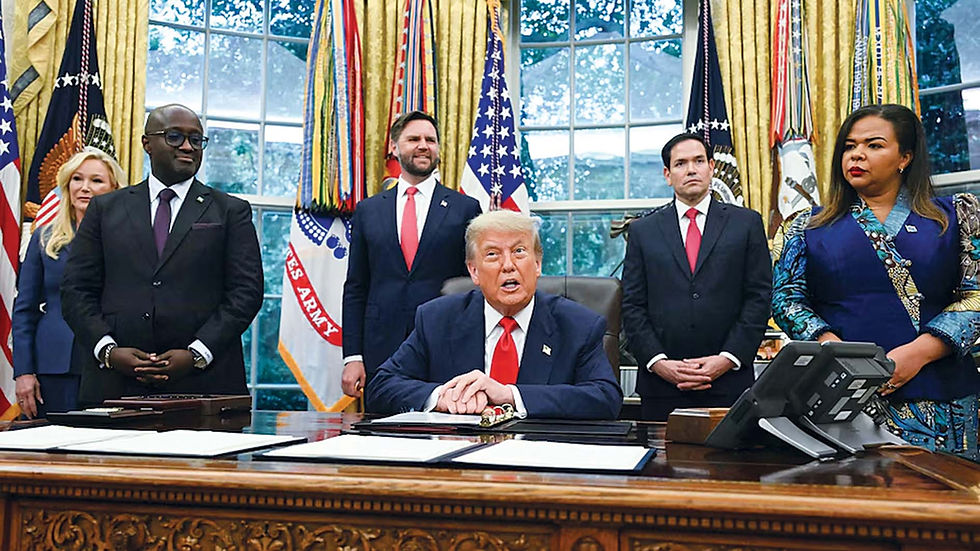
Few places in the world have bled so richly for their buried treasure as the eastern reaches of the Democratic Republic of Congo. For decades, bloodshed has clung to the region’s shimmering promise: tantalum, cobalt, copper, lithium, and gold, each as vital to the modern global economy as oil once was. Now, a fragile accord brokered by America’s most unpredictable statesman, Donald Trump, may signal a new chapter not only for central Africa, but for the geopolitics of green energy.
Last week, Rwanda and Congo signed what has been dubbed the ‘Washington Accord,’ a U.S.-engineered peace agreement that aims to end the latest iteration of a brutal and seemingly endless war. The deal commits Rwanda to withdraw its troops from Congolese soil within 90 days, and to initiate, alongside Kinshasa, a regional economic integration plan that might entice Western investors and development funds.
The timing and symbolism are both potent. The Trump administration, keen to shore up its foreign-policy credentials ahead of the 2024 U.S. election, cast itself as a peacemaker and a power broker. “We’re getting, for the United States, a lot of the mineral rights from the Congo as part of it,” Trump boasted with characteristic bravado. His language may be crass, but the strategic calculus is clear: Congo’s minerals are indispensable for technologies like electric vehicles, smartphones, and semiconductors. America, locked in strategic rivalry with China, is racing to secure its place in the battery supply chain. Africa, long a pawn in global resource extraction, is once again central to the great power game.
The roots of Congo’s misery lie deep. The scars of Belgian colonialism, Mobutu’s kleptocracy, and the 1994 Rwandan genocide have not healed. That genocide, in which 800,000 Tutsis and moderate Hutus were murdered in just 100 days, reverberated across the border. When genocidaires fled into eastern Congo, Rwanda, then led by Paul Kagame, launched incursions to hunt them down. These interventions morphed into full-scale invasions, economic pillage, and proxy wars that sucked in half a dozen countries in what many called ‘Africa’s World War.’
Though the guns fell mostly silent in the early 2000s, the peace was deceptive. Rwanda continued to support various rebel groups in eastern Congo, the most prominent being the M23, a Tutsi-led militia that resurfaced with alarming force in 2024, seizing key towns and mining regions in North Kivu. UN experts and Western diplomats allege that Rwanda’s backing for the group is both military and financial. Kigali denies it, but the presence of Rwandan soldiers in Congo is undeniable.
The recent M23 offensive threatened to escalate into another regional conflagration. Congo, under President Félix Tshisekedi, called on the Southern African Development Community (SADC) for help, while accusing Rwanda of naked aggression. Kigali, for its part, framed its involvement as pre-emptive defence and economic stabilisation. Amid the sabre-rattling, Washington spotted an opportunity.
Trump’s involvement, while unexpected, is not without precedent. His administration, ever eager to strike deals, has taken an unorthodox interest in Africa, particularly where minerals and optics align.
If the deal holds, it could unlock billions in Western investment and begin the long-overdue work of stabilising eastern Congo. But it is a big if. The Congolese government remains sceptical. Past peace agreements, like those signed in Lusaka (1999), Pretoria (2002), and Nairobi (2013), were quickly betrayed.
As demand for green technologies accelerates, Congo’s cobalt and lithium reserves become ever more valuable. China already dominates processing and refining; the West, if it is to decarbonise with strategic autonomy, needs new partners. The Washington Accord is a tentative step in that direction. Yet history counsels caution. Peace in central Africa has been declared before, often to the applause of foreign capitals and the silence of Congolese villages still haunted by war.
For now, though, the machetes are paused. Whether this moment becomes a turning point or just another entry in Africa’s long ledger of broken promises depends not just on Trump, but on what Kigali and Kinshasa do next.


Comments