

Unearthing India’s Forgotten Histories
From restoring ancient temples to rewriting historical narratives, this year’s Prakashchandra Surana Historian Award celebrated the need for a wider understanding of India’s past.
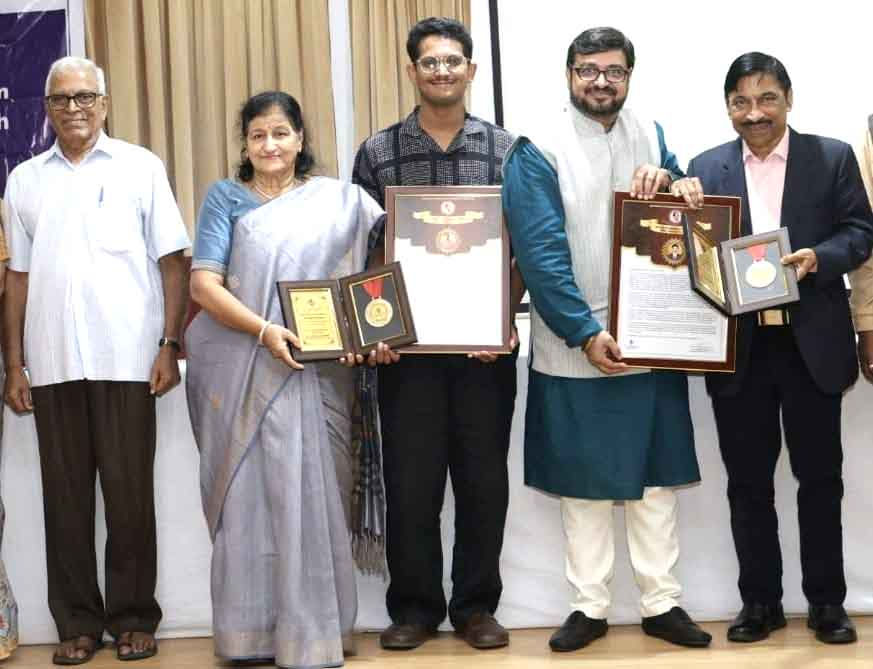
Pune: History is not merely a record of vanished centuries but a map to understanding the present. That was the central message at the fifth edition of the ‘Late Shri Prakashchandra Surana Historian Award’, where archaeologist K.K. Muhammed and historian-author Aniruddh Kanisetti were honoured for their contributions to preserving and expanding the understanding of India’s past.
The awards, instituted by the Quantum Foundation, were presented at the convocation hall of the Deccan College Post-Graduate and Research Institute in Yerwada. The main award was presented to K.K. Muhammed, former Regional Director of the Archaeological Survey of India (ASI) and a leading figure in Indian archaeology, by renowned archaeologist Padmashri Dr. K. Paddayya and Quantum Foundation Chief Trustee Pushpa Surana.
Changing Contours
The ceremony also recognised the changing contours of historical scholarship by conferring the ‘Digital Historian Award’ on Aniruddh Kanisetti, author, storyteller and recipient of the Sahitya Akademi Yuva Puraskar. In addition, the foundation launched the Quantum Scholarship to support young researchers pursuing higher studies in history and archaeology. The first scholarship was awarded to Pune-based researcher Sujay Khalate for his Ph.D. work in ’Ancient Indian History, Culture and Archaeology.’
The initiative reflects a growing recognition that historical research requires not only academic commitment but also institutional support. In his introductory address, Quantum Foundation representative Dr. Pratik Surana emphasised that understanding history was essential for making sense of contemporary society.
“Everything around us has a history. To gain new knowledge and correctly understand the present, it is necessary to know the past,” he said.
The award ceremony was attended by Prasad Joshi, Vice Chancellor of Deccan College, Prof. Sonal Kulkarni, Dean of Deccan College, and Shahida Ansari, Head of the Archaeology Department.
For Muhammed, the honour was a recognition of a lifetime spent bridging the gap between archaeological discovery and heritage conservation. Speaking after receiving the award, he recalled his work in restoring the ancient Bateshwar temple complex in Morena, Madhya Pradesh, a project widely regarded as a landmark in heritage restoration. He said he had now undertaken the restoration of select ancient temples in Hampi, Karnataka.
Yet, he cautioned that India’s celebration of its heritage often exceeds its efforts at preservation. While archaeology and ancient monuments occupy a prominent place in public discourse, the actual execution of conservation projects remains inadequate, he said.
According to Muhammed, thousands of historic structures across the country could be revived if stronger governmental initiatives and sustained conservation efforts were undertaken. The challenge, he suggested, was not the absence of heritage but the absence of a systematic approach to protect it.
Kanisetti, meanwhile, used the occasion to highlight another challenge confronting Indian historiography — the dominance of a largely North-centric narrative.
“The history we learn has remained largely North-centric. South India produced great empires that not only contributed immensely to India but also expanded their influence into Southeast Asia. These histories are rarely discussed,” he said.
He argued that a fuller understanding of India’s past required moving beyond familiar political narratives and exploring the diverse regional traditions, kingdoms and cultural exchanges that shaped the subcontinent.
The award ceremony thus became more than a recognition of individual achievements. It was a reminder that history is a constantly evolving field — one that depends as much on excavating forgotten monuments as on questioning established narratives. As India debates its identity in the present, the search for a more complete understanding of its past has become an increasingly important intellectual pursuit.


Comments