top of page

By:

Asha Tripathi

14 April 2025 at 1:35:28 pm

Stop Comparing, Start Growing

Success does not grow in comparison; it grows in focus. Over the years, women have made significant strides in every sphere of life. From managing homes to leading organisations, from nurturing families to building successful careers, women have proved that strength and resilience are deeply rooted in their nature. Financial independence has become a significant milestone for many women today, bringing with it confidence, dignity, and the freedom to shape one’s own destiny. However, along...

Stop Comparing, Start Growing

Success does not grow in comparison; it grows in focus. Over the years, women have made significant strides in every sphere of life. From managing homes to leading organisations, from nurturing families to building successful careers, women have proved that strength and resilience are deeply rooted in their nature. Financial independence has become a significant milestone for many women today, bringing with it confidence, dignity, and the freedom to shape one’s own destiny. However, along with growth has come another silent challenge — the tendency to constantly observe, compare, and sometimes even compete with the journeys of others. But a crucial question arises: Is it necessary to track the growth of others in order to grow ourselves? From my personal experience of more than two decades as an entrepreneur, I have realised something very powerful — true growth begins the moment we stop looking sideways and start looking within. A Small Beginning I had a flourishing career of teaching abroad, but when I restarted my career after moving back to India, my beginning was extremely small. My very first assignment was a simple home tuition for a single student, and the amount I earned was meagre. There was nothing glamorous about it. No recognition, no large batches, no big earnings. Just one student and one opportunity. But instead of worrying about how others were doing, how many students they had, or how much they were earning, I made a conscious decision—my only focus would be on improving myself. I focused on teaching better, preparing better, and becoming more disciplined and consistent. And slowly, without even realising it, things began to grow. One student became two, two became a small group, and gradually, over the years, the work expanded beyond what I had initially imagined. Looking back today, I can confidently say that the growth did not happen because I competed with others. It happened because I competed with myself yesterday. Comparison Creates Noise When we keep watching others' journeys too closely, we unknowingly divert our own energy. Comparison creates unnecessary noise in our minds. It brings doubts, insecurities, and sometimes even negativity. Instead of walking our own path with clarity, we start questioning our speed, our direction, and our worth. True success grows through focus, not comparison. Every woman has her own story, her own pace, and her own struggles that others may never see. The path of one person can never be identical to another's. So comparing journeys is like comparing two different rivers flowing towards the same ocean — each with its own route, its own curves, and its own rhythm. As women, we already carry many responsibilities. We balance emotions, relationships, work, and society's expectations. In such a life, the last thing we need is the burden of comparison with one another. Instead, what we truly need is support for each other. When women encourage women, something extraordinary happens. Confidence grows. Opportunities multiply. Strength becomes collective rather than individual. There is enough space in the world for every woman to create her own identity. Each of us can build our own niche without stepping on someone else's path. Choose Encouragement Envy weakens us, but encouragement empowers us. Rather than questioning how someone else is progressing, we can ask a more meaningful question: "How can I grow a little better than I was yesterday?" Lift As You Rise Today, after twenty years of experience, the most valuable lesson I have learned is simple yet profound — focus on your own work with honesty and dedication, and success will quietly follow you. We, women, are capable, resilient, and creative. We do not need to pull each other down or compete in unhealthy ways. Instead, we can lift each other up while building our own dreams. Because when one woman rises, she does not rise alone. She inspires many others to believe that they can rise, too. And perhaps that is the most beautiful form of success. (The writer is a tutor based in Thane. Views personal.)

Unlikely Convergence

Updated: Jan 31, 2025

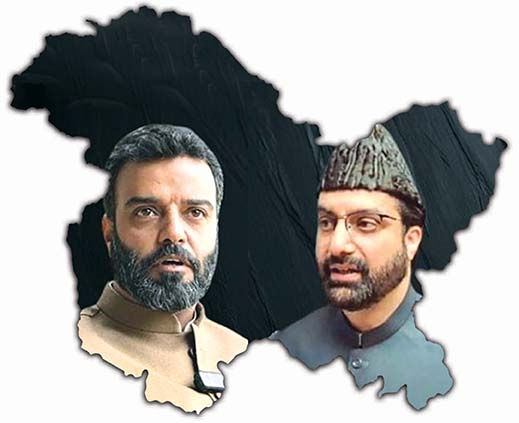
The meeting between Hurriyat’s Mirwaiz Umar Farooq and National Conference’s Aga Syed Ruhullah signals a shift in the political landscape of Jammu and Kashmir, but it raises more questions than answers.
Jammu and Kashmir
Jammu and Kashmir

In an unprecedented move, two influential political leaders from opposite ends of the ideological spectrum in Jammu and Kashmir (J&K) - Hurriyat Conference chairman Mirwaiz Umar Farooq and National Conference (NC) Member of Parliament Aga Syed Ruhullah – recently met in New Delhi to ostensibly discuss the pressing issues facing the people of J&K and Muslims across India.


The hour-long meeting is believed to signify the complex and evolving dynamics in J&K’s post-Article 370 era. The discussions centered on three key concerns: the abrogation of Article 370, the proposed Uniform Civil Code (UCC), and the Waqf (Amendment) Bill.


Historically, the Hurriyat Conference and the NC have been bitter rivals, representing divergent political ideologies. The Hurriyat Conference, born out of a coalition of separatist groups in the early 1990s, had long advocated for J&K’s independence from India or its merger with Pakistan, depending on the faction. On the other hand, the NC has traditionally supported the region’s autonomy within the Indian Union. To see these two leaders meet - one representing the mainstream political establishment, the other the face of separatism - is a striking reminder of the deepening political fissures within the state, but also an indication of shifting priorities.


Farooq, who heads the Muttahida Majlis-e-Ulema (MMU), an umbrella body of over 40 Muslim organizations in J&K, has been at the forefront of the region’s struggle for autonomy. In contrast, Ruhullah, a Shia cleric and an MP of the NC, has been more attuned to the intricacies of national politics, especially with the rise of concerns about Muslim rights across India. The meeting itself underscores the growing realization among political leaders in J&K that the region’s future cannot be understood in isolation from the broader issues facing Muslims in India, particularly in the aftermath of contentious legislative moves like the UCC and the Waqf Bill.


The Waqf (Amendment) Bill, which is currently under review by Parliament, has sparked significant controversy among Muslim leaders. The Bill proposes a central government-controlled Waqf board to manage properties belonging to the Muslim community, raising fears that it could infringe upon the community’s autonomy and rights. Mirwaiz Farooq, who had previously submitted a memorandum to the Joint Parliamentary Committee on the matter, has voiced strong opposition to the Bill, warning that it could turn Muslims into second-class citizens. His meeting with Ruhullah was a chance to align their positions and explore ways to build opposition across party lines, with plans to approach leaders like Chandrababu Naidu and Nitish Kumar – BJP’s coalition partners - for support.


For Farooq and Ruhullah, the UCC apparently represents an existential threat to the pluralistic fabric of India, particularly for Muslims. The two leaders have expressed concerns that the UCC could marginalize Muslim personal laws, further eroding the community’s rights and freedoms. This issue, much like the Waqf Bill, has led to growing tensions within the Muslim community, which is already feeling besieged by the government’s sweeping reforms.


While the meeting between these two leaders signifies a convergence of concerns, it is unclear whether this moment of unity will lead to a broader political shift in J&K. Farooq, who was once the face of J&K’s separatist movement, has sought to adjust his stance to address the changing realities post-2019. Yet his alliance with Ruhullah, who represents a party deeply entrenched in India’s political fabric, may face scepticism from his own supporters, many of whom view the NC as complicit in the dilution of J&K’s autonomy.


There is a significant political risk involved for the NC as its support for such an alliance could also alienate its base, which harbours reservations about such a cooperation with the Hurriyat. The political landscape in J&K is evolving, but whether this new-found alliance between Farooq and Ruhullah will result in meaningful political change remains uncertain.


Comments


bottom of page