

Who Owns the South China Sea?

The South China Sea has become the testing ground for the future of global trade and the balance of power in Asia.

For centuries, great powers have understood a simple truth that whoever controls the seas shapes the destiny of nations. In the twenty-first century, that proposition has acquired renewed urgency in the waters of the South China Sea, a vast maritime crossroads through which the arteries of global commerce flow. It has emerged as one of the world’s most consequential geopolitical fault lines.
Nearly four-fifths of all internationally traded goods by volume travel by sea. From crude oil and liquefied natural gas to automobiles, electronics, grain, and manufactured products, modern life depends on uninterrupted access to maritime trade routes. Among these routes, few are more important than those traversing the South China Sea. Nearly a quarter of global maritime trade passes through these waters. The region handles roughly 45 percent of the world’s crude oil shipments, more than 40 percent of propane trade, and over a quarter of global automotive commerce. The economic value of goods transiting the South China Sea annually is estimated at more than $5 trillion. Any prolonged disruption would reverberate far beyond East Asia.
High Stakes
The stakes have become even higher as global trade patterns evolve. New South-South trade corridors linking Asia with Africa and Latin America are expanding rapidly. Intra-Asian commerce continues to grow. Consequently, the South China Sea has become not merely a regional waterway but a central hub of an increasingly multipolar global economy.
At the heart of the tensions lies China’s expansive territorial claim. Beijing asserts sovereignty over most of the South China Sea, relying on historical claims that overlap extensively with the exclusive economic zones of neighbouring states, including Vietnam, the Philippines, Malaysia, and Brunei. These claims have generated persistent friction and deep anxiety across Southeast Asia.
The international community’s legal position appears clear. In 2016, an international arbitral tribunal in The Hague ruled that China’s sweeping claims lacked legal basis under the United Nations Convention on the Law of the Sea (UNCLOS). Beijing rejected the ruling outright and has continued to consolidate its position through a combination of military, coast guard, and maritime militia activities.
Over the past decade, China’s transformation of disputed reefs into fortified artificial islands has altered the strategic landscape. Airstrips, missile systems, radar installations, and naval facilities now dot parts of the contested region. Meanwhile, encounters between Chinese and Philippine vessels have become increasingly frequent and confrontational, raising fears that a localized incident could escalate into a broader conflict.
The United States has repeatedly reaffirmed its security commitments to the Philippines and conducts regular Freedom of Navigation Operations to challenge excessive maritime claims. Other countries including Japan, Australia and several European powers, have increased their naval presence and surveillance activities in support of an open maritime order.
Yet the South China Sea is not solely a contest between China and the United States. For India, too, these waters carry profound strategic significance.
Maritime Security
Traditionally viewed as a continental power preoccupied with its land borders, India increasingly recognizes that its economic future is inseparable from maritime security. More than $200 billion worth of Indian trade passes through the South China Sea and the Strait of Malacca. By value, this represents well over half of India’s total international trade.
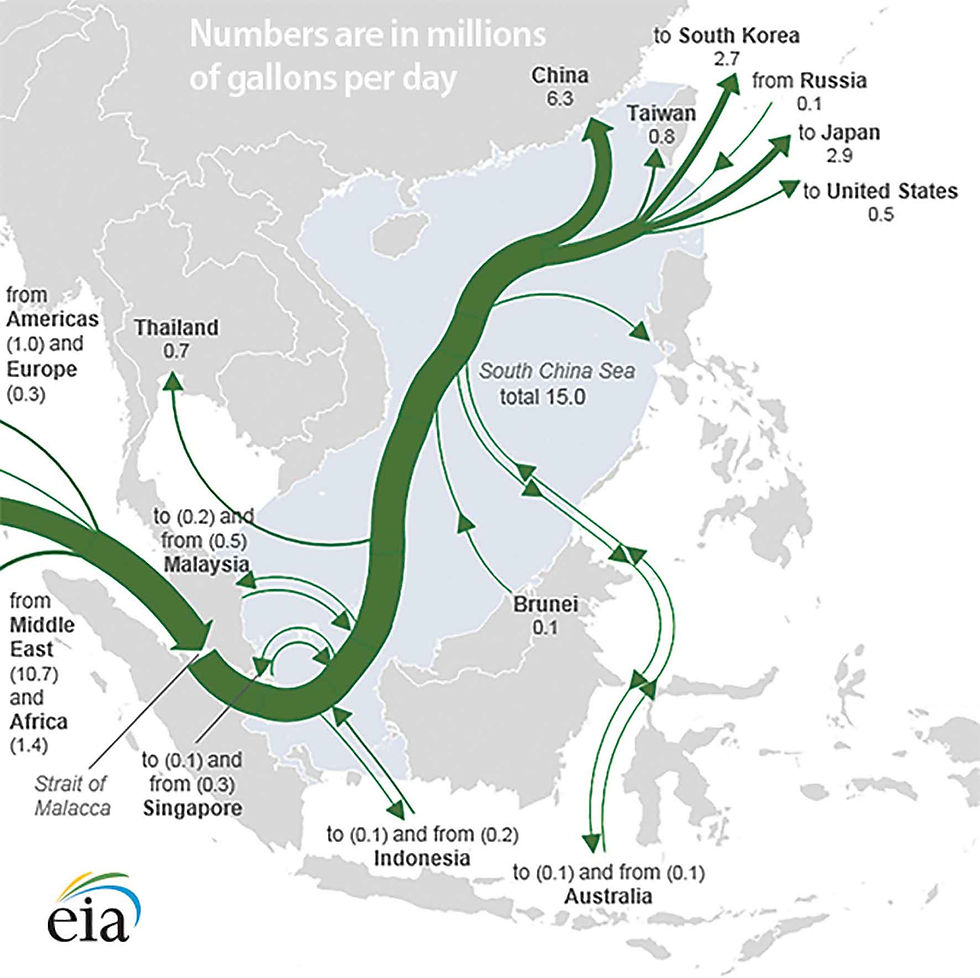
These waters connect India to some of its most important economic partners, including Japan, South Korea, China, and the member states of ASEAN. A substantial portion of India’s energy imports, particularly crude oil and liquefied natural gas sourced from the broader Asia-Pacific region, transits these sea lanes. The same routes facilitate the flow of electronics, industrial inputs, and manufactured goods that are essential to India’s growth.
Consequently, freedom of navigation in the South China Sea is not a distant diplomatic concern for New Delhi. It is a vital national interest.
India has consistently expressed concern regarding China’s militarization of disputed territories and its reluctance to adhere fully to international maritime norms. At diplomatic forums, New Delhi has repeatedly emphasized respect for international law, particularly UNCLOS, as the basis for resolving maritime disputes.
The Indian Navy has simultaneously expanded its operational presence across the Indo-Pacific. Regular deployments into the South China Sea signal India’s determination to protect its economic interests and contribute to regional stability. New Delhi has also strengthened security partnerships with Southeast Asian countries, most notably the Philippines, to which it has supplied BrahMos missile systems. Such moves reflect India’s willingness to assume a more active strategic role in the region.
Economic engagement has complemented these security initiatives. Indian public-sector enterprises, including ONGC Videsh, have maintained investments in offshore energy exploration projects in Vietnamese waters despite Chinese objections.
This engagement forms part of a larger strategic architecture. Through its Act East Policy, India has deepened economic and diplomatic ties with Southeast Asia. Through the SAGAR initiative (Security and Growth for All in the Region), it has promoted cooperative maritime security. And through the Quadrilateral Security Dialogue, or Quad, alongside the United States, Japan, and Australia, India has supported the vision of a free, open, and rules-based Indo-Pacific.
Nevertheless, formidable challenges remain. China’s economic influence across Asia is vast. ASEAN countries often seek a delicate balance between economic dependence on Beijing and strategic cooperation with external powers. India’s own leverage remains constrained by resource limitations and competing strategic priorities closer to home.
These realities suggest that New Delhi must continually refine its South China Sea strategy. The objective is not confrontation but resilience: safeguarding trade routes, strengthening partnerships, supporting international law, and ensuring that no single power can unilaterally dictate the terms of maritime access.
As the late American senator John C. Stennis once observed, cooperation among navies demonstrates a collective resolve to defend maritime security against emerging threats. In an era of rising geopolitical rivalry, the South China Sea is a test of whether the international order can preserve openness in the very waters upon which global prosperity depends.
(The writer is a retired naval aviation officer and a defence and geopolitical analyst. Views personal.)


Read as Respected Deshmukh Sir
Redprvted Deshmukh Sir,
Article on South China Sea is very interesting.You have covered almost all aspects of the issue.Reading your articles give insights of the issue. China's domination in South China Sea is mainly due to it's first economic power and then military superiority.Since 2014 India are increasing its msritime power still we have to achieve much more than what is with us at present.Presence of QUAD countries in South China Sea may restrict China's arrogancy.China is most non trustworthy country which every one knows but can't singly restrict its expansioanist move so needs collective action from surrounded countries. India alongwith other Quad countries require to take initiative. Thanks for sending me the informative article . Shirish Sumant