

India’s Broken Examination Machine

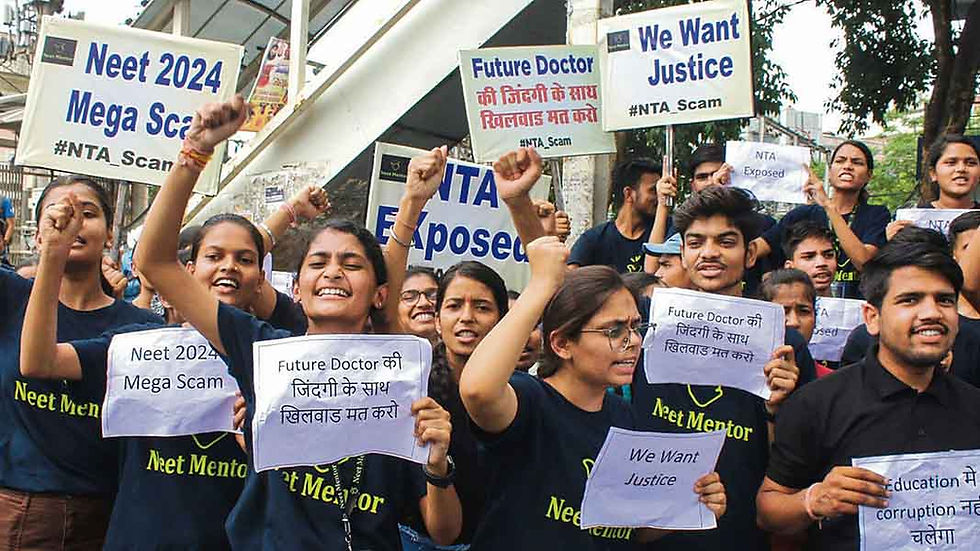
Three examination controversies unfolded in the country within a single month in May. The NEET-UG 2026 was cancelled after a paper leak affecting 22.79 lakh candidates. The CBSE’s Class 12 revaluation portal collapsed under first-day traffic, and answer sheet mix-ups under its new On-Screen Marking system were publicly confirmed. UPSC Prelims 2026 triggered a nationwide debate over whether its paper design had crossed from difficulty into unfairness.
Collectively, these point to a major examination governance problem rather than one of integrity. The distinction matters for policy.
Security failures invite security responses in form of stricter penalties and CBI investigations. The Public Examinations (Prevention of Unfair Means) Act, 2024 prescribes three to ten years imprisonment and fines up to Rs. 1 crore for organised paper leaks. An expert committee after NEET 2024 had recommended on-centre question paper printing. And yet, NEET 2026 was leaked.
If the governance architecture surrounding an examination is weak, the leak finds a different entry point regardless of which specific vulnerability was sealed last time.
But governance failure is different from a security failure. The NTA failed to prevent disruptions in five of fourteen examinations it conducted in 2024. A parliamentary standing committee flagged in December 2025 that the agency’s performance had not inspired confidence. The Supreme Court observed in May 2026 that the NTA had not learned lessons despite directions issued after 2024.
Likewise, the CBSE deployed On-Screen Marking across 18.5 lakh Class 12 students without piloting the revaluation infrastructure at scale. The Ministry of Education deployed IIT Madras and IIT Kanpur experts to address portal failures a week after those failures had already damaged students’ ability to seek revaluation within deadlines. These are accountability gaps.
No Institutional Capacity
India’s examination system has been built on a centralisation model that assumes scale produces efficiency. In governance terms, that assumption holds only when the central institution has the administrative capacity, accountability mechanisms, and feedback loops to manage what it has centralised. The NTA does not. A single examination now determines medical education access for 22.79 lakh candidates. A single CBSE portal processed over 1.26 lakh revaluation applications within three hours of opening. A single UPSC cycle offers fewer than one thousand vacancies to over eight lakh candidates. In each case, centralisation has expanded reach but not expanded institutional capacity or the ability to absorb failures without those failures cascading directly onto students.
The UPSC Prelims controversy reveals a different dimension of the same problem. The GS Paper 1 ran to 56 pages, carried 44 triple-statement questions, and introduced scenario-based ethics reasoning into what has historically been a factual recall examination. The CSAT introduced communication-based questions for the first time in its history. The expected general category cutoff dropped to 82-86, from 92.66 in 2025. The UPSC’s response was silence.
Hindi-medium and regional-language candidates raised credible concerns about translation quality creating an uneven playing field. None of this received a formal response.
The government’s answer to NEET 2026 is computer-based testing from 2027. That may improve operations, but it is no substitute for reform. The NTA’s 2024 plan to expand CBT infrastructure was never completed, leaving just 552 centres for 22 lakh candidates. In 2026 it blocked 120 Telegram channels carrying the leaked paper; the leak still spread widely enough to force cancellation. CBSE’s experience points to the same problem. Its new On-Screen Marking system, introduced to improve transparency and reduce errors, instead produced answer-sheet mix-ups, payment glitches displaying fees from Re. 1 to Rs. 69,420 per subject, and a fake cancellation notice that gained traction because students had little faith in official communication.
Accountability Gaps
What the examination system actually lacks is a functioning accountability structure. NTA, CBSE, and UPSC are all self-reporting bodies. No independent authority has a statutory mandate to audit examination processes, verify logistics chains, assess infrastructure readiness before deployment, or evaluate what an institution learned after a failure.
Every response documented in May 2026, the CBI probe, the IIT expert teams, the extended CBSE deadline, the Supreme Court observations, was triggered after a failure that had already occurred and already damaged students. Preventive governance requires risk assessment before deployment.
CBSE’s Controller of Examinations acknowledged in May 2026 that errors are possible when evaluating 1.25 crore answer scripts annually. That acknowledgment came after public pressure from a viral social media post. An enforceable transparency standard requires institutions to disclose error rates and corrective outcomes as routine policy, not as damage control.
Debate on examination reform focuses largely on procedural fixes while overlooking the social cost of institutional failure. NEET exists not merely to conduct an exam but to ensure access to the medical profession through merit rather than privilege or wealth. When lakhs of students spend years preparing only for an exam to be cancelled after a WhatsApp leak, faith in that promise is undermined. At least three student suicides have been linked to the NEET 2026 scandal. The Rs. 300 crore collected in fees can be refunded but the years lost in preparation, the mental strain and erosion of trust cannot.
Yet examination bodies face little external accountability. After NEET 2026, the NTA focused on re-examination logistics. CBSE addressed answer-sheet mix-ups largely after cases went viral on social media, while UPSC remained silent over concerns about its prelims. In the absence of mandatory transparency, independent oversight or legal consequences, institutions have stronger incentives to protect their reputations than expose their weaknesses. Any serious reform must change those incentives.
India’s examination system needs an independent examination audit authority with statutory powers, operating separately from the Ministry of Education, with a mandate to assess institutional readiness before deployment and publish findings publicly. Mandatory pre-deployment testing of any new digital infrastructure at representative scale before use in a high-stakes examination context. A legal framework that creates enforceable accountability for examination bodies, not only for individuals who leak papers. The current policy direction merely addresses symptoms of a system that runs without adequate external accountability. It does not address the system.
(The writer is an independent public policy researcher. Views personal.)


Comments