top of page

By:

Abhijit Mulye

21 August 2024 at 11:29:11 am

‘Bharat Ratna to Savarkar will increase its prestige’

Mumbai: Rashtriya Swayamsevak Sangh (RSS) Sarsanghachalak Dr. Mohan Bhagwat on Sunday threw his full weight behind the long-standing demand to confer the Bharat Ratna on Swatantryaveer Vinayak Damodar Savarkar, asserting that the Hindutva ideologue’s inclusion would enhance the dignity of the country’s highest civilian honour. Bhagwat, who explained the genesis and growth of the RSS over past 100 years in two lectures at the Nehru Centre here on Saturday and Sunday, replied to several...

‘Bharat Ratna to Savarkar will increase its prestige’

Mumbai: Rashtriya Swayamsevak Sangh (RSS) Sarsanghachalak Dr. Mohan Bhagwat on Sunday threw his full weight behind the long-standing demand to confer the Bharat Ratna on Swatantryaveer Vinayak Damodar Savarkar, asserting that the Hindutva ideologue’s inclusion would enhance the dignity of the country’s highest civilian honour. Bhagwat, who explained the genesis and growth of the RSS over past 100 years in two lectures at the Nehru Centre here on Saturday and Sunday, replied to several questions. While replying to one of the questions, he remarked, “If Swatantraveer Savarkar is given the Bharat Ratna, the prestige of the Bharat Ratna itself will increase.” He was asked, why there has been a delay in conferring the Bharat Ratna on Savarkar, in reply to which, Bhagwat said, “I am not part of that committee. But if I meet someone, I will ask. Even without that honour, he rules the hearts of millions of people.” he added. Social Divisions Bhagwat replied to questions that were clubbed in 14 different groups ranging from national security to environment, social harmony, youth, arts and sports. Whenever the questions suggested or expressed expectations that the RSS should do certain things, Bhagwat stressed on the involvement of the society and initiative from the society in resolving the problems. While addressing the critical issue of Uniform Civil Code, Bhagwat stated that the UCC should be framed by taking everyone into confidence and must not lead to social divisions. In the same way while replying to the question related to illegal migrants in the country, Bhagwat urged people to “detect and report” the “illegal infiltrators” to the police. He also urged people not to give them any employment and to be more “vigilant.” Backing SIR He highlighted that the Special Intensive Revision (SIR) exercise has already revealed the “foreigners” living in the country. “The government has a lot to do regarding infiltration. They have to detect and deport. This wasn’t happening until now, but it has started little by little, and it will gradually increase. When the census or the SIR is conducted, many people come to light who are not citizens of this country; they are automatically excluded from the process,” he said. “But we can do one thing: we can work on detection. Their language gives them away. We should detect them and report them to the appropriate authorities. We should inform the police that we suspect these people are foreigners, and they should investigate and keep an eye on them, and we will also keep an eye on them. We will not give employment to any foreigner. If someone is from our country, we will give them employment, but not to foreigners. You should be a little more vigilant and aware,” he added. SC Chief Emphasising the inclusivity of the Sangh, he said that anyone can become ‘Sarsanghchalak’ (RSS chief), including the SC and STs, as the decision is solely dependent on the work that any individual put for the organisation. “Kshatriya, Vaishya, Shudra or Brahmin does not qualify for the Sarsanghchalak position (RSS Chief), a Hindu will become the one who works and is best available. A Hindu will become, and that can also be an SC or ST. Anyone can become it depends on the work. Today, if you see, all classes have representation in the Sangh. The decision is taken on the basis of one who works and is best available,” he said. He pointed out that when the RSS was founded, its work began in a Brahmin-dominated community and hence, most of its founders were Brahmins, which led to the organisation being labelled as a Brahmin outfit at the time. People always look for an organisation that has representatives from their community, he said. “If I were to choose a chief, I would go by the ‘best available candidate’ criterion. When I was appointed RSS chief, there were many best candidates, but they were not available. I was the one who could be relieved from duties and appointed,” he said. He said that to belong to the Scheduled Caste or Scheduled Tribe communities is not a disqualification, and neither is being a Brahmin a qualification to become the RSS chief. Ready to step down if Sangh asks for Dr. Mohan Bhagwat on Sunday said the Sangh had asked him to continue working despite his age, while stressing that he would step down from the post whenever the organisation directs him to do so. “There is no election to the post of RSS chief. Regional and divisional heads appoint the chief. Generally, it is said that after turning 75, one should work without holding any post,” Bhagwat said. “I have completed 75 years and informed the RSS, but the organisation asked me to continue working. Whenever the RSS asks me to step down, I will do so, but retirement from work will never happen,” he said.

India’s Plastic Waste: Systems Exist; Results Don’t

India has initiatives to tackle plastic waste. What it lacks is coordination, infrastructure and sustained public participation.

In continuation of my last article, let us explore a few more challenges India faces in managing its plastic waste.


Informal Waste Sector

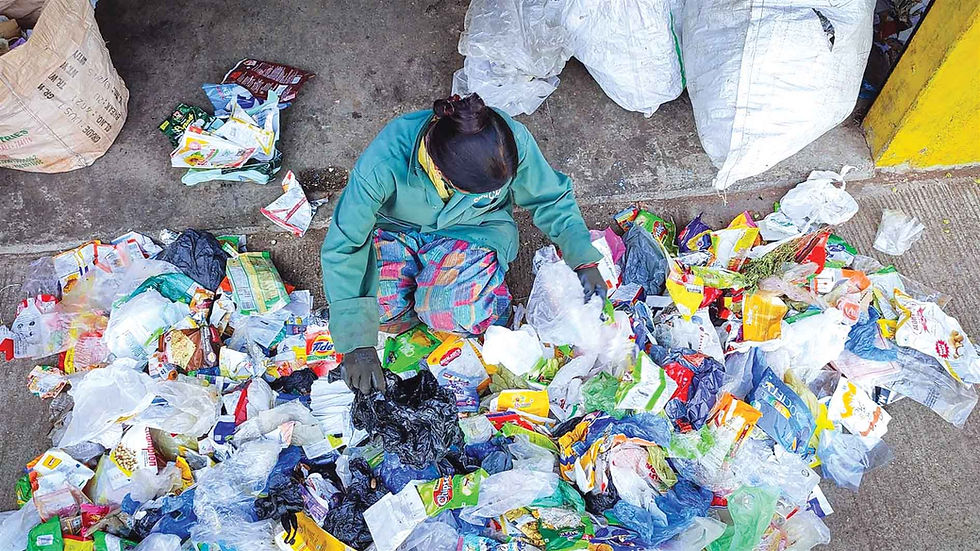
In India, a significant portion of waste—particularly in urban areas—is managed by informal waste pickers. You may often have noticed small children and women sifting through heaps of roadside rubbish, drains, or overflowing bins to collect plastic bottles, polythene bags, wrappers, pouches, and similar items. Yet, because this work remains largely unorganised and outside any formal system, plastic waste collection is far less efficient than it ought to be.


As a society, we should show them the utmost respect and gratitude. Although they do this work to earn their daily bread, they play a crucial role in segregating waste and, in doing so, unknowingly serve both society and Mother Earth. In many neighbourhoods, they are the real first line of recycling. However, despite their significant contribution, their work remains unregulated and unsupported, with little access to safety gear, health protection, or even basic standards of dignity. This makes the process not only inefficient but also hazardous, exploitative and deeply dehumanising.


There is, without doubt, tremendous potential for strengthening waste management through the informal sector, especially if they are recognised, trained and integrated into municipal systems. However, at present, the process of collection and segregation remains fragmented, inconsistent and poorly coordinated.


Inefficient Recycling Systems

Some urban centres have introduced plastic recycling programmes, but the systems in place are often fragmented and ill-equipped to cope with the sheer volume of plastic waste being generated each day. A 2020 report noted that only around 60% of India’s plastic waste is collected, and barely 30% of it is recycled. As a result, large quantities of plastic continue to end up in landfills, clog drains and water bodies, or are simply incinerated—creating yet another set of environmental and health concerns.


A major challenge lies in dealing with certain categories of plastic—particularly multilayered plastic (MLP)—which cannot be recycled easily using conventional methods. MLP refers to packaging material that contains at least one layer of plastic as the primary component, combined with one or more layers of paper and aluminium foil, either as a laminate or as a co-extruded structure. Most companies favour MLP for packaging because it is lightweight, highly water-resistant, and reduces shipping volume. It also helps extend the shelf life of products such as fruit juices, sweets and namkeen, keeping them fresh for longer periods even at room temperature.


However, despite its commercial advantages and widespread use, recycling this type of packaging remains costly and technically difficult, precisely because of its multilayered composition. Separating the layers is complex, processing requires specialised infrastructure, and the economics of recycling often do not make it viable at scale.


Public Awareness and Participation

Despite the many government initiatives aimed at reducing plastic waste, public awareness about the importance of waste segregation, recycling and plastic reduction remains worryingly low. Many people still dispose of plastic carelessly, mixing it with wet waste or throwing it into open bins, drains and public spaces—thereby worsening the problem. (I had elaborated on this in one of my earlier articles in the series.) In addition, there is often little real incentive for individuals and businesses to cut down plastic consumption or actively participate in recycling programmes. Even where systems exist, participation is inconsistent and largely dependent on personal motivation rather than habit or enforcement.


The challenge of shifting consumer behaviour is further compounded by the fact that alternatives to plastic—such as eco-friendly packaging—are often more expensive and less easily available. For many households and small businesses, the cheaper option wins, even when they understand the long-term environmental cost. Convenience, affordability and accessibility still outweigh environmental considerations in everyday decision-making.


My friend’s granddaughter, Malika, who lives in Pune, has a strikingly clear perception of rag-pickers. Once, her grandmother asked her whether their regular ‘kacharewala’ (the household garbage collector) had turned up or not. Malika immediately retorted, “What kacharewala, grandmother… that person is not the kacharewala. We are, because we generate kachara (garbage).”


Will continue in the next week! Till then, have a great weekend!


 (The author is an environmentalist. Views personal.)


Comments


bottom of page