top of page

By:

Akhilesh Sinha

25 June 2025 at 8:23:54 pm

When Dissent Becomes Disorder

India’s battle against Naxalism is fast moving beyond the gun to the more shadowy battlefield of ideas. The tendency of some educated people who describe themselves as intellectuals to provide ideological justification for violence, disorder and anti-establishment activities is often viewed as a manifestation of “urban Naxalism”. In his Independence Day address from the Red Fort, Prime Minister Narendra Modi broadened this idea by introducing the term dimaagi Naxalism or “Naxalism of the...

When Dissent Becomes Disorder

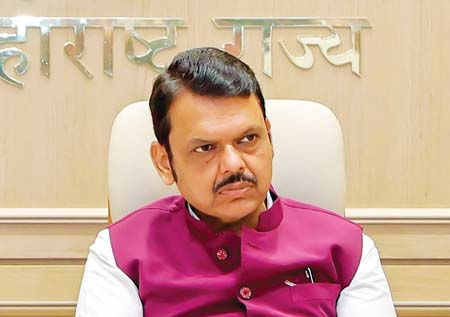
India’s battle against Naxalism is fast moving beyond the gun to the more shadowy battlefield of ideas. The tendency of some educated people who describe themselves as intellectuals to provide ideological justification for violence, disorder and anti-establishment activities is often viewed as a manifestation of “urban Naxalism”. In his Independence Day address from the Red Fort, Prime Minister Narendra Modi broadened this idea by introducing the term dimaagi Naxalism or “Naxalism of the mind,” warning citizens against individuals and ideologies that, like termites, seek to weaken India’s democracy and development from within. The concern deepens when the line between the democratic right to protest and violent anarchy is deliberately blurred. The alleged assault on security personnel, police officers and media representatives during the recent NEET paper-leak protest at Delhi’s Jantar Mantar has revived this debate. A similar pattern was witnessed during the anti-Citizenship Amendment Act protests at Shaheen Bagh, where large gatherings of educated protesters eventually gave way to unrest, culminating in the violence associated with the episode. Similar questions were raised over police action during student protests in Ranchi, Jharkhand, against alleged irregularities in a recruitment examination. Yet political reactions there, too, appeared influenced by circumstances and prevailing power equations. If the right to dissent is vital to democracy, so too is the need to uphold law and order and protect the dignity of public institutions. Selective Outrage The Congress and other Opposition parties have repeatedly disrupted parliamentary proceedings over the police action at Jantar Mantar, while remaining silent after condemning police action against students in Ranchi. When the government calls for a discussion in Parliament, Rahul Gandhi objects, saying that he does not want to listen to a “lecture” from the Union Home Minister. Such selective outrage raises an important question: should democratic principles change according to political convenience? The removal of the Tricolour from the Red Fort during the farmers’ agitation, calls during the Shaheen Bagh protests for severing the “Chicken’s Neck” and isolating the northeastern states from the rest of India, and slogans of “Azadi-Azadi” raised during various protests - all point to them being instances of “Naxalism of the mind.” The Narendra Modi government had set March 2026 as its target for making the country free of Naxalism, and Union Home Minister Amit Shah has since declared India “Naxal-free.” The Centre’s security- and development-oriented strategy against Naxalism has produced significant results in several affected regions. However, the challenge cannot be confined to the forests alone. During the NEET protests organised by the Cockroach Janata Party at Jantar Mantar, around 400 social-media handlers allegedly based in Pakistan and other countries attempted to turn the demonstration violent and create disorder. “Urban Naxal” is not a new term of political discourse. It is generally used in reference to urban, educated groups and networks that have faced allegations of providing ideological, legal, propagandist or other forms of support to the Maoist movement. The Naxal movement began with the rural armed uprising of 1967, but the role of cities and intellectuals has been an important part of its strategic thinking from the outset. In Naxal-Mukt Bharat, authors Tuhin A. Sinha and Dr Alok Kumar Dwivedi describe how, from Charu Mazumdar’s writings to the CPI (Maoist)’s 2004 document Urban Perspective, there is a clear strategic emphasis on viewing cities as bases for recruitment, resource mobilisation, legal assistance and broader public support. This is why it is no longer sufficient to view Naxalism merely as a forest-based challenge. Understanding its ideological dimensions and urban networks is equally essential. The debate became more intense following the 2018 Bhima Koregaon case, when the Pune Police investigation cited certain letters and documents to discuss alleged links between urban networks and Maoist organisations. The arrests of several activists brought the issue into the national spotlight. Serious Challenge According to the Prime Minister, such networks seek to undermine the morale of security forces, obstruct development projects and present the discourse between the state and Maoism in a one-sided manner. In his speech on the occasion of our 80th Independence Day, Modi cautioned that while India has achieved significant success against “armed Naxalism” in the forests, “dimaagi Naxals” are now waiting for an opportunity. According to him, people influenced by Maoist ideology had once occupied positions in the corridors of power and, as advisers to government committees, influenced public policies. Maoist literature, poetry and discussions within closed groups have helped create an ideological vocabulary in which violent rebellion was portrayed not as a crime but as a means of social transformation. This narrative subsequently provided an ideological foundation for the expansion of the Naxal movement and for extending support to certain protest movements. In Naxal-Mukt Bharat, Sinha and Dwivedi have accused several intellectuals including Arundhati Roy, historian Ramachandra Guha, Jean Drèze, Amit Bhaduri, Gautam Navlakha, Binayak Sen and Nandini Sundar, of influencing what they describe as the ‘Naxal narrative. From the anti-CAA protests to farmers’ agitations and opposition to development projects, it has been claimed that some of the same faces and organisations repeatedly appeared. Recently, while taking shelter in a shopping complex during heavy rain in Delhi, I had the opportunity to overhear a conversation between two people. They were discussing the protests at Jantar Mantar and student movements in Ranchi. One of them said that if the Jantar Mantar protest had continued for a few more days, it could have spread across the country, creating an opportunity to remove the Modi government and fundamentally change the existing, democratically-elected system. If the objective of a movement is to violently overthrow a democratically elected government and dismantle the constitutional order, it is certainly a matter of serious concern. It would be inappropriate to draw broad social or political conclusions from a private conversation. Yet hearing similar sentiments from political leaders and so-called intellectuals is deeply worrying. The strength of democracy lies in debate, dissent and peaceful protest. But the line between protest and anarchy must remain equally clear. No violent ideology can be given protection under the guise of democratic rights, however attractive its packaging may be. It is therefore essential for both the government and society to safeguard the right to dissent while remaining equally vigilant against violence and attempts to undermine the constitutional order. That is the balanced path between democratic values and the national interest. Protesters or Provocateurs? Prime Minister Narendra Modi’s use of the term “dimaagi Naxal” in his Independence Day speech has once again brought political discourse to the centre of a sharp ideological debate. The Congress and other Opposition parties have described it as an attempt to silence dissent. Their argument rests on a basic principle of democracy: citizens have the right to question those in power. Former Finance Minister P. Chidambaram responded sarcastically, saying, “I am proud to be a Mental Naxal.” Aam Aadmi Party convenor Arvind Kejriwal also said that if patriotism and raising one’s voice for one’s rights amount to being a “Mental Naxal”, then he was proud to be called one. Congress president Mallikarjun Kharge questioned the idea that demanding one’s rights or asking questions of the government could be considered anti-national. Young people, particularly Gen-Z, and ordinary citizens who raise their voices for their democratic and fundamental rights cannot simply be branded as Naxalites or anti-national, he argued. The Congress has described the remark as a deliberate attempt to suppress dissent and silence the Opposition, insisting that it will continue to support issues of public interest and peaceful protests. Congress communications chief Jairam Ramesh referred to the earlier debate over “Urban Naxals” and asked: if no clear definition was ever provided for that term, what is the justification for introducing a new label such as “Dimaagi Naxal”? RJD leader Tejashwi Yadav, referring to farmers’ protests and questions raised by young people, alleged that the government labels its critics variously as “Khalistanis”, “urban Naxals” or “andolanjeevis”. TMC MP Kirti Azad also took a swipe at the government, questioning what kind of definition of patriotism treats educated and questioning citizens as “mental Naxals”. AAP leader Sanjay Singh likewise described the remark as an attempt to suppress the voice of the people. Senior advocate Prashant Bhushan asked whether young people protesting for their rights were also being branded as “mental Naxals”. But there is another side to this debate, and it is equally important. Naxalism is not merely an ideology confined to taking up arms. If an ideological network seeks to erode public trust in democratic institutions, legitimise violence or disorder, or undermine the constitutional order, it is legitimate to question and scrutinise such a tendency. The term “mental Naxal”, therefore, can have meaningful relevance only if it is backed by a clear, objective and verifiable definition. The right to ask questions is fundamental to democracy, but the right to endorse violence or disorder is not. Drawing and preserving that fine line is perhaps the most important requirement of the present debate. The Politics of Anarchy Following Prime Minister Narendra Modi’s “Mental Naxal” remark, the Opposition accused him of trying to suppress voices of dissent. The BJP and its allies, however, hit back, arguing that it is important to distinguish between democratic dissent and an ideological tendency that seeks to spread anarchy. Assam Chief Minister Himanta Biswa Sarma strongly reacted to former Union Home Minister P. Chidambaram’s sarcastic remark that he was proud to be a “mental Naxal.” Sarma went a step further, describing Chidambaram not merely as a “mental Naxal” but as a “pure Naxal,” and demanded an inquiry into his tenure as Home Minister. He questioned why more effective steps were not taken against Naxalism when senior Congress leaders lost their lives in Naxalite violence in Chhattisgarh. Sarma alleged that the Congress wants to destabilise the country’s peaceful environment in the hope of returning to power in 2029. Maharashtra Chief Minister Devendra Fadnavis said, “I think the Prime Minister has made exactly the right point. Gun-wielding Naxalism has been defeated. But even more dangerously, we are now seeing a kind of mental Naxalism among people whose minds are filled with anarchy. Unfortunately, we saw an example of this at a Congress programme today as well. The decision to play the full version of Vande Mataram on August 15 was taken within the powers provided by the Constitution.” BJP Rajya Sabha MP Sudhanshu Trivedi also offered his interpretation of “mental Naxalism.” He said, “A mental Naxal is someone who says that ‘Naxals are Gandhians with guns.’ A mental Naxal is someone who saw the CAA as a law to strip people of their citizenship, even though not a single Muslim lost citizenship in five years. A mental Naxal is someone who sees a war cry in ‘Jai Shri Ram’, but finds secular music even in calls for ‘Sar Tan se Juda’.” Union Minister Chirag Paswan defined “mental Naxals” as people who seek to create disorder in society, cannot accept the building of a developed India, or work with foreign powers to obstruct India’s path towards becoming a global power. The BJP also sought to make an issue of Rahul Gandhi’s absence from the Independence Day celebrations. BJP Media Co-convenor Pradeep Bhandari linked it to what he described as the mindset of a “mental Naxal ecosystem” and accused the Congress of alleged indifference towards national symbols. In a democracy, criticism of the government, protests and dissent are legitimate civil rights. But when a movement or ideology is associated with violence, the weakening of institutions or a deliberate attempt to create disorder, questioning and criticising it is also part of democratic discourse.

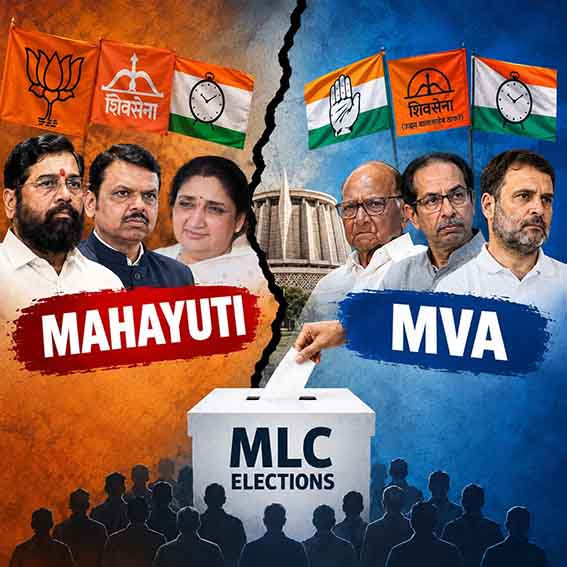
Mahayuti sweeps MLC polls amid MVA cross-voting

Mumbai: Maharashtra Legislative Council elections have exposed the soft underbelly of both the ruling as well as the opposition combine. While the BJP couldn’t prevent rebellion in Nashik to ensure election of Mahayuti candidate, the MVA challenge was decimated under defection and cross-voting at several places effectively preventing them from adding anything to their strength in the upper house of Maharashtra legislature.


Despite these internal vulnerabilities, the ruling Mahayuti alliance asserted absolute dominance in the Local Authorities constituencies, effectively routing the opposition Maharashtra Vikas Aghadi (MVA). Out of the 17 seats that went to the polls, the Mahayuti—comprising the Bharatiya Janata Party (BJP), the Eknath Shinde-led Shiv Sena, and the Sunetra Pawar-led Nationalist Congress Party (NCP)—secured a massive victory by winning 16 seats. The final tally stood at 11 seats for the BJP, three for the Shiv Sena, two for the NCP, and one for an independent candidate. With six Mahayuti candidates having already been elected unopposed before the June 18 voting, the battleground was left open for the remaining 11 constituencies, where the BJP demonstrated a flawless strike rate.


Rebel’s Victory

However, the ruling alliance’s strategic flaws were laid bare in the Nashik local authorities constituency, a seat allocated to the Shiv Sena within the Mahayuti quota. The official Mahayuti candidate, Narendra Darade, suffered a humiliating defeat at the hands of Gokul Gite, an independent candidate and BJP rebel. Gite secured a decisive 357 votes in the first round itself, effortlessly crossing the winning quota of 303 out of 605 valid votes, while Darade managed only 248. This outcome triggered immediate political tremors. Gokul Gite’s brother, Ganesh Gite—a known supporter of BJP Minister Girish Mahajan—launched a scathing attack on Darade, citing his severe lack of public contact over the last eight years. Despite intense pressure from Mahayuti leaders to withdraw, Gokul Gite remained in the fray, allegedly conducting a covert campaign fueled by voter dissatisfaction and tacit support from the MVA and local outfits. Following Darade’s allegations of betrayal, Minister Uday Samant announced that a detailed report analyzing the exact cause of the defeat would be submitted to Chief Minister Eknath Shinde.


Nagpur’s Record

Conversely, the MVA’s humiliation was systemic and most pronounced in the Nagpur constituency. BJP’s Rajiv Potdar registered a record-breaking victory, defeating Congress candidate Atul Londhe by a staggering margin of 682 votes. Despite the MVA possessing an estimated numerical strength of 211 votes, Londhe managed a mere 130 votes. This massive cross-voting prompted Londhe to allege that the BJP engaged in horse-trading, claiming votes were bought for Rs 10 lakh each.


The debacle led Congress leader Vikas Thakre to demand strict disciplinary action against the “traitors,” signaling a deepening internal crisis within the grand old party. Similar narratives of cross-voting echoed in Satara, where BJP’s Dhairyashil Kadam defeated NCP (Sharad Pawar faction) candidate Abhaysinh Jagtap. Kadam secured 593 votes against Jagtap’s 292, with political observers estimating that over a hundred MVA votes shifted to the BJP due to the strategic maneuvering of local leaders.


Marathwada Magic

The Dharashiv-Latur-Beed constituency provided further evidence of the MVA’s unraveling, heavily influenced by the ongoing “Operation Tiger”—the systematic defection of Uddhav Thackeray loyalists to the Eknath Shinde camp. BJP’s Basavaraj Patil secured a landslide victory with 845 votes, defeating Congress’s Mahesh Deshmukh, who received just 124 votes. This massive margin was facilitated by an estimated 150 MVA votes shifting to the BJP, a move widely linked to the anticipated defection of Thackeray-faction MP Om Raje Nimbalkar to the Shinde camp. In Nanded, BJP’s Amar Rajurkar completed a hat-trick of victories by securing 339 votes, decisively defeating the MVA-backed candidate, Krishna Patil Ashtikar. Krishna’s father, MP Nagesh Patil Ashtikar, was also reportedly caught in the crosshairs of the defection drive, leading to widespread confusion among MVA voters and sealing his son’s defeat with a meager 84 votes.


Ultimately, while the Legislative Council results are a resounding endorsement of the Mahayuti’s political arithmetic, they serve as a stark warning to both factions. The ruling alliance must address its rogue elements, but the widespread cross-voting and the MVA’s inability to hold onto its core voter base indicate that the opposition is severely struggling to maintain internal cohesion ahead of the impending assembly elections.
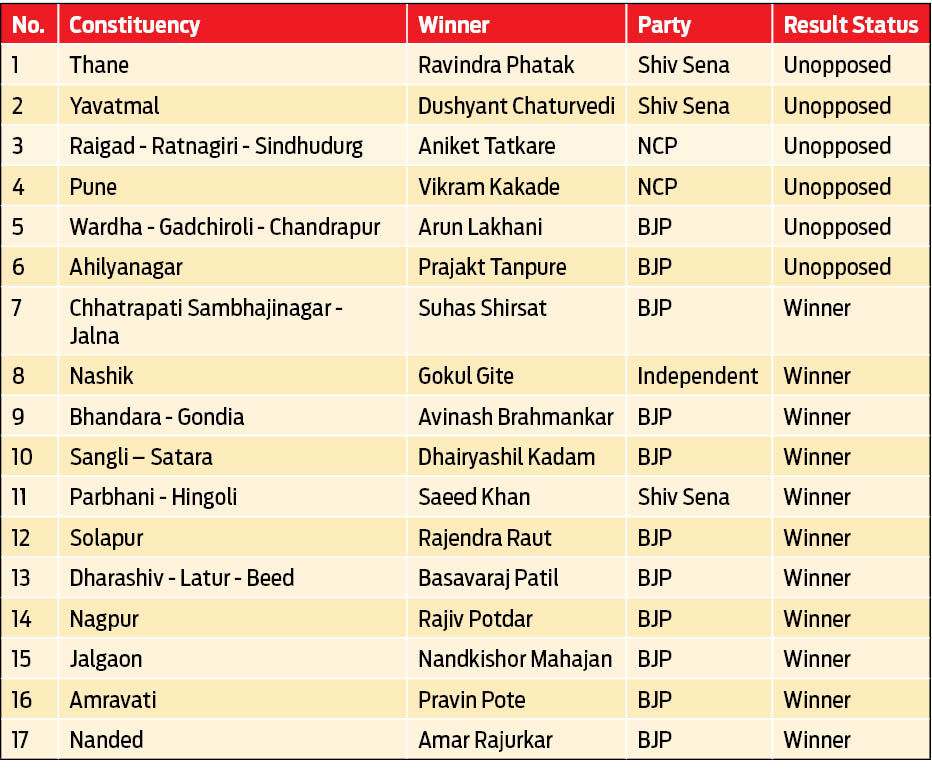
Party-wise Performance:
• BJP: 11 seats (2 unopposed)
• Shiv Sena: 3 seats (2 unopposed)
• NCP: 2 seats (both unopposed)
• Independent: 1 seat (BJP rebel)

Comments


bottom of page