

Symbol of political pride, power and pragmatism
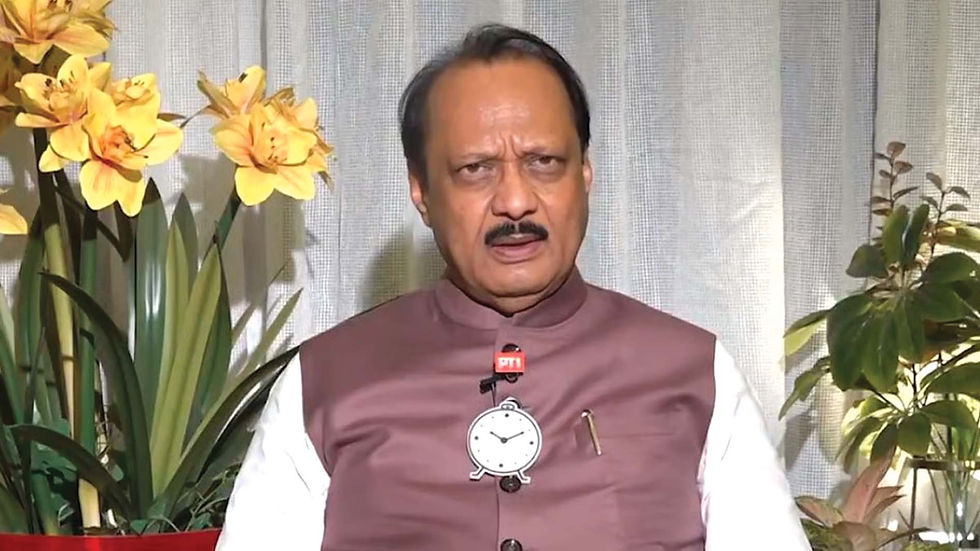
Mumbai: Ajit Ashatai Anantrao Pawar - who straddled Maharashtra’s political landscape like a colossus for nearly 45 years - was snuffed out in a plane crash in Pune early on Wednesday, plunging his Nationalist Congress Party (NCP) into precarity and the ruling Mahayuti government into turmoil.
The nephew of Nationalist Congress Party (SP) President Sharad Govindrao Pawar, Ajit Pawar was 66 and is survived by his wife Sunetra, an MP, and two sons, Parth and Jay. Parth, a wannabe politician, is a bachelor, while Jay married Rutuja Pravin Patil in December 2025.
Born with a ‘political silver spoon’ into the formidable Pawar family, Ajit Pawar’s political trajectory spanned Baramati’s village politics to the cooperative sector, and then to state - and briefly, national - roles. The crowning glory of his career was - being elected Deputy Chief Minister a record six times.
The ‘Pawar-ful’ surname raised towering expectations from Ajit Pawar, thanks largely to his 'Kaka', Sharad Pawar’s ascent as the state’s youngest Chief Minister at the age of 38 in 1978. Yet, Ajit Pawar had to struggle for years to carve an independent niche under Sharad Pawar’s ever-looming giant penumbra, finally emerging from the long eclipse in July 2023 following a vertical split in the NCP.
Humble Grassroots
Rising from humble grassroots political engagement, he quickly grasped the pulse of rural Maharashtra and the state’s political dynamics, especially during the era of coalition politics that has dominated the scene for over a quarter century.
Ajit Pawar concentrated his official power on initiatives ranging from roads, dams and irrigation networks to tough financial decisions. Aided by his brash bluntness style of functioning, a loafing officialdom sprang into action to avoid his dark scowls or wrath.
Over decades as an MLA (eight times), MP and in other key positions, Ajit Pawar mastered the art, science and mechanisms of governance - the movement of files, the working of departments, how decisions are translated into policy and finally implemented to reach the last man standing.
En route, his decisions courted multiple controversies and dubious charges, yet he dashed towards his destinations unperturbed. These included corruption allegations, big and small intra-party and external political confrontations, and his unabashed yet unfulfilled desire to become Chief Minister - all of which marked him as an all-weather survivor.
Iron Control
A retired official recalled his iron control over the bureaucracy, especially during his tenure handling the critical Finance portfolio of the country’s largest state economy. He focused sharply on rural road infrastructure, irrigation projects, water supply schemes, and extensive canal and dam networks.
These initiatives were coupled with strict fiscal discipline, firm budgeting and a ringmaster-style implementation - a tribute to his administrative acumen and efficiency. However, in recent years, he succumbed to realpolitik pressures that not only raised question marks but also catapulted the state’s debt burden to record highs, but he airily brushed aside all censure.

Comments