
The Reckoning of Suez: Britain’s Post-Imperial Dilemma Since 1956

Part 2: Seven decades after the Suez crisis, Britain’s relentless prime ministerial churn reflects a nation still searching for a durable post-imperial settlement.
If Keir Starmer’s resignation last month has a deeper significance, it lies not in the circumstances of his departure but in what it reveals about modern Britain. The country’s recent political turbulence is often attributed to Brexit, immigration, economic stagnation or the distorting effects of social media. But the deeper story begins in 1956, when the Suez Crisis forced Britain to confront a question that no government has convincingly answered since: what is Britain for after its empire?
Nearly 70 years after Suez exposed Britain’s diminished place in the world, Starmer’s resignation is the latest reminder that the country is still searching for a durable post-imperial settlement. Suez has often been described as Britain’s imperial obituary. But that is a somewhat simplistic perception.
Britain remained one of the world’s largest economies, a nuclear power, a permanent member of the United Nations Security Council and America’s closest strategic ally. As historian David Edgerton has argued in The Rise and Fall of the British Nation (2018), post-war Britain was far stronger and more technologically sophisticated than the nostalgic accounts of decline suggest. Britain’s problem was not an immediate collapse of power but a growing uncertainty about its purpose.
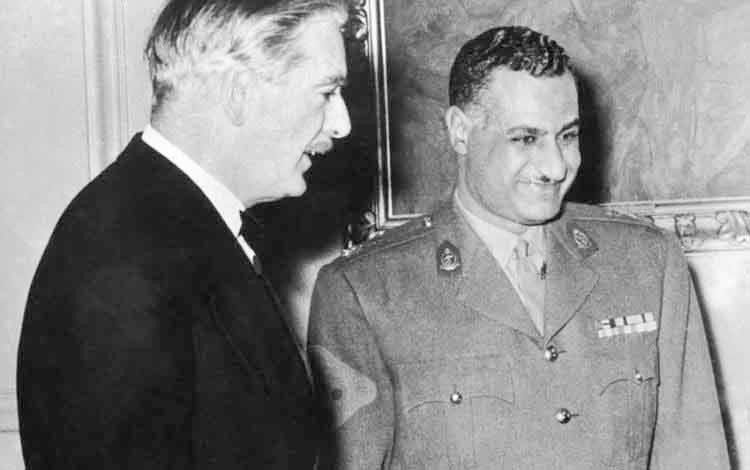
When Egyptian President Gamal Abdel Nasser nationalised the canal in July 1956, then British Prime Minister Anthony Eden interpreted the move not merely as a strategic challenge but as an affront to Britain’s standing in the world. Like many of his generation, Eden viewed international politics through the prism of the 1930s: dictators had to be confronted, and Eden cast Nasser in the role of an ‘Arab Mussolini,’ at times even another Hitler - a profound misreading of a fervent anti-colonial nationalist that Nasser really was.
Britain and France then opportunistically entered into a secret understanding with Israel under the Protocol of Sèvres, whereby an Israeli invasion of Sinai would provide the pretext for Anglo-French military intervention to ‘separate’ the combatants and regain control of the canal.
While the operation achieved its immediate military objectives, it proved to be a diplomatic and strategic catastrophe. U.S. President Dwight Eisenhower refused to support what Washington regarded as an act of collusive adventurism, and applied intense financial pressure, causing the sterling to come under attack. Britain was forced into an ignominious withdrawal - not because it had been defeated on the battlefield, but because it could no longer act independently of the United States.
Far more than the military setback was the psychological shock. For more than a century, Britain’s governing elite had operated within a settled understanding of the nation’s place in the world. Suez exposed the uncomfortable truth that this inherited self-image no longer matched geopolitical reality.
Identity Crisis

Unlike France, which reinvented itself through the institutions of the Fifth Republic, or West Germany, which anchored its post-war identity in European integration, Britain has never forged a comparable consensus about what should succeed its empire. Instead, successive governments oscillated between competing visions of the nation’s future. That dissonance would shape British politics for decades.
Harold Macmillan understood the dilemma better than most. Remembered for declaring that Britons had “never had it so good,” he was also the statesman who recognised that decolonisation was irreversible. His celebrated “Wind of Change” speech in Cape Town acknowledged that African nationalism could no longer be resisted and that Britain would have to adapt to a post-imperial world. Macmillan’s achievement lay in managing Britain’s retreat with remarkable political dexterity. As Alistair Horne noted in his biography Macmillan, 1957–1986 (1989), he sought to transform Britain into a modern European state without provoking national panic.
Yet, the transition remained incomplete. Membership of the European Economic Community in 1973 represented an attempt to redefine Britain’s place in the world. Europe promised influence after empire. But it also served as a constant reminder that Britain was no longer setting the rules and was joining an organisation largely designed by others.
Andrew Gamble, in Britain in Decline (1981), argued that post-war British politics had become dominated by what he called “the politics of decline.” Governments of both parties grappled with slowing growth, industrial unrest and the steady erosion of Britain’s relative economic and geopolitical weight, while few politicians were willing to acknowledge that Britain had become a major European state rather than an independent imperial power.
Was Britain fundamentally European? Was it Atlantic? Was it a global trading nation? Or was it still, in some residual sense, an imperial power with a unique global role?
Untidy Endings
No government succeeded in settling those questions which resurfaced generation after generation under different political disguises. The 1970s illustrated this uncertainty with unusual clarity. Edward Heath’s confrontation with the trade unions culminated in his famous question to the electorate: “Who governs Britain?” Heath intended it as a challenge to organised labour, whose strikes had repeatedly paralysed the country. In retrospect, however, the question proved prophetic for entirely different reasons.
Power, meanwhile, steadily drifted away from Westminster. In the post-war decades, governments contended first with the trade unions, then with Brussels, later with an increasingly assertive judiciary, and eventually with referendums that challenged the traditional doctrine of parliamentary sovereignty.
The spectacular collapse of Liz Truss’s premiership in 2022 revealed how financial markets could now discipline governments more swiftly than Parliament itself. Even prime ministers commanding comfortable Commons majorities found themselves constrained by party factions, central banks, bond markets and international institutions. Weak leadership notwithstanding, Britain’s instability stems from a growing uncertainty over where authority actually resides.
Harold Wilson perhaps anticipated today’s predicament better than any other post-war prime Minister. As Ben Pimlott argued in his acclaimed 1992 biography, Wilson’s gift lay not so much in resolving Britain’s contradictions but in containing them.
His successors would prove no more successful. While the crisis changed shape, from industrial unrest and inflation to Brexit and constitutional fragmentation, but the underlying dilemma remained remarkably constant. Britain had still not agreed on the purpose that should replace its empire.
Recent British prime ministers from Cameron to Starmer have governed less as reformers than as crisis managers. Whatever the immediate causes of their departures, each inherited contradictions they thought were easier to manage than to resolve. Their governments were consumed by crises rather than animated by a coherent vision of Britain’s future. Their departures point to a deeper problem that Britain is searching not merely for new leaders but for a new national settlement.

Starmer’s promise of competence could not resolve the larger question of what Britain’s post-Brexit state was meant to be.
Many commentators have portrayed the 2016 Brexit referendum as a revolt against Brussels. If one reads deeper, it is equally a revolt against Britain’s post-Suez settlement. Millions of voters rejected the assumption that Britain’s future lay in accepting a diminished role within larger international structures. While Brexit promised the recovery of sovereignty, confidence and global influence, it instead exposed how little agreement existed about what sovereignty was actually meant to achieve.
Brexit answered the question of whether Britain should leave the European Union. But it left unresolved the larger question of what kind of country Britain wished to become thereafter.
Britain today, in many ways, bears a striking resemblance to the country of the 1970s. Then, the post-war consensus had exhausted itself while Thatcherism had yet to emerge. Today, Brexit has dismantled the assumptions that governed Britain for nearly half-a-century, yet no comparable settlement has taken its place.
The fragmentation of British politics reflects that deeper uncertainty. While Westminster still appears to operate within a familiar two-party system, beneath the surface the old certainties are steadily eroding. Scotland has increasingly followed a distinct political trajectory, with the question of independence never entirely disappearing. Northern Ireland, meanwhile, operates within its own constitutional framework, where Brexit has complicated the delicate balance established by the Good Friday Agreement.
Nigel Farage’s Reform UK has fractured the Conservative coalition, while the Greens increasingly challenge Labour among younger, urban voters. The political loyalties that underpinned British politics for much of the twentieth century are steadily weakening.
Few anticipated this predicament more presciently than political theorist Tom Nairn. In his classic The Break-Up of Britain (1977), written decades before Brexit or Scottish independence became mainstream political issues, Nairn argued that Britain had never fully adapted its political institutions to the realities of a post-imperial age. The British state, he suggested, still rested upon assumptions forged during the imperial era, even as the empire itself disappeared. Unless Britain reinvented its constitutional and political identity, he warned, centrifugal forces would steadily pull at the Union itself.
Deeper Currents
Britain’s post-war history can be understood as a succession of political settlements punctuated by moments of rupture. The settlement forged after 1945 collapsed during the economic and industrial crises of the 1970s. Thatcherism supplied a new organising philosophy, while New Labour modified rather than overturned it. Brexit shattered that consensus in turn. What Britain has yet to produce is a successor capable of commanding comparable authority.
For years, commentators have likened Britain’s rapid turnover of prime ministers to post-war Italy, long caricatured as Europe’s archetype of political instability because governments frequently collapsed while the state itself continued to function. The comparison, however, is misleading. Italy’s instability has traditionally reflected coalition arithmetic and fragmented party politics. Britain’s recent turbulence runs deeper. Its post-war reputation for stable government rested not merely upon constitutional arrangements, but upon a broad consensus about what Britain was, where it belonged and what role it sought to play in the world. Once that consensus dissolved, institutional stability inevitably became more fragile.


The shadow of Suez lingers not because the crisis itself dominates public consciousness, but because the questions it first posed remain unanswered. How should Britain define itself after empire? What relationship should it maintain with Europe? How should it exercise influence in a world increasingly dominated by continental powers such as America, China and India? Above all, what story should Britain tell itself?
It is in this context that Starmer’s resignation must be understood, as the latest chapter in Britain’s long post-imperial reckoning. It is not so much that Britain has had six Prime Ministers in a decade; democracies do endure periods of political turbulence. The remarkable fact is that, seventy years after Suez, Britain is still grappling with the same fundamental question: what should succeed its empire?


Comments