top of page

By:

Reeva Sakaria

8 November 2025 at 3:04:18 pm

How transport systems make urban life easier

Did you know Mumbai commuters lose hundreds of hours every year not in distance, but in delays, waiting, and uncertainty. In Mumbai, commuting can feel like a challenge, but technology is quietly changing that. Intelligent transport systems (ITS) are helping people navigate the city more efficiently by combining real-time data, adaptive routing, and smart coordination across trains, metros, monorails, buses, and last-mile options. At the forefront of this transformation is Yatri, Mumbai’s...

How transport systems make urban life easier

Did you know Mumbai commuters lose hundreds of hours every year not in distance, but in delays, waiting, and uncertainty. In Mumbai, commuting can feel like a challenge, but technology is quietly changing that. Intelligent transport systems (ITS) are helping people navigate the city more efficiently by combining real-time data, adaptive routing, and smart coordination across trains, metros, monorails, buses, and last-mile options. At the forefront of this transformation is Yatri, Mumbai’s official local app. Using ITS, Yatri shows the best combination of transport modes in real time, provides accurate live locations of trains and metros, and even enables smart, easy metro ticketing via QR codes. The result: a commute that’s no longer an uncertain experience, but a predictable, stressfree journey. It’s 8:20 a.m., and you have a 9:30 a.m. meeting in BKC, at a place you’ve never been to before. You pause for a moment, weighing your options. Do you risk sitting in traffic in a cab, watching the minutes tick by, or take a train and hope you don’t miss it by a minute? Will one small delay early in the journey quietly snowball into being late? This familiar moment of hesitation is something countless commuters in Mumbai experience every single day. In a city like ours, peak-hour travel is rarely linear. A route that looks manageable on a map can quietly stretch from under an hour to well over 80 minutes, with average speeds during rush hour dropping to 10–15 km/h on key corridors. Over time, I’ve noticed how commuters adapt: leaving earlier than necessary, padding schedules with buffers, mentally preparing for delays, carrying the cognitive load of uncertainty long before the journey even begins. What often goes unnoticed is how strong Mumbai’s public transport network already is. Every day, local trains carry nearly 7 million people across the city. Metros cut through peak-hour chaos with steady, reliable travel times. Buses, autorickshaws, skywalks, and short walks quietly take care of the last mile. But in real life, the challenge isn’t availability—it’s coordination. When commuters are forced to mentally stitch together trains, buses, metros, and walking routes without reliable information, they default to what feels familiar rather than what’s efficient. Take a common rush-hour commute from Lower Parel to Andheri East. By road alone, this journey can easily take 75–90 minutes on a bad day as traffic slows unpredictably. But when modes are combined, walking to Lower Parel station, taking a local train to Andheri, switching to the metro, and finishing with a short walk, the trip often takes just 45–55 minutes. That’s a time saving of 30–40 minutes per trip. Over a five-day workweek, that adds up to 2.5 - 3 hours; over a year, more than 100 hours reclaimed, time that would otherwise be lost to waiting, guesswork, and congestion. According to a report by The Times of India, using real-time data and adaptive routing, intelligent transport systems can cut commute times by 30–40% and reduce congestion hours by up to 35%. Cities around the world that have adopted ITS are already seeing the impact: fewer hours wasted inching through traffic, and more time getting where people need to be. What excites me most is how commuters themselves are becoming part of the solution. An overcrowded train, a signal failure, or a last-minute platform change often unfolds in real time through shared updates. On Yatri chat, people flag delays, confirm train arrivals, and alert fellow travellers before official announcements. This two-way flow, where technology is strengthened by human insights, creates a living, responsive network rather than a static schedule. Yatri brings journey planning, metro ticketing, live train locations, and real-time travel information into a single platform, helping commuters navigate efficiently across local trains, metros, monorails, buses, and last-mile options without guesswork. By combining intelligent transport systems with real-time updates from both technology and fellow travellers, journeys become predictable, stress-free, and under control, making cities feel smaller, connections closer, and everyday life just a little easier to navigate. The writer is a co-founder of Yatri. Views personal.)

Unity within MVA suffers significant blow

CM Devendra Fadnavis' customary tea party on the eve of Assembly Session. | Pic: DGIPR

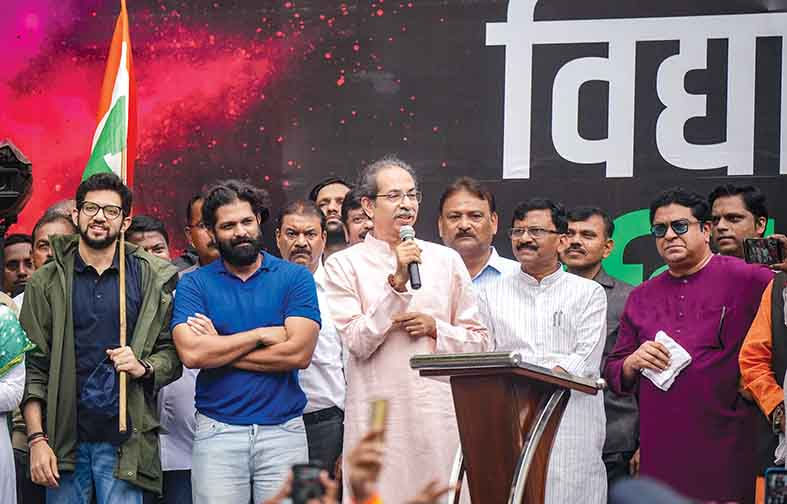
Mumbai: The facade of unity within the Maha Vikas Aghadi (MVA) has suffered a significant blow on the eve of the Maharashtra Legislature’s budget session. What was meant to be a show of strength against the Mahayuti government has instead exposed deep-seated mistrust and conflicting ambitions, primarily centered around the upcoming Rajya Sabha elections. The cracks were most visible during the customary opposition press conference and the boycott of Chief Minister Devendra Fadnavis’s tea party, where leaders from Sharad Pawar’s NCP (SP) were conspicuously absent, signaling their exclusion from the alliance’s core decision-making process.


The primary source of friction is the lone Rajya Sabha seat that the MVA can mathematically secure with its combined strength of roughly 50 MLAs. Sources reveal that Uddhav Thackeray has been in direct, exclusive contact with the Congress high command in Delhi to negotiate the candidacy, reportedly keeping the Sharad Pawar faction entirely out of the loop. This exclusion has sparked rumors of a shifting power dynamic within the MVA, where the Shiv Sena (UBT) and Congress appear to be forming a "primary bloc," leaving the veteran Pawar to navigate the political waters independently.


Adding to the internal turmoil is a sharp public disagreement within the Shiv Sena (UBT) itself. While party spokesperson Sanjay Raut has publicly advocated for giving Sharad Pawar another term in the Rajya Sabha as a gesture of alliance solidarity, he has been met with stiff resistance from within his own camp. Former minister Aaditya Thackeray has countered this stance by citing the cold arithmetic of the assembly. Aaditya argued that based on current numbers—where the Sena (UBT) holds 20 seats compared to the NCP (SP)’s 10—the claim to the seat naturally belongs to the Thackeray faction. He further remarked that Raut requires a more aggressive "companion" in the Upper House to sustain the party's offensive against the central government, hinting that the seat should go to a loyalist rather than an ally.


The timing of this internal rift is particularly delicate as Sharad Pawar struggles with health issues. The 85-year-old leader was admitted to Pune’s Ruby Hall Clinic for the second time in a fortnight on Sunday, suffering from mild dehydration and fatigue. His hospitalization has cast a shadow of uncertainty over his own plans for re-election, even as his allies debate whether to support him or field their own candidates.


The broader political landscape further complicates the MVA's predicament. With the Mahayuti alliance—comprising the BJP, Eknath Shinde’s Shiv Sena, and the NCP—holding a dominant majority, they are expected to sweep six of the seven Rajya Sabha seats. The MVA’s inability to settle on a single candidate for the seventh seat not only threatens their chances of an unopposed victory but also provides the ruling coalition with an opportunity to exploit these growing divisions. As the budget session begins, the MVA faces the daunting task of proving that it is still a cohesive unit, or risk entering the 2026 electoral cycle as a house divided.

Comments


bottom of page