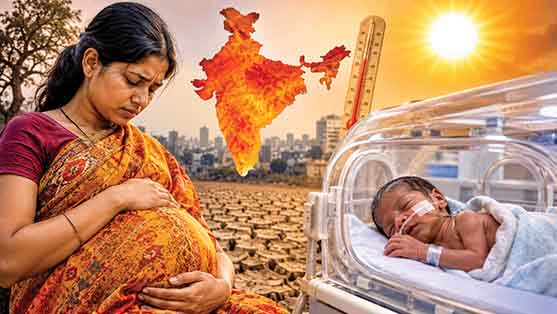
Mumbai: Climate change may be threatening unborn babies with a new study claiming that global-warming triggered an additional 8,830 premature births in India in just one month - April 2024 – with Bihar, Uttar Pradesh, Jharkhand and West Bengal among the worst-hit states.
Besides India, the toll attributed to climate change in Bangladesh and Philippines stood at an estimated 10,600 pre-term babies during that month, said the report released by Zero Carbon Analytics (ZCA) – a week before the UN Climate Change Conference (COP31) in Turkiye from Nov. 9-20.
No longer restricted to rising temperatures, melting glaciers, erratic monsoons or unpredictable floods and droughts, the climate change effects are now directly affecting public health and pregnant women, pushing them into premature labour and endangering the lives of newborns or potentially threatening them with lifelong health issues if born before completing 37-weeks of full pregnancy, indicates the report.
The ZCA said that the April 2024 heatwave which engulfed large parts of South and Southeast Asia, was made at least 45 times more likely by human-caused climate change. Without this human-induced warming, the study estimates that these 10,600 additional premature births could have been avoided, said this first of its kind study.
Citing the overall impact, it compared April 2024 with a typical April month, with researchers finding approximately 16,150 excess pre-term (premature) births across the three countries. India recorded a 3.6pc increase, against 11.9pc in Bangladesh and 10pc in the Philippines.
In India, the burden was heavily concentrated in Bihar, Uttar Pradesh, West Bengal and Jharkhand, which together accounted for approximately two-thirds of the country’s excess premature births.
The future could be even more frightening, warn the researchers under the upcoming global warming scenarios and gloomy predictions. The experts claim that India could witness more than 15,000 excess preterm birth during a typical April by 2050 – or nearly double of April 2024 in barely 25 years.
While UP is projected to face the maximum burden of such premature births, Bihar and even Rajasthan would follow, as per the ZCA study which combined temperatures and birth data, climate attribution sciences and advanced climate modelling.
Interestingly, the UN recently highlighted the heat-related threats to pregnancy and childbirth as ‘a potentially fatal new faultline in the climate crisis’. The WHO, WMO, UNICEF and UNFPA have also launched a global framework to monitor heat-related health risks among pregnant women, newborns and children.
Threats to unborns
As per the ZCA, South Asia has the highest rates of preterm births 13.2 pc, compared with any global region as per the Germanwatch’s Climate Risk Index-2026. India, Bangladesh and Philippines rank 15th, 13th and 7th on the ‘climate-vulnerable’ countries.
Pregnancy-specific heat exposure is also rising faster in these countries than almost anywhere in the world and exposure to extreme heat during pregnancy is linked to other pregnancy complications such as hypertension, gestational diabetes, severe maternal morbidity, and stillbirth.
Besides, other climate-fuelled extreme weather events such as droughts and floods, together with the deadly air pollution caused by burning fossil fuels, present a simultaneous - and growing - threat to maternal and neonatal health in the region.
Lead Author Dr. Joanne Bentley-Mckune and ZCA’s Senior Research Analyst said climate change was making extreme heat more frequent and intense, increasing preterm births and their lifelong implications, warning that the impact could increase with rising mercury that could make April 2050 more dangerous than the extraordinary heat of April 2024.
She highlighted the injustice that “countries contributing relatively little to historical greenhouse-gas emissions were bearing a disproportionate share of the health consequences”.
AIIMS Guwahati’s Nodal Officer for Climate Change, Prof. (Dr). Rashmi Agarwalla described climate change as “a public-health emergency, with pregnant women and newborns on its frontline”.
“Anaemia, poor nutrition and prolonged outdoor work further compound heat-related risks, particularly among vulnerable communities,” she cautioned.
There are other concerns as the report exposes glaring gaps in India's healthcare preparedness to deal with this emerging crisis. “Maternal health policies and heat-action plans do not systematically protect pregnant women and newborns against extreme temperatures. Better antenatal care, access to cooling facilities and effective early-warning systems are urgently needed,” it added.