 India has a long and remarkable tradition of mythological and religious films, television serials and devotional music enjoying immense popularity. Sustained across generations, this tradition remains alive, with the latest big-budget production of Ramayana representing its newest chapter. The deeply religious character of Indian society has played a significant role in keeping these stories relevant.
The tradition of mythological cinema dates back to Raja Harishchandra (1913), the first silent film directed by Dadasaheb Phalke. This was hardly surprising. Cinema was then an entirely new medium and business, and developing original stories and screenplays was no easy task. Filmmakers naturally gravitated towards mythological narratives that audiences already knew and could readily understand.
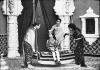
In 1917, Phalke produced the silent film Lanka Dahan. Wherever it was screened, cinema halls virtually acquired the atmosphere of temples or pilgrimage centres. Audiences removed their footwear before entering.
In those days, many cinema halls required spectators to sit on the floor, while others had floor seating in front and wooden benches at the back. During certain scenes in Lanka Dahan, spectators would bow before the screen with folded hands, expressing their profound religious faith.
Interestingly, a 484-foot-long original print of Lanka Dahan is preserved at the National Film Archive of India in Pune.
A Remarkable Chapter
In 1942, Prakash Pictures produced Ram Rajya simultaneously in Marathi and Hindi under the direction of Vijay Bhatt. Belonging to the black-and-white era, the two versions featured largely the same cast.
According to one reference, certain technical processes relating to the Marathi version were completed later, and it reached theatres in 1944.
Based on the Valmiki Ramayana, the film’s screen adaptation, screenplay and dialogues were written by Vishnupant Aundhkar. Raja Badhe penned the lyrics, Shankarrao Vyas composed the music, P. G. Kukde handled cinematography, and Pratap Dave was responsible for editing.
Prem Adib portrayed Lord Rama in the Hindi version, while Chandrakant played the same role in Marathi. Shobhana Samarth portrayed Sita in both.
An interesting story associated with the production was widely discussed at the time. Prem Adib and Shobhana Samarth were reportedly bound by an agreement not to smoke cigarettes or consume alcohol until the film was completed.
Filmmaking, particularly the production of religious films, was then approached with considerable devotion. Today, such stories may sound almost legendary, but they were regarded as realities of that era.
Ram Rajya featured ten songs and was shot entirely at Prakash Studios in Mumbai, where filmmakers generally constructed different sets and completed their shooting indoors.
The film was released at Super Talkies on Grant Road in south-central Mumbai, a cinema hall that continues to operate even today. The theatre scheduled two Hindi shows and one Marathi show daily. Such was the film’s popularity that it enjoyed a remarkable 102-week run at Super Theatre.
Before screenings, audiences would break coconuts in front of the screen and offer prayers. Such spectators played an important role in establishing and popularising cinema in India.
Another noteworthy development was the screening of Ram Rajya at the Museum of Modern Art in the United States on May 5, 6 and 7, 1947, which received an encouraging response.
The film also has a remarkable association with Mahatma Gandhi. Contemporary print media reported that Ram Rajya was the only film he had watched in his lifetime, a distinction that continues to be recalled.
Box-Office Phenomenon
During the 1960s and 1970s, filmmakers Homi Wadia and Chandrakant consistently produced films drawing on stories, episodes and major as well as minor characters from the Ramayana and Mahabharata. These productions gradually cultivated a dedicated audience.
The extraordinary popularity of Jai Santoshi Maa (1975), produced by Satram Rohra, virtually created box-office history.
In several towns and villages, temples dedicated to Santoshi Mata were established while the film was still running to packed houses. Rural audiences would remove their footwear before entering cinema halls. During the song Main To Aarti Utaroon Re, spectators would stand up and perform the aarti.
It was an extraordinary instance of audiences elevating a cinematic experience to something approaching the sacred.
Released in Mumbai on May 30, 1975, Jai Santoshi Maa soon made a tremendous impact. Interestingly, Ramesh Sippy’s Sholay arrived on August 15 that year, but the devotional film’s popularity continued unabated. The phenomenon demonstrated the extraordinary appeal of religious cinema.
Its success encouraged several other films in the genre. Some found audiences, while others failed to replicate its achievement.
An Unprecedented Phenomenon
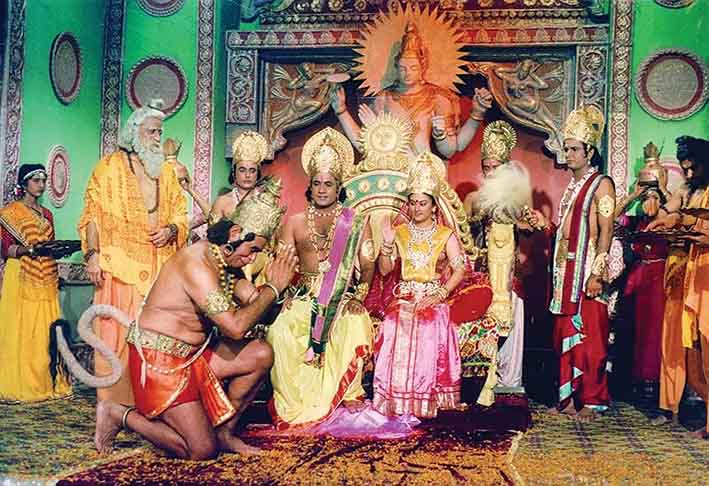
Ramanand Sagar’s Ramayan established an entirely new benchmark for mythological entertainment.
The serial began airing on Doordarshan’s national network on Sunday, January 25, 1987. Each 35-minute episode was telecast at 9 am every Sunday.
From its very first episode, it captured the hearts of viewers — or, more appropriately, devotees.
Colour television had arrived in India in 1982, just five years earlier, while black-and-white television sets, introduced in 1972, were still common. Television had yet to reach every household.
Consequently, homes possessing television sets became centres of attraction every Sunday morning. Relatives, neighbours and friends gathered in large numbers, creating an atmosphere resembling a village fair.
In rural areas, television sets were sometimes installed in open spaces near temples or on verandas, allowing entire communities to watch Ramayan together. During its telecast, streets across the country wore a deserted look.
The programme was watched with extraordinary religious devotion.
After 78 Sundays, Ramayan concluded on July 31, 1988. Subsequently, B. R. Chopra’s Mahabharat, which he produced and directed, occupied the same time slot and received an equally phenomenal response.
The extraordinary enthusiasm surrounding both serials received extensive media coverage. Their popularity remains a subject of discussion even today.
The success of Ramayan transformed Arun Govil, who portrayed Lord Rama, and Dipika Chikhlia, who played Sita, into household names. Their association with these characters became so strong that audiences often expected them to attend public functions in their screen appearances.
Both actors acquired a lifelong association with the characters. During the celebrations surrounding the consecration of the Ram Mandir, Govil and Chikhlia gave numerous interviews recalling their experiences of making and appearing in the serial, transporting audiences back to those unforgettable Sundays.
Technology Versus Faith
Om Raut’s Adipurush offered another cinematic interpretation of the Ramayana. However, its excessive reliance on visual effects proved unintentionally comical in places, undermining the story’s original spirit and emotional appeal.
The experience demonstrated that technological sophistication alone cannot recreate the devotional connection audiences expect from mythological cinema.
The latest big-budget Ramayana represents another stage in this cinematic journey, employing contemporary visual effects and artificial intelligence. The transformation from Phalke’s rudimentary silent films to modern technological spectacles has been remarkable.
Yet, whether on the big screen or television, mythological narratives have consistently elicited an overwhelming response from ordinary Indian audiences. The examples outlined here offer a glimpse of this enduring tradition.
From Raja Harishchandra and Lanka Dahan to the latest Ramayana, Indian mythological cinema is not merely a story of changing filmmaking techniques, production methods and technology. It is also the story of an extraordinary bond between cinema, devotion and audiences.
Technology has changed. Cinema has evolved. But the faith that has sustained this genre for more than a century remains remarkably resilient.
(The writer is a journalist and film critic. Views personal.)