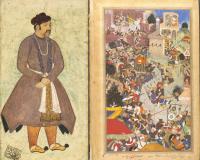
The plains of Panipat have held an extraordinary place in the Indian historical imagination. For few geographical locations in world history have witnessed so many encounters that so drastically altered the political destiny of South Asia. The two battles of Tarain in 1191 and 1192 CE and the three encounters at Panipat in 1526, 1556 and 1761 CE, have made this contested stretch in today’s Haryana district a veritable graveyard of empires and ambitions.
Of these, the Second Battle of Panipat, fought 470 years ago on November 5, 1556, is perhaps the most tantalising for what might have been.
The contest would determine whether the fragile Mughal restoration under the boy-emperor Akbar would survive, or whether an indigenous empire under the remarkable Hindu military adventurer Hemchandra or Hemu, who had come within striking distance of establishing a new ruling house in Delhi, would be forged. Ultimately, a freak battlefield accident decided the outcome.
A Disintegrating Empire
The political landscape of Hindustan between 1554 and 1556 was one of complete disintegration. Sher Shah Sur’s death during the siege of Kalinjar in 1545 deprived the Afghans of his administrative and military genius which had temporarily driven the second Mughal, Humayun, from India. The Sur dynasty rapidly collapsed into fratricidal civil war within a decade of the founder’s demise.
By the mid-1550s, three distinct claimants of the Sur house tore the empire apart, leaving the empire of Delhi reduced to a fragmented domain.
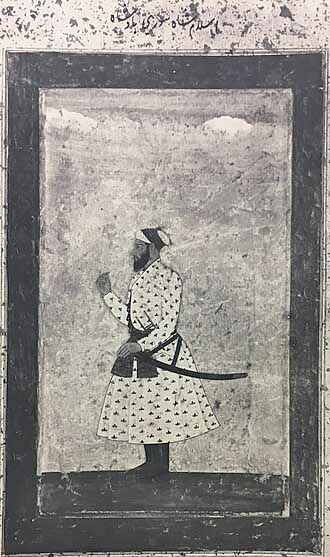
The last substantial ruler of the Sur house was Mubariz Khan, Sher Shah’s nephew, who assumed the title Muhammad Adil Shah, popularly called ‘Adali.’ Having murdered the young successor of Islam Shah (Sher Shah’s son), he occupied Delhi but proved incapable of governing effectively.
Adali’s government, however, acquired an unexpected measure of administrative and military strength through his Hindu minister, Hemchandra or Hemu, whose ascent was extraordinary.
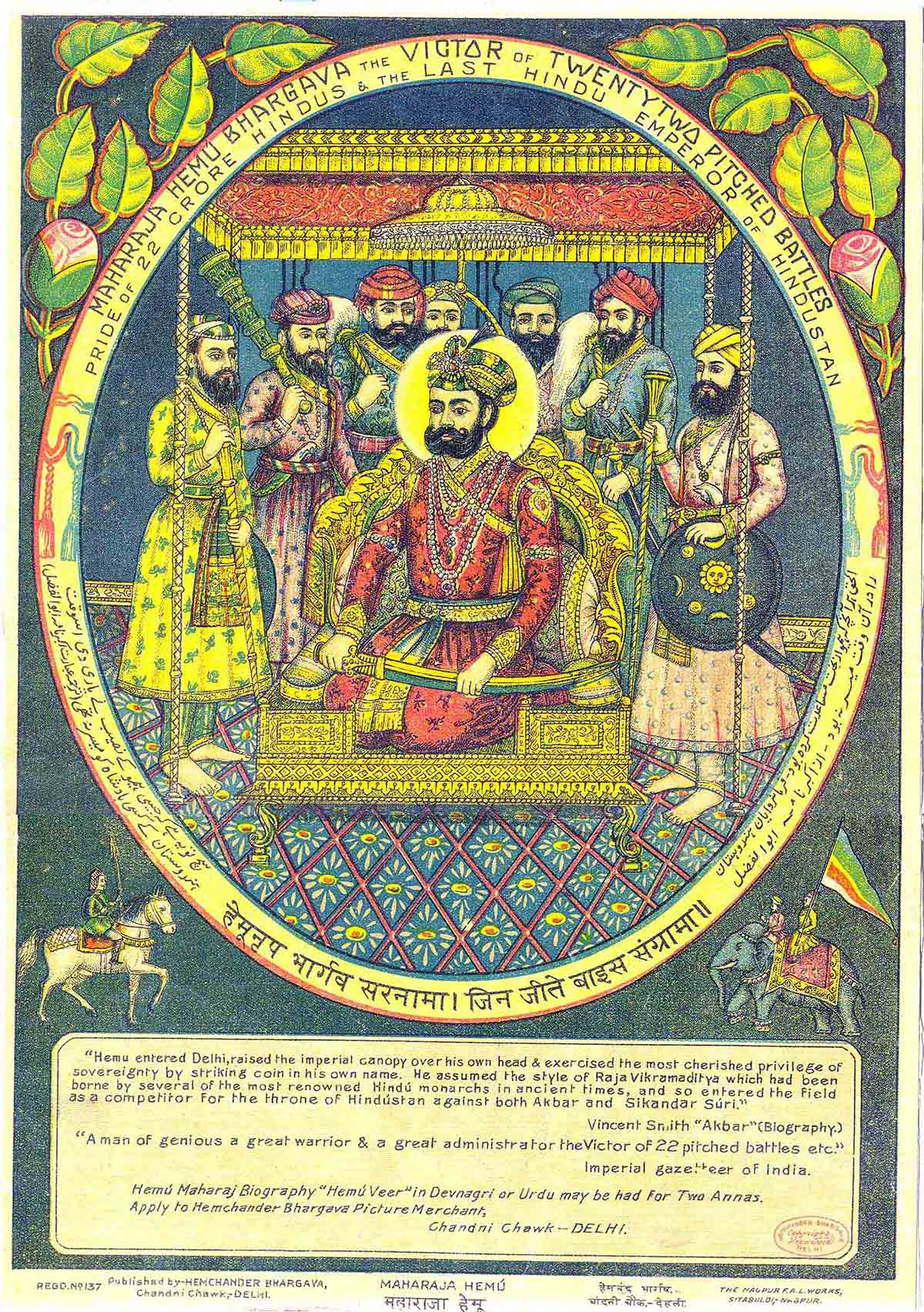
Jadunath Sarkar, in Military History of India (1952), describes him as the finest military genius on the Afghan side after Sher Shah’s death. Born into a poor family of the Dhusar section of the Baniya community, Hemu began his career as a grocer or hawker in Rewari, in Mewat. Badauni describes him as having been gradually elevated from supervising the markets and administering punishments to positions of considerable responsibility under Islam Shah. He subsequently headed the intelligence and postal departments and was entrusted with confidential military assignments.
R.C. Majumdar, in Volume VII of The History and Culture of the Indian People (1974), calls Hemu “a forgotten Hindu hero” who rose from a greengrocer’s shop to the throne of Delhi, while observing that his was a remarkable story of social mobility in a political order dominated by Muslim military aristocracies and competing dynasties. Hemu’s administrative integrity, sternness in dealing with corrupt officials and conspicuous military ability earned him Adali’s confidence, although they also antagonised the old Afghan nobility.
Despite Mughal court chroniclers like Abu-l Fazl and Badauni painting his character in the blackest colours as an upstart enemy of the Mughals, their own accounts testify to Hemu’s military brilliance. Abu-l Fazl records that Hemu defeated the pretender Ibrahim Khan, crushed Sultan Muhammad of Bengal, and overcame Taj Khan Karrani and Rukn Khan Nuhani. He emerged victorious in 22 battles against the rivals of Adali, earning the absolute loyalty of Afghan chieftains who willingly served under a Hindu commander – something unprecedented for the times.
The Road to Delhi
As news of Humayun’s death spread, Hemu swept westward from the eastern provinces with a powerful force to reclaim the royal capitals. Agra was evacuated without a fight. Hemu pursued the retreating Mughals to Tughlaqabad, five miles east of the Qutb Minar, where Tardi Beg, the Mughal governor of Delhi, made a stand on October 7, 1556. However, Hemu succeeding in defeating the Mughal forces, capturing 160 elephants, 1,000 Arab horses, and an immense quantity of valuable booty.
Jadunath Sarkar’s reconstruction of this battle is an illuminating account of Hemu’s tactical abilities. The Mughal army, commanded by Tardi Beg, initially enjoyed success. Its vanguard and left wing drove back their opponents and captured hundreds of elephants. Believing the battle won, many Mughal soldiers dispersed to plunder the Afghan camp. Hemu, however, had deliberately held back 300 select elephants and a body of cavalry in reserve. He suddenly unleashed them against Tardi Beg’s exposed centre. The Mughal officers fled in confusion, followed by Tardi Beg himself.
Hemu, displaying considerable restraint, did not scatter his troops in chaotic pursuit. He maintained his battle formation and subsequently occupied Delhi.
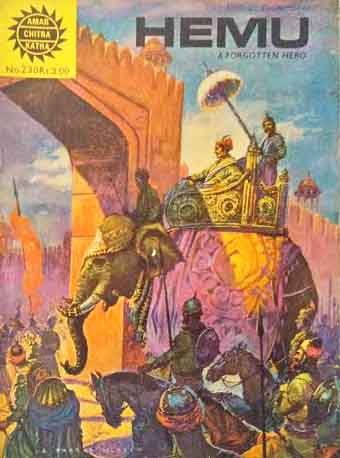
on Hemu, by Pratap Mullick
Hemu entered Delhi in triumph. As R.C. Majumdar emphasizes, Hemu was the only Hindu to ascend the throne of Delhi since the fall of Prithviraj Chauhan at the Battle of Tarain in 1192 AD. Recognizing that his nominal master Adali was far away in Chunar, Hemu distributed the immense booty (save for the war-elephants) among his officers, thereby securing their allegiance. With their concurrence, he raised the imperial canopy over his head, issued coins in his own name and assumed the title ‘Raja Bikramajit’ or ‘Vikramaditya,’ recalling the celebrated Hindu monarchs of antiquity.
Majumdar argues that his adoption of Vikramaditya may also have reflected an aspiration to establish a Hindu raj. His chances were not negligible. After all, Babur, Sher Shah and Humayun had demonstrated within living memory that a determined military adventurer could seize the throne of Delhi.
When the panicked remnants of the Mughal army reached Akbar and Bairam Khan at Sirhind, Bairam Khan acted with decisive ruthlessness. Taking advantage of Tardi Beg’s ‘dereliction of duty,’ Bairam Khan had him summarily executed - an act performed while the young Akbar was out hawking.
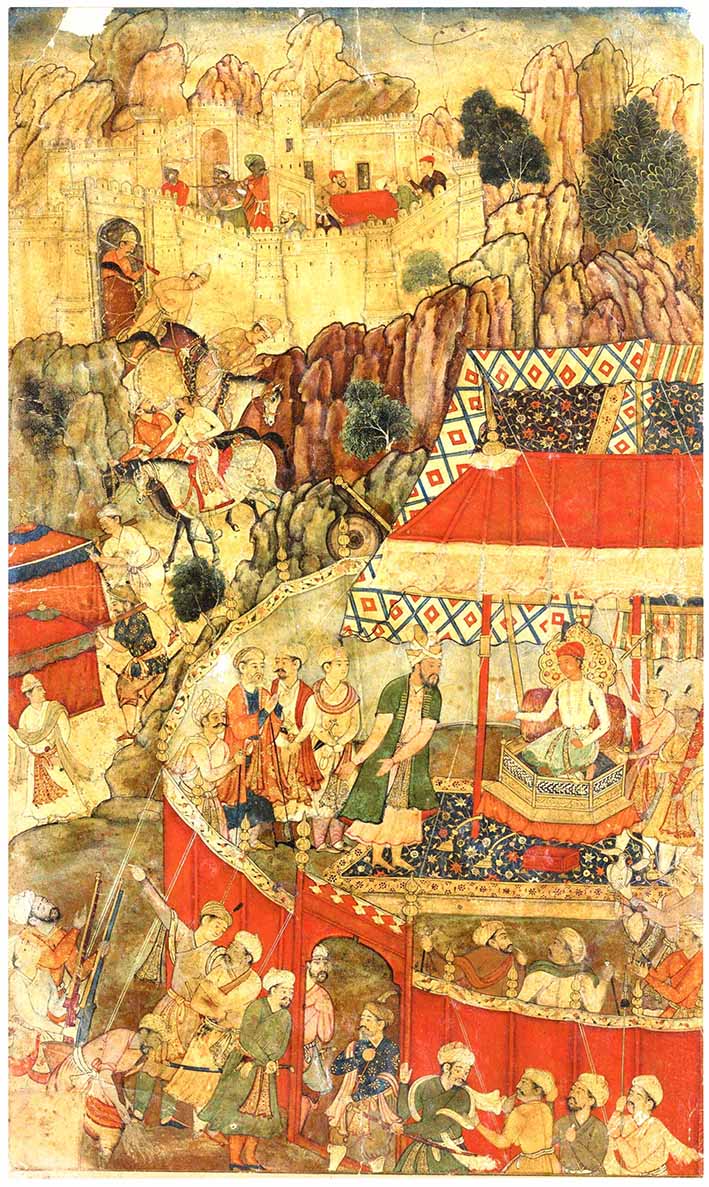
This controversial episode has resulted in conflicting accounts. Abu’l Fazl suggests that Bairam Khan used Tardi Beg’s failure to defend Delhi to eliminate a dangerous rival within the Mughal camp while Badauni indicates that the Protector obtained something approaching Akbar’s permission.
Firishta, meanwhile, believed that the execution was necessary to prevent the Mughal army from disintegrating under competing commanders – a view shared by Vincent Arthur Smith in his Akbar, the Great Mogul (1917). It was a brutal beginning to the consolidation of Akbar’s authority.
For the moment, Sikandar Sur was of little consequence. The contest was now between Hemu, seeking to establish his own sovereignty, and Bairam Khan, defending the inheritance of the young Akbar.
The Fateful Battle
The struggle coincided with one of the most devastating famines recorded in Indian history. The scarcity of 1555 and 1556 ravaged the Agra and Delhi territories, where armies had been assembled and the countryside repeatedly plundered. Both Badauni and Abu’l Fazl describe the appalling conditions, including reports of cannibalism and widespread desolation. The armies approaching Panipat were thus fighting over an empire whose inhabitants were already enduring extraordinary misery.
Bairam Khan’s counsellors advised retreat to Kabul. He rejected the proposal, deciding that the Mughal claim to Hindustan was worth defending. Akbar and his guardian advanced through Harsha’s old dominion of Thanesar towards Panipat, the very plain where his grandfather Babur had defeated Ibrahim Lodi three decades ago in 1526.
Hemu’s artillery, sent ahead of the main army, was captured by the Mughal vanguard in a preliminary engagement. It was a serious reverse, but Hemu still enjoyed a substantial numerical advantage. He advanced his main army of 30,000 Rajput and Afghan horsemen, supported by 500 war-elephants clad in plate armour carrying musketeers and crossbowmen.
Smith gives the strength of his elephant corps as 1,500, while Sarkar mentions 500. Whatever the precise number, these armoured beasts, carrying musketeers and crossbowmen, constituted the principal striking force of his army.
On November 5, the armies were drawn up in three divisions. Akbar, accompanied by Bairam Khan, remained well behind the fighting troops. The actual Mughal command rested with experienced generals, particularly Ali Quli Khan Shaibani with roughly 10,000 Mughal cavalry.
Hemu occupied the centre of his own formation, with Shadi Khan Kakar commanding the right wing and Ramya, his nephew, the left.
Hemu launched the initial assault. His elephants threw both Mughal wings into confusion, inflicting heavy casualties. The Mughal cavalry, however, avoided confronting the beasts directly. Employing superior horsemanship and archery, they withdrew from frontal engagements, wheeled around and attacked the Afghan-Rajput forces from the flanks and rear. The Mughal centre, meanwhile, halted behind a deep ravine that impeded the elephants and continued to discharge missiles at the advancing enemy.
As the elephant assault weakened, Ali Quli Khan manoeuvred his cavalry around the obstacle and struck the Afghan centre from behind. Hemu responded with repeated counter-charges, directing his elephants towards the threatened positions and personally encouraging his soldiers. Two of his trusted lieutenants, Bhagwan Das and Shadi Khan Kakar, fell before him. Yet the battle remained fiercely contested.
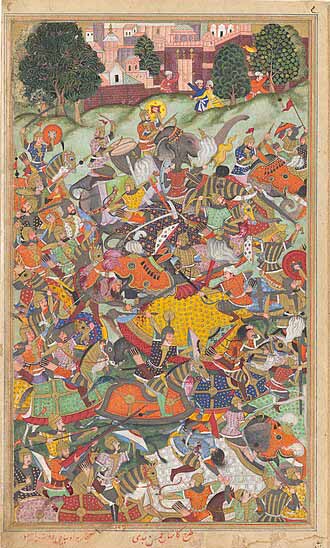
the Akbarnama (c. 1590s)
Then, a stroke of pure accident and fate intervened. A stray arrow pierced Hemu’s eye, and according to V.A. Smith, penetrating his brain and rendering him unconscious. Though bleeding profusely, Hemu pulled the arrow out, bandaged his eye with a scarf, and continued to urge his men forward until he fainted in his hauda. An Indian army of that era could never survive the loss of its leader, on whose life its pay depended. Seeing their commander fall, the Afghan and Rajput ranks broke into hopeless flight.
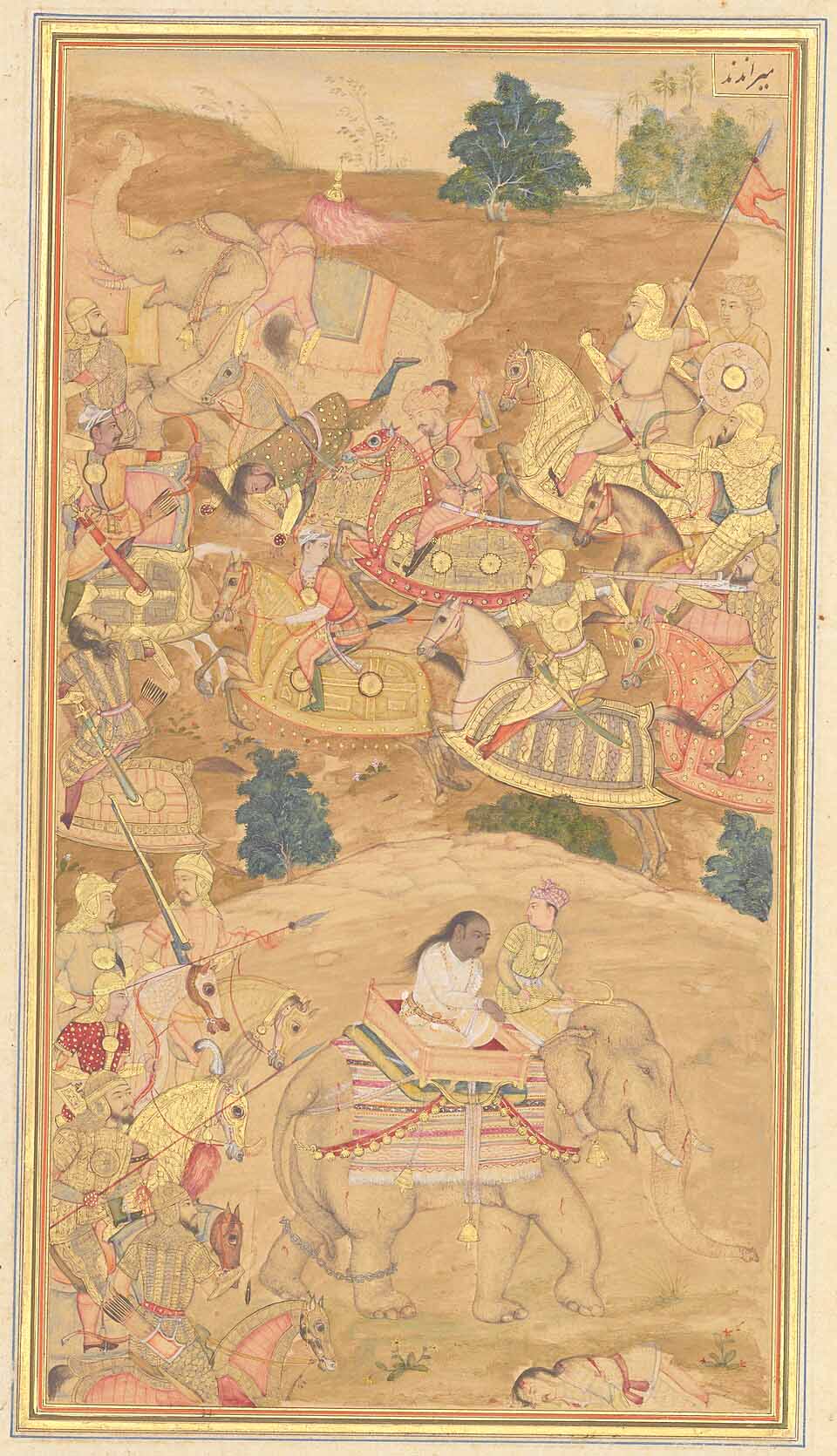
Hemu’s elephant was captured and brought to the rear, where the unconscious hero was brought before Bairam Khan and Akbar. Bairam Khan urged Akbar to earn the title of Ghazi by fleshing his sword on the captive; the boy prince obeyed, smiting Hemu on the neck with his scimitar before the bystanders plunged their swords into the corpse. Hemu’s head was sent to Kabul to be exposed, and his trunk was gibbeted at one of the gates of Delhi.
The tragedy extended beyond the battlefield to Hemu’s homeland in the Sarkar of Alwar. When Mughal forces under Pir Muhammad invaded the township where Hemu’s family lived, Hemu’s aged father was captured. Abu-l Fazl records that when called upon to convert to Islam, the old man steadfastly refused, stating that for eighty years he had worshipped his God according to his religion, and asked why he should change it merely from fear of his life. Pir Muhammad executed him on the spot.
The Accident of History
The British historian E.H. Carr, in What Is History? (1961), discusses the famous proposition associated with Pascal that had Cleopatra’s nose been shorter, the face of the world might have changed. He also cites Edward Gibbon’s observation about the gout that prevented Sultan Bayezid from marching into central Europe: “An acrimonious humour falling on a single fibre of one man may prevent or suspend the misery of nations.”
Hemu’s arrow belongs in this distinguished company of historical contingencies.
What if Hemu had won? He would still have faced formidable obstacles. The Afghan nobility was deeply divided, Sikandar Sur remained a potential rival, and establishing a durable Hindu monarchy over a politically fragmented northern India would have been an enormous undertaking. But Hemu had already demonstrated the ability to command Afghan loyalty, defeat powerful opponents and administer a kingdom. A victory at Panipat might have enabled him to establish a new dynasty in Delhi, thereby fundamentally altering the subsequent history of the subcontinent.
R.C. Majumdar has argued that Hemu’s story has been written almost entirely by enemies who feared him and consequently tarnished his reputation. In a typically trenchant assessment, he says that the time had come to restore the memory of a remarkable figure whose achievements had been forgotten by his countrymen.
Four centuries and seven decades after the battle, Hemu remains a tantalising figure in Indian history: a Hindu commoner who rose through the ranks of an overwhelmingly Muslim military aristocracy to challenge established dynasties, command the loyalty of Afghan chieftains and briefly occupy the throne of Delhi - a trajectory virtually unprecedented for his time. He lost his kingdom not through any demonstrable failure of military judgement, but to an arrow that struck at the decisive moment.
Panipat had decided the fate of empires before. But this time, it was shaped not by the victor but the man who would be king.